 微物联研究院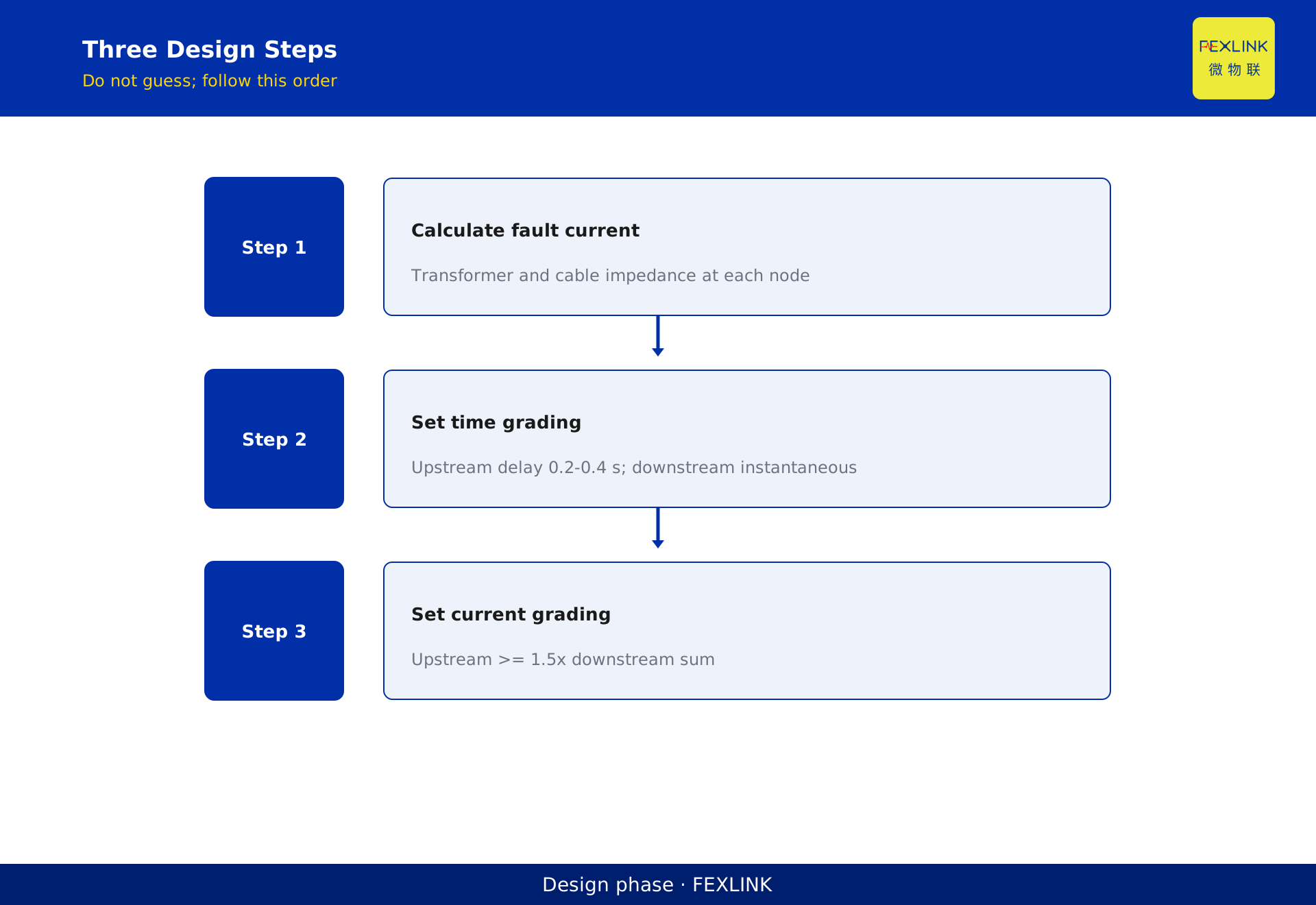
Direct Answer
The essence of upstream/downstream selectivity: keep the two tripping curves from overlapping across the full current range. There are two ways to achieve it: time selectivity (add a short delay of 0.2–0.4 s upstream so the downstream trips first) and current selectivity (set the upstream pickup clearly above the sum of downstream ratings, separated by current threshold). Critical loads combine both; end circuits use high-breaking fast breakers as backup. If every breaker looks correct on paper yet faults still darken whole floors, this step was skipped.
In a new hospital inpatient tower, every breaker was correctly sized by rated current on the drawings. Three months after commissioning, a short at a nurse-station socket tripped the whole floor. Review showed: upstream MCCB was instantaneous, downstream MCB was instantaneous—no time grading; upstream pickup was nearly equal to the downstream sum—no current grading. Both selectivities were lost.
1. Why "Every Breaker Is Right" Still Darkens Whole Floors
Selecting a single breaker answers one question: can this switch protect its own circuit? But distribution is a multi-level tree; whichever segment faults should be cut by the breaker closest to it.
Selectivity coordination answers another layer: between upstream and downstream breakers, who trips first, who trips second, and in which current band.
- Single-device selection: the breaker can clear faults in its own circuit.
- Coordination selection: the fault cuts only that segment, everything else stays up.
Both are required. Doing only the first gives you "every breaker right, whole floor down in operation."
2. Time Selectivity: Let the Downstream Trip First
Approach: add short-time delay upstream; downstream is instantaneous.
- Downstream MCB/MCCB: trips the moment fault current hits the threshold.
- Upstream MCCB: waits 0.2–0.4 seconds after hitting the threshold before tripping.
With a time gap ≥ 0.2 s, the downstream has enough time to clear first. If downstream trips, the upstream short-delay never elapses and resets.
Cost: during the upstream short delay, fault current keeps flowing through both—the upstream must withstand the I²t and electrodynamic force during that window, so its breaking capacity and short-time rating must be adequate.
Best for: MCCB-to-MCCB chains where upstream and downstream settings are close.
3. Current Selectivity: Separate by Current Threshold
Approach: set the upstream pickup clearly above the sum of downstream rated currents.
- Downstream sum: e.g. eight 32 A branches = 256 A.
- Upstream pickup: choose 400 A or 630 A, not 315 A.
Fault current must exceed the downstream threshold before it can exceed the upstream threshold. The protection bands separate along the current axis.
Cost: with a higher upstream setting, small end-circuit faults may not be seen upstream—which is correct; those should trip downstream.
Best for: large gaps between upstream and downstream ratings; upstream is incoming or bus-tie.
4. How to Combine Both
Ordinary office building: current selectivity primary (upstream ≥ downstream sum), time selectivity secondary (upstream 0.2 s short delay).
Hospital / data center / continuous process: combine both—upstream short delay 0.3–0.4 s plus 1.5× margin on pickup. End circuits use high-breaking fast MCBs to guarantee millisecond clearance on real short circuits.
Never: both instantaneous + upstream pickup close to downstream sum—this configuration cascades on every fault.
5. Where FECB2SP and ESI Fit
Design-stage coordination is paper work. After energization, whether the operating time gap is real and selectivity actually holds needs data.
- FECB2SP sits on end branches and records current peak and operating time on each trip.
- ESI sits on incoming/bus-tie nodes and records switch position changes and trip signals.
After a few real faults, you can reverse-check: when downstream tripped, did upstream also move? Is the time gap really ≥ 0.2 s? Did the design drift?
This turns "paper selectivity" into "operational selectivity" and matches the periodic verification required by GB 50054.
6. One Table to Remember
| Scenario | Time selectivity | Current selectivity | End-circuit backup |
|---|---|---|---|
| Ordinary office | Upstream 0.2 s delay | Upstream ≥ 1.5× downstream sum | Standard MCB |
| Commercial complex | Upstream 0.3 s delay | Upstream ≥ 1.5× downstream sum | High-breaking MCB |
| Hospital / data center | Upstream 0.3–0.4 s delay | Upstream ≥ 2× downstream sum | Current-limiting fast MCB |
| Continuous process | Upstream 0.3 s delay | Upstream ≥ 1.5× downstream sum | Current-limiting fast MCB |
7. Time Selectivity vs Current Selectivity
A reader may ask: what is the difference between time selectivity and current selectivity?
Time selectivity: relies on a time gap —
- Downstream trips instantaneously.
- Upstream delays by 0.2 s.
- Downstream trips first, upstream stays closed.
Current selectivity: relies on current thresholds —
- Downstream setting is lower.
- Upstream setting is higher.
- Fault current crosses the downstream threshold first, then the upstream threshold — downstream trips first.
Which is better?
Time selectivity: suited when upstream and downstream settings are close. Current selectivity: suited when there is a large gap between settings.
Critical applications: use both — double insurance.
8. How to Verify Coordination in Practice
A reader may ask: the design says the coordination is correct, but how do you verify it during actual operation?
Use data:
FECB2SP smart breaker:
- Records peak current and clearing time for every trip.
- When downstream trips, check whether upstream also moved.
ESI digital status monitor:
- Records incoming breaker status changes.
- Checks whether the upstream breaker tripped incorrectly.
Example:
- A fault occurs: downstream FECB2SP trips at 15 ms.
- Upstream ESI records: upstream breaker did not move.
- Time selectivity works — downstream tripped first, upstream stayed.
If upstream also moved — the time gap is insufficient — adjust the settings.
This is "operational selectivity verification" — design calculations must be confirmed with real running data.
9. A Real-Life Case
A hospital had a problem: a short on a small outlet circuit would trip the entire floor's main distribution board.
Investigation:
- Downstream: C16 MCB, instantaneous at 5–10× = 80–160 A.
- Upstream: 100 A MCCB, instantaneous at 10× = 1000 A.
- Calculated fault current at the outlet: 500 A.
The problem: 500 A was above the downstream upper threshold (160 A) — so downstream should have tripped. But the downstream MCB took 40 ms to clear, while the upstream MCCB instantaneous response was only 20 ms. The upstream hardware was faster.
The fix:
- Upstream MCCB reconfigured with 200 ms short-time delay.
- Downstream MCB kept as is.
- Time gap: 200 ms − 40 ms = 160 ms — above the 200 ms requirement? Wait, 160 ms is below 200 ms. So they also upgraded the downstream MCB to a fast-clearing type (10 ms).
- New time gap: 200 ms − 10 ms = 190 ms — close to the 200 ms target.
After the fix, a similar downstream short tripped only the local outlet breaker. The floor distribution board stayed closed. Patient rooms stayed powered.
10. Common Questions
Q: Why can't I just use one big breaker for everything? A: Because that would trip everything when one circuit faults. Selectivity means only the faulty circuit trips — not the whole building.
Q: Is 0.2 s time gap always enough? A: It is the minimum per GB 50054. For critical circuits, use 0.3 s or more to be safe.
Q: Can I verify selectivity during commissioning? A: Not easily — you do not want to create a real short to test. Use the FECB2SP records from real faults to verify after they happen.
11. One Sentence to Remember
Selectivity means only the faulty circuit trips. Time selectivity and current selectivity are two ways to achieve it. Critical applications use both.
12. How the ESI Helps
The ESI digital status monitor tracks the incoming main breaker's status. When a downstream fault occurs, you can check:
- Did the downstream breaker trip?
- Did the upstream breaker also move?
- What was the time difference?
This turns a black-box event into a transparent sequence. If the upstream tripped at the same time as the downstream, your time gap is not enough and needs re-adjustment. If upstream stayed closed, the selectivity works.
13. Quick Checklist
When checking selectivity:
- Verify downstream trips first.
- Check the upstream time delay.
- Measure the actual time gap from records.
- Confirm fault current falls in the downstream zone.
- Re-adjust settings based on real event data.
This checklist ensures your selectivity design works in practice, not just on paper.
Real data beats paper calculations every time.
Trust the records. Verify with data.
Always.
Always verify.
Scope and Limitations
This article applies to GB 50054-2011 on upstream/downstream selectivity. Time gaps and current margins are typical engineering values; specific projects must be verified by fault-current calculation and manufacturer tripping curves. The hospital mentioned is an anonymized example. FECB2SP and ESI provide operational verification; they do not replace design-stage coordination calculation.