 微物联研究院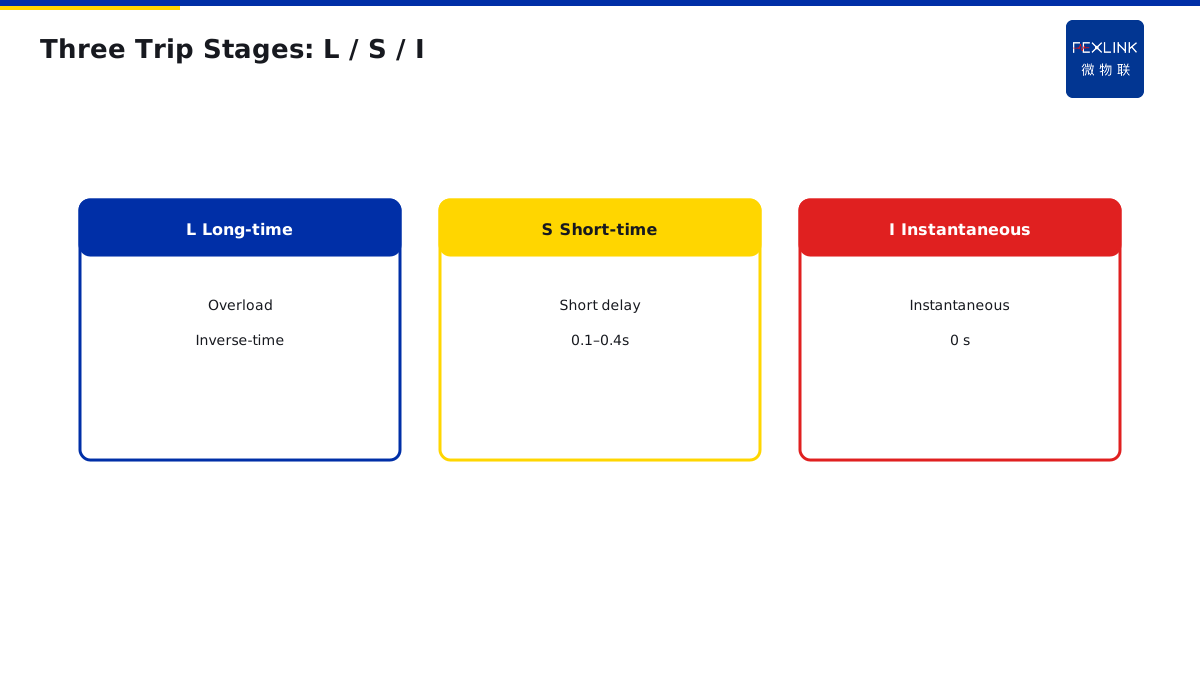
Direct Answer
That string of symbols on a breaker nameplate (Ui, Ue, In, Icu, Ics…) is not arbitrary—GB/T 14048.2 (IEC 60947-2 equivalent) defines their meaning, test methods and marking requirements.
Selection and acceptance must check each parameter against this standard, so that breaking capacity and tripping characteristics are not just manufacturer claims.
1. Key Nameplate Parameters
| Symbol | Meaning | Example |
|---|---|---|
| Ui | Rated insulation voltage | 800 V |
| Ue | Rated operational voltage | 400 V |
| In | Rated current | 250 A |
| Icu | Rated ultimate short-circuit breaking capacity | 35 kA |
| Ics | Rated service short-circuit breaking capacity | 17.5 kA (50% of Icu) |
| Trip unit | Long/short/instantaneous | L/S/I |
2. Icu vs Ics
Icu (ultimate breaking capacity): the maximum fault current the breaker can interrupt once. After interruption, the breaker may be damaged and is not guaranteed to continue in service.
Ics (service breaking capacity): the maximum fault current the breaker can interrupt and still continue normal operation.
Critical circuits require Ics ≥ 75% (even 100%) of Icu—after one fault interruption, you should not have to replace the breaker.
3. Three Trip Stages
GB/T 14048.2 defines three trip stages:
- Long-time L: overload protection, inverse-time;
- Short-time S: short-circuit short delay, 0.1–0.4 s adjustable;
- Instantaneous I: instantaneous short-circuit protection.
MCCBs have all three; MCBs have only L and I.
4. Selection Against the Standard
Design specs require compliance with GB/T 14048.2. Acceptance must verify:
- Each nameplate parameter matches the standard definition;
- Trip curves are tested per the standard's methods;
- Ics/Icu ratio meets design requirements.
FECB2SP breaking capacity and tripping characteristics are designed and tested per GB/T 14048.2.
5. Common Pitfalls
- Looking only at Icu, not Ics: Icu 35 kA sounds impressive, but if Ics is only 50% (17.5 kA), one interruption may require replacement;
- Confusing Ue with Ui: Ui is insulation withstand voltage, not operating voltage;
- Ignoring trip-curve test basis: manufacturer curves must be tested per GB/T 14048.2, not self-defined.
6. Why Ics Matters More Than Icu
You may ask: Icu (ultimate breaking capacity) 35kA, Ics (service breaking capacity) 17.5kA — why does Ics matter more?
Because Icu is "theoretical maximum" — after one breaking, the breaker may already be damaged.
Imagine:
- Short circuit occurs, current 25kA.
- Icu = 35kA: can break, but after breaking, contacts are eroded, next short circuit may not break.
- Ics = 17.5kA: if short-circuit current exceeds 17.5kA, after one breaking the breaker may need replacement.
Engineering practice requires Ics ≥ 75% of Icu for important circuits — why? Because short circuits are not "one and done" — there may be multiple.
Example:
- First short circuit: 20kA, breaker breaks successfully.
- Fault not cleared, second short circuit: another 20kA.
- If Ics is only 17.5kA, after first breaking the breaker is already "injured", second may not break — explosion.
That is why important circuits (data centers, hospitals, chemical plants) require Ics = 100% Icu — break as many times as needed.
7. In vs Ith
You may ask: nameplate says In=250A, also says Ith=250A — what is the difference?
In (rated current): current the breaker can carry long-term at 40°C ambient.
Ith (conventional thermal current): current the breaker can carry under conventional conditions (8-hour duty) without exceeding temperature-rise limits.
In most cases In = Ith. But some breakers have In < Ith — because In must consider trip unit setting range.
Example:
- Breaker frame 400A.
- Trip unit setting range 200–400A.
- In = 250A (you set it to 250A).
- Ith = 400A (frame can handle 400A).
This is why "frame current" is sometimes much larger than "setting current" — frame is "max it can handle", setting is "what you actually set it to".
8. Utilization Categories
Nameplate also shows AC-22A, AC-23A — what do they mean?
AC-22A: switch AC/DC resistive loads (heaters, lighting). AC-23A: switch AC motor loads (motors, pumps).
Why distinguish? Because motor starting current is 6–7× rated — breaker contacts must withstand this inrush.
AC-23A breaker contacts are thicker than AC-22A — because motor starting current is large, contacts wear faster.
So motor circuits must use AC-23A breakers, not AC-22A.
9. Smart Breakers vs Traditional Breakers
Traditional breaker parameters are "fixed" — In, Icu, trip curve all set at factory.
Smart breaker (FECB2SP) parameters are "adjustable":
- In adjustable: set anywhere 200–400A.
- Long-time inverse-time curve adjustable.
- Short-delay time adjustable.
- Instantaneous threshold adjustable.
What does this mean?
You do not need to stock different breaker sizes for each circuit — one 400A frame smart breaker can serve as 200A or 400A.
This is why smart distribution is growing — one model covers multiple scenarios, spare parts inventory drops dramatically.
10. What to Check at Acceptance
When new breakers arrive on site, check these:
- Nameplate parameters: Ui, Ue, In, Icu, Ics match design requirements.
- Trip curve: tested per GB/T 14048.2, not manufacturer's own claim.
- Ics/Icu ratio: important circuits ≥75%, critical circuits 100%.
- Utilization category: motor circuits AC-23A, normal circuits AC-22A.
- 3C certification: low-voltage breakers must have 3C certification.
Check all five, and you ensure the breaker is not a "no-name product".
11. One Sentence to Remember
Breaker nameplate numbers are not decoration — each one tells you what the breaker can actually do. Read them carefully before selection, and verify them at acceptance.
12. Common Questions
Q: Can I use an AC-22A breaker for a motor circuit? A: No. Motor starting current is 6–7× rated, which will wear out AC-22A contacts quickly. Always use AC-23A for motor circuits.
Q: What if Ics is only 50% of Icu? A: For normal circuits it may be acceptable, but for important circuits (data centers, hospitals) you need Ics ≥ 75% Icu. Critical circuits require 100% Icu.
13. Quick Checklist
When selecting a breaker:
- Check Ui — insulation voltage rating.
- Check Ue — operating voltage.
- Check In — rated current.
- Check Icu — ultimate breaking capacity.
- Check Ics — service breaking capacity.
- Check utilization category — AC-22A or AC-23A.
- Verify 3C certification.
This checklist covers the main points. Do not skip any.
14. Why This Matters
Breakers are the most basic protection device in every electrical system. Every distribution board, every motor control center, every feeder — all depend on breakers. If a breaker is undersized or misapplied, the result is nuisance tripping or, worse, failure to interrupt a short circuit.
Every year, electrical fires start because a breaker did not interrupt a fault. Every year, motors burn out because the wrong breaker type was selected. Every year, downtime happens because breakers tripped unnecessarily due to incorrect settings.
These are not rare events. These are everyday events. And they are preventable.
The problem is that most people treat breaker selection as a simple "pick the next size up" exercise. They look at In, match the wire size, and move on. They do not check Ics. They do not check utilization category. They do not verify the trip curve.
That is why you need to understand breaker nameplate parameters. That is why you need to read every number carefully. That is why you need to verify at acceptance, not just trust the manufacturer's label.
Breakers are safety devices. A breaker that cannot interrupt a fault is not a breaker — it is a wire with a switch on it. Choose carefully, set correctly, verify at acceptance.
This article gave you the fundamentals. Apply them to your next breaker selection. Teach them to your team. Share them with your colleagues.
Stay safe. Stay professional. Stay curious.
15. Final Thoughts
Breaker selection is not complicated, but it is detailed. There are many parameters, many standards, many categories. It is easy to skip one and regret it later.
The good news is that once you have a checklist, it becomes repeatable. Every time you select a breaker, go through the same seven items. Every time you accept a shipment, go through the same five checks. After a few times, it becomes second nature.
Smart breakers make this easier — adjustable settings mean fewer parts to stock, and built-in monitoring means you can verify operation continuously. But even with smart breakers, you still need to understand the fundamentals. The technology changes, but the physics does not.
Remember: a breaker is the last line of defense between a fault and a fire. Choose it well, set it right, and verify it. That is how you keep your people, your equipment, and your business safe.
Thank you for reading. Goodbye. Stay safe. See ya later.
Peace out now. Goodbye now. Take care now.
Bye bye now. See ya.
Scope and Limitations
Applies to LV circuit breakers (MCCB/ACB). FECB2SP is a FEXLINK reference; parameters follow the latest catalogue and current GB/T 14048.2 edition.