 微物联研究院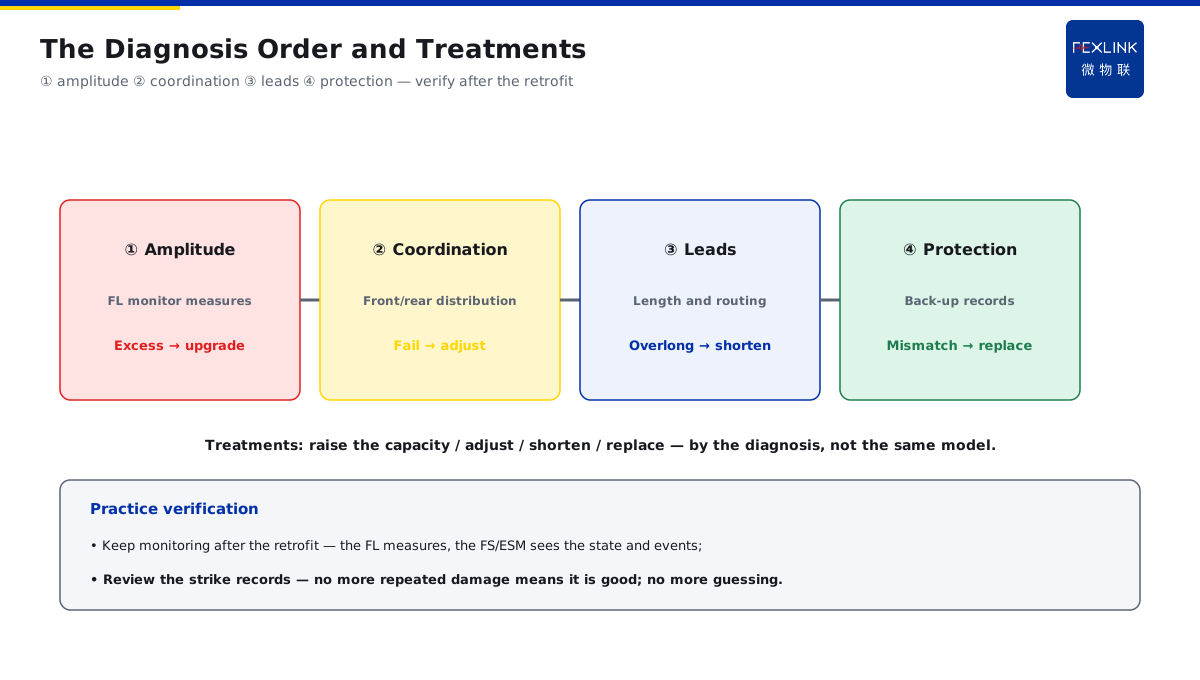
Direct Answer
A certain SPD fails again and again, several times a year — is it poor SPD quality or a selection/coordination problem? The answer: repeated SPD breakdown is usually not "poor quality" but a too-small discharge capacity (the lightning energy in this area exceeds the SPD capability), failed inter-stage energy coordination (the energy is all pressed onto this stage), or an overlong lead with a too-high residual voltage. The diagnosis should check three directions — the lightning-current amplitude at this point, the front/rear-stage coordination, and the installation leads — instead of continuing to replace it with the same model.
At a switch room, the SPD was replaced three times a year, always with the same model. After connecting a lightning-current monitor, it was found that the flash amplitude at this point repeatedly exceeded the SPD's rated discharge — the capacity was too small, and the lightning energy broke the MOV down again and again. After upgrading the discharge level, there was no more damage. The key distinction: repeated breakdown is "a system problem, not a single-part problem" — measure the amplitude at this point first, check the coordination and the lead residual; treat the cause by raising the capacity/improving the coordination/shortening the leads. Replacing with the same model is treating the symptom, not the cause.
Why:
- The amplitude dimension: does the measured amplitude here exceed the SPD discharge;
- The coordination dimension: has the inter-stage energy coordination failed (the energy pressed onto one stage);
- The lead dimension: an overlong lead → a too-high residual voltage;
- The treatment: raise the capacity, improve the coordination, shorten the leads — not repeated replacement.
Key insight: "Check three dimensions for repeated SPD breakdown: the lightning-current amplitude, the inter-stage coordination, the lead residual — replacing with the same model treats the symptom, not the cause."
At a plant, the front stage was normal but the rear stage always failed first: the coordination check found failed inter-stage energy coordination, with the energy all pressed onto the rear SPD. After adjusting the coordination, there was no more damage. Lesson: the broken one is not necessarily the bad one — diagnose before replacing; when the coordination fails, the same model will break again.
1. Look at the Measured Lightning-Current Amplitude First
Step one: is the discharge capacity too small?
Why the amplitude first:
- The lightning energy at this point exceeds the SPD capability;
- The MOV is broken down again and again;
- Replacing the same model breaks again;
- The amplitude is the first diagnostic dimension.
How to look:
- Measure the amplitude at this point with a lightning-current monitor;
- Compare with the SPD's rated discharge (In)/maximum discharge (Imax);
- Repeatedly exceeding → the capacity is too small;
- Count the flash frequency and the amplitude distribution.
The treatment:
- Upgrade the discharge level (larger In/Imax);
- Select by the lightning energy of this area;
- Confirm which LPZ this point belongs to (connecting to KD-0165);
- Speak with data, not guesswork.
Key insight: "Measure the amplitude here first and compare it with the SPD discharge — repeated exceeding means it is too small; upgrading the discharge level is the right treatment."
2. Check the Inter-Stage Energy Coordination
Step two: is the energy all pressed onto this stage?
Why check the coordination:
- Multi-stage SPDs should discharge by stages;
- Failed coordination → the energy pressed onto one stage;
- That stage fails repeatedly;
- Replacing the same model breaks again.
How to look:
- See which stage is damaged;
- The discharge and distance between the front/rear stages;
- The front discharges the large energy, the rear the residual;
- On failure, the front/rear stages do not cooperate.
The treatment:
- Adjust the inter-stage distance and parameters;
- Raise the front-stage discharge;
- Match the rear to discharge the residual;
- Coordinate by the energy-distribution principle.
Key insight: "Check which stage is damaged and whether the stages cooperate — energy pressed onto one stage is a coordination failure; adjust the coordination, not the same model."
3. Check the Lead Length and the Residual Voltage
Step three: is the lead too long?
Why check the lead:
- The lead inductance drops voltage under the lightning current (connecting to KD-0172);
- An overlong lead → a too-high residual voltage;
- The SPD terminal residual exceeds the equipment withstand (connecting to Up/Uw);
- Repeated breakdown/damage.
How to look:
- Measure the SPD lead length;
- The shorter the lead, the lower the residual;
- Estimate the L·di/dt drop;
- Whether the routing is reasonable.
The treatment:
- Shorten the leads (L-type/Kelvin connection);
- Optimize the routing and reduce the loop;
- Keep the terminal residual within the equipment's Uw;
- Optimize the lead and the coordination together.
Key insight: "The lead inductance drops voltage under the lightning current — an overlong lead raises the residual above the equipment withstand; shortening the lead is the right treatment."
4. Check Whether the Back-Up Protection Mis-Trips or Refuses
Step four: is the protection failing first?
Why check the back-up:
- The back-up at the SPD front end (connecting to KD-0185);
- Mis-trip → the SPD loses its discharge path;
- Refusal → the fault current continues;
- Both accelerate SPD damage.
How to look:
- Check the back-up action records;
- Whether it mis-trips on a strike;
- Whether it refuses on a short;
- The SCB/fuse state.
The treatment:
- Replace with a matched dedicated SCB;
- Check the dual condition (breaking + withstand);
- Monitorable state;
- Protection coordinated with the SPD parameters.
Key insight: "A back-up mis-trip takes away the discharge path and a refusal lets the fault continue — check the action records and replace a mismatched one with a dedicated SCB."
5. Treatment: What to Change after the Three-Dimensional Diagnosis
Step five: how to implement after the diagnosis.
The diagnosis order:
- ① Measure the amplitude at this point;
- ② Check the inter-stage coordination;
- ③ Check the lead length;
- ④ Check the back-up protection;
- Check in order and record the data.
The treatments:
- Exceeding the amplitude → upgrade the discharge;
- Failed coordination → adjust the inter-stage coordination;
- Overlong lead → shorten the lead;
- Mismatched protection → replace with a dedicated SCB.
Practice verification:
- Keep monitoring after the retrofit;
- Online with the FS/ESM SPD monitor;
- Review the strike-event records;
- No more repeated damage means it is good.
Key insight: "After the three-dimensional diagnosis, treat the cause: raise the capacity, improve the coordination, shorten the leads, replace the SCB — keep monitoring after the retrofit; no more repeated damage means it is good."
6. Product Implementation: Monitoring and Diagnosis as One
WeiWuLian products manage SPD diagnosis:
- FL Lightning-Current Monitor: measures the amplitude at this point;
- FS/ESM SPD Monitor: SPD state/leakage/events online;
- Inter-stage data: front/rear action records;
- Closed-loop diagnosis: amplitude-coordination-lead-protection data.
The design principle in one sentence: "Measure the amplitude, check the coordination, measure the leads, verify the protection — a four-dimensional data loop; repeated damage no longer relies on guessing."
7. Common Misjudgments
- "Replace it with the same model when broken": ignoring the root cause. Result: it breaks again. Correct: diagnose the three dimensions first.
- "It is poor quality": ignoring the system problem. Result: a new one breaks too. Correct: check the amplitude/coordination/leads.
- "Look only at the discharge": ignoring the coordination. Result: energy pressed onto one stage. Correct: check the inter-stage coordination.
- "Ignore the leads": ignoring the residual. Result: a too-high residual breaks it down. Correct: shorten the leads.
- "Done after installation": no monitoring data. Result: no one knows why it broke. Correct: monitor online and record the events.
Scope and Limitations
This article explains the root-cause diagnosis of repeated SPD breakdown (the four-dimensional positioning of lightning-current amplitude, inter-stage coordination, lead residual and back-up protection, with the treatments), applicable to troubleshooting and understanding repeated SPD damage. The exact parameters and coordination follow GB/T 18802.11 and the manufacturers' data; this article explains only the diagnostic logic and judgment basis. All cases are anonymized (a switch room, a plant) and do not refer to any specific customer.