 微物联研究院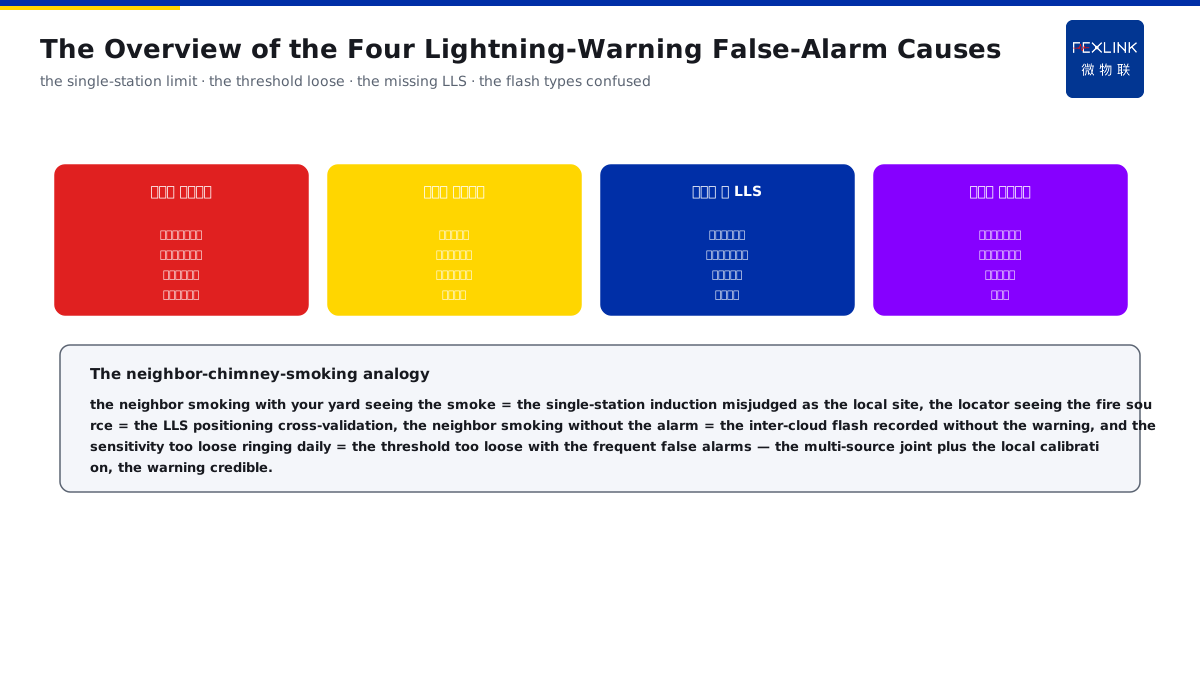
Direct Answer
When the lightning warning frequently sounds without the actual strike, and the personnel gradually stop trusting it, where does the problem lie? The answer: the frequent false alarms usually come from four causes — the single-station electric-field detection misjudging the induction of the neighboring thunderstorm cloud as the local-site risk; the threshold calibration too loose; no cross-validation with the lightning location system (LLS); and directly equating "the electric-field anomaly" with "a cloud-to-ground flash is coming". The improvement directions are the multi-station plus the LLS joint judgment, the threshold calibrated by the local thunderstorm characteristics, and the distinction between the "inter-cloud flash" and the "cloud-to-ground flash".
At an open-pit mining area where the warning system produced frequent false alarms, the site began the "crying wolf" — the workers became numb to the warnings and responded slowly when the real thunderstorm arrived; the investigation found that the single-station electric-field detection misjudged the induction of the thunderstorm cloud twenty kilometers away as the local-site risk, and the threshold was calibrated too loose. After re-calibrating the threshold by the local thunderstorm characteristics and accessing the lightning-location data for the cross-validation, the false alarms dropped significantly. The improvement core: the single-station electric-field limitation, the threshold too loose, the missing LLS cross-validation, and the inter-cloud/cloud-to-ground not distinguished — the multi-station joint plus the local calibration, the warning credible.
Why:
- The main cause one: the single station misjudging the neighboring thunderstorm as the local site;
- The main cause two: the threshold calibrated too loose, warning at the slightest movement;
- The main cause three: the missing lightning-location-system cross-validation;
- The improvement: the multi-station joint, the threshold localization, and the flash-type distinction.
Key insight: "The four false-alarm causes have four things — the single-station electric-field limitation (the neighboring-thunderstorm induction misjudged as the local site), the threshold too loose (warning at the slightest movement), the missing LLS cross-validation (the single-source judgment without the corroboration), and the inter-cloud/cloud-to-ground not distinguished (the field anomaly not equal to the cloud-to-ground flash) — the multi-station joint plus the local calibration, the warning credible."
At a port where the false-alarm rate was high after the warning deployment, the dispatch gradually ignored the warnings; after accessing the lightning location system, the response decision first confirmed the thunderstorm-cloud position and its distance from the site, the false-alarm rate dropped and the warning trust was restored. Lesson: the warning credibility relies on the cross-validation — the single-station judgment without the corroboration, the false alarms inevitably consume the trust.
Overview: run "the single-station electric-field limitation → the threshold calibration too loose → the missing LLS cross-validation → the inter-cloud and the cloud-to-ground not distinguished" as one false-alarm-cause interpretation. The frequent false alarms come from four causes. The four layers are unfolded below.
A "the neighbor's chimney smoking" analogy: think of the single-station electric-field warning as judging whether the neighbor's house is on fire by only seeing the smoke rising in your own yard. When the neighbor's chimney smokes, your yard also sees the smoke (the distant thunderstorm cloud charged, the single-station field induction grows), but the fire is in the neighbor's house and cannot burn yours — the single station cannot distinguish "the smoke is the neighbor's" from "the fire is right here", so the warning sounds, yet the neighbor's house is not on fire (the false alarm). Installing the LLS is like installing a "locator": it can see from which house the smoke rises, how far the fire is from your house, and whether it is a real open flame (the cloud-to-ground flash), and only when the open flame is confirmed near your house does the alarm sound (the cloud-to-ground flash approaching triggers the warning); when the neighbor only puffs a little smoke (the inter-cloud flash), it records without alarming. Then the threshold calibration: if the alarm sensitivity is set too loose, the neighbor's chimney smoking daily triggers the alarm (the field slight movement warning), ringing ten times a day, and when a real fire comes, no one takes it seriously (the crying wolf); calibrating the sensitivity by the local situation to "only a real open flame rings", the trust returns. The chimney analogy: the neighbor smoking with your yard seeing the smoke = the single-station induction misjudged as the local site, the locator seeing the fire source = the LLS positioning cross-validation, the neighbor smoking without the alarm = the inter-cloud flash recorded without the warning, and the sensitivity too loose ringing daily = the threshold too loose with the frequent false alarms — the multi-source joint plus the local calibration, the warning credible.
1. The Main Cause One: The Single-Station Electric-Field Limitation
Step one: why the single-station electric-field detection is easy to misjudge.
The single-station limitation:
- The field varies with the distance;
- The neighboring-thunderstorm induction large;
- Not necessarily the local-site risk;
- The single station hard to determine the distance.
The misjudgment process:
- The distant thunderstorm cloud charged;
- The induced field too large;
- The single station unable to distinguish the distance;
- The local-site risk falsely warned.
The right understanding:
- The field value affected by the distance;
- The large value not necessarily the local site;
- The multi-station joint needed;
- The LLS positioning corroboration needed.
Key insight: "The single-station limitation has three things — the limitation (the field varying with the distance/the neighboring-thunderstorm induction large/the single station hard to determine the distance), the misjudgment process (the distant thunderstorm induction too large/unable to distinguish the distance/the local site falsely warned), and the right understanding (the large value not necessarily the local site/the multi-station joint needed/the LLS corroboration needed) — the single station insufficient, the joint accurate."
2. The Main Cause Two: The Threshold Calibration Too Loose
Step two: how the too-loose threshold calibration causes the false alarms.
The too-loose manifestation:
- The threshold set low;
- Warning at the slight field movement;
- The normal fluctuation triggering;
- The frequent false alarms.
The too-tight problem:
- The threshold set high;
- Missing the real thunderstorm;
- The site not trusting the warning;
- The dilemma of both.
The right calibration:
- By the local thunderstorm characteristics;
- The field distribution statistically analyzed;
- The threshold by the scene;
- The graded warning.
Key insight: "The threshold calibration has three things — the too-loose manifestation (the low threshold/warning at the slight movement/the normal fluctuation triggering), the too-tight problem (the high threshold/missing the real thunderstorm/the site not trusting), and the right calibration (by the local thunderstorm characteristics/the field distribution statistically analyzed/the threshold by the scene graded) — the calibration localized, the false alarms down."
3. The Main Cause Three: The Missing LLS Cross-Validation
Step three: the value of the lightning-location-system cross-validation.
The single-source limitation:
- Only relying on the field judgment;
- No thunderstorm-position corroboration;
- The misjudgment hard to find;
- The poor credibility.
The LLS value:
- Locating the thunderstorm position;
- Judging the distance from the site;
- The cloud-to-ground-flash identification;
- The cross-validation.
The joint judgment:
- The field + the LLS joint;
- Warning only when nearby with the cloud-to-ground flash;
- The single-source anomaly reviewed first;
- The false alarms down significantly.
Key insight: "The cross-validation has three things — the single-source limitation (only the field/no position corroboration/the misjudgment hard to find), the LLS value (locating the thunderstorm position/judging the distance/the cloud-to-ground-flash identification), and the joint judgment (the field + the LLS joint/warning only when nearby with the cloud-to-ground flash/the single-source anomaly reviewed first) — the two-source cross, the false alarms down significantly."
4. The Main Cause Four: The Inter-Cloud and the Cloud-to-Ground Not Distinguished
Step four: distinguishing the inter-cloud flash and the cloud-to-ground flash.
The two flash types:
- The inter-cloud flash: the discharge between the clouds;
- The cloud-to-ground flash: the discharge between the cloud and the ground;
- The threats different;
- The warning focus different.
The false-alarm source:
- The field anomaly unable to distinguish the flash type;
- The inter-cloud flash treated as the cloud-to-ground;
- Warning without the strike;
- "The crying wolf".
The right distinction:
- The LLS identifying the flash type;
- The cloud-to-ground flash the real local threat;
- The inter-cloud flash recorded without the warning;
- The false alarms down significantly after the distinction.
Key insight: "The flash-type distinction has three things — the two flash types (the inter-cloud flash between the clouds/the cloud-to-ground flash between the cloud and the ground/the threats different), the false-alarm source (the field anomaly unable to distinguish the flash type/the inter-cloud treated as the cloud-to-ground/warning without the strike), and the right distinction (the LLS identifying the flash type/the cloud-to-ground flash the real local threat/the inter-cloud recorded without the warning) — the flash types clear, the warning accurate."
5. Product Implementation: The Warning-Credibility Improvement
WeiWuLian makes the lightning warning "multi-source joint, the threshold local, and the credibility reliable":
- The multi-station field joint: the multi-station data fusion judgment;
- The LLS cross-validation: the lightning location corroborating the position and the flash type;
- The threshold localization: calibrated by the local thunderstorm characteristics;
- The FG gateway convergence: the multi-source data unified decision.
The design principle in one sentence: "The single station insufficient with the multi-station joint, the threshold calibrated by the local characteristics, the LLS cross-validating the position and the flash type, and the cloud-to-ground flash only warned — the multi-source joint, the warning credible."
6. Common Understanding Misjudgments
- "Frequent warnings mean the system is sensitive": wrong. The frequent warnings may be the too-loose threshold, and the false alarms consume the trust.
- "The large field value means the local strike is coming": wrong. The large value may be the neighboring-thunderstorm induction, requiring the multi-station and the LLS corroboration.
- "The lightning location alone is enough": wrong. The field and the LLS are complementary, and the joint judgment is accurate.
- "All lightning should be warned": wrong. The cloud-to-ground flash is the real local threat, and the inter-cloud flash is recorded without the warning.
- "The frequent false alarms mean the system is bad": wrong. Most false alarms come from the configuration issues, and the calibration and the joint can improve significantly.
Scope and Limitations
This article interprets the causes of the frequent lightning-warning false alarms and the improvements (the single-station limitation, the threshold calibration, the cross-validation and the flash-type distinction), applicable to the false-alarm troubleshooting and the credibility improvement of the warning system. The specific configuration follows the local thunderstorm characteristics and the system capability; this article explains only the causes and the directions. All cases are anonymized (an open-pit mining area/a port) and do not refer to any specific customer.