 微物联研究院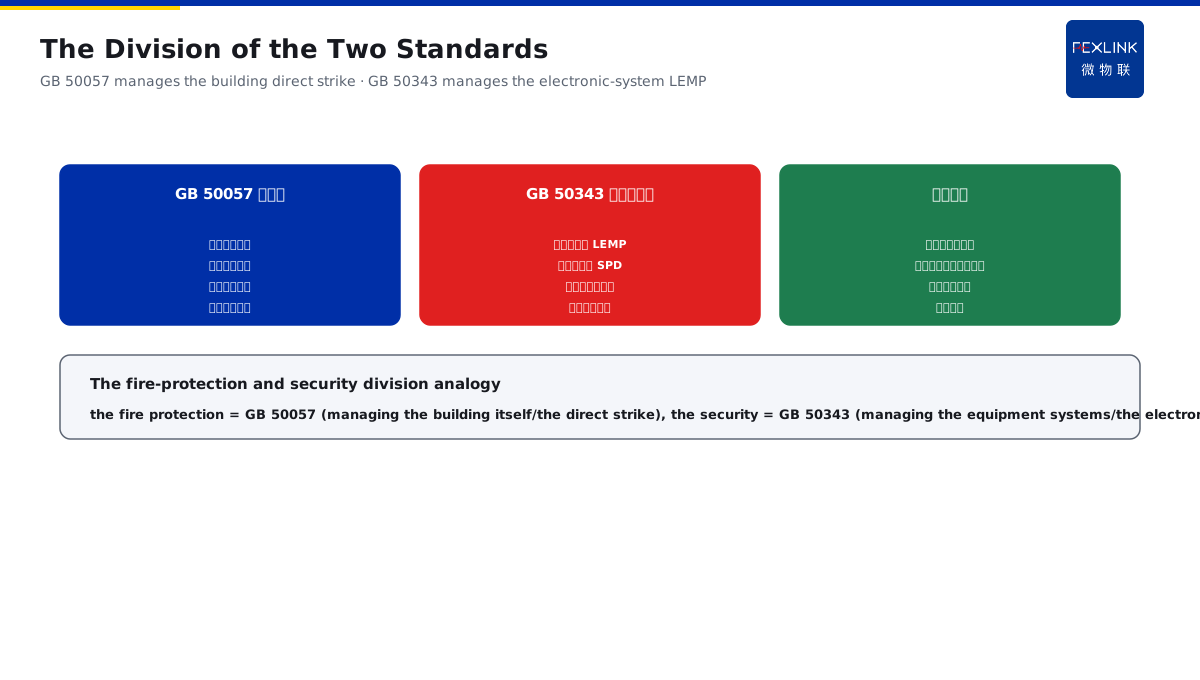
Direct Answer
The weak-current and information projects are often required to "comply with GB 50343" — what exactly does this standard require? The answer: GB 50343, the Technical Code for Protection of Electronic Information System Against Lightning, is dedicated to the electronic information systems and provides the LEMP protection level, the shielding, the equipotential bonding, the comprehensive-cabling SPD grading and the earthing requirements; it complements GB 50057 (the building lightning protection): the former manages "how the electronic systems protect against the electromagnetic pulse", and the latter manages "how the buildings protect against the direct strike".
At a data-center computer-room project designed per GB 50343: the computer room was configured at the Class-A protection level, the graded SPDs at the incoming line, the local equipotential bonding and the shielding in the computer room, and the shielding-layer earthing of the comprehensive-cabling cables; during the thunderstorm season, the equipment remained zero-damaged after the lightning events. The design core: the complementary division, the level grading, and the comprehensive protection — GB 50343 manages the electronic-system LEMP, GB 50057 manages the building direct strike, and the protection level determines the configuration.
Why:
- The complementary division: GB 50343 manages the electronic systems, GB 50057 manages the buildings;
- The protection level: the A/B/C/D levels determined by the importance;
- The comprehensive requirements: the shielding/equipotential/graded SPDs;
- The special earthing: the electronic-system earthing has the dedicated provisions.
Key insight: "GB 50343 has four points — it manages the LEMP of the electronic information systems (complementary to the building lightning protection), the protection-level grading (determined by the importance), the comprehensive protection of the shielding/equipotential/SPDs, and the dedicated earthing provisions — the weak-current project compliance looks at this standard."
At an office-building comprehensive-cabling project once designed only per GB 50057, the weak-current computer room was not protected against the LEMP, and a lightning strike damaged the switch ports; after the graded SPDs and the computer-room equipotential bonding were added per GB 50343, the equipment stayed stable during the thunderstorm season. Lesson: designing a weak-current project only per the building lightning protection is not enough — the electronic systems need the GB 50343 LEMP protection separately, and both standards must be satisfied.
Overview: run "how the two standards are divided → how the protection level is set → how the shielding/equipotential/SPDs are configured → what the earthing special provisions are" as one GB 50343 interpretation. The national standard GB 50343, the Technical Code for Protection of Electronic Information System Against Lightning, is dedicated to the electronic information systems and provides the LEMP protection level, the shielding, the equipotential bonding, the comprehensive-cabling SPD grading and the earthing requirements. The four layers are unfolded below.
A "fire-protection and security division" analogy: think of GB 50057 and GB 50343 as the fire-protection and security systems of an office building. The fire protection manages "the fire itself" (the building direct-strike protection): the alarms, the sprinklers and the evacuation routes, managing whether the fire will burn and whether the people can escape; the security manages "the property safety in the building" (the electronic-system LEMP protection): the access control, the surveillance and the alarm probes, managing whether the property and the equipment will be stolen or damaged. The two systems have different duties but both must be built: with only the fire protection and no security, the building does not burn but the equipment is stolen; with only the security and no fire protection, the equipment stays but the building burns. The weak-current project works the same: with only the GB 50057 design, the building does not suffer the direct strike but the electronic equipment is damaged by the electromagnetic pulse; with only the GB 50343 design, the equipment is protected but the building itself is not. Both standards must be satisfied, and the complementary division is the complete protection. The fire-protection analogy: the fire protection = GB 50057 (managing the building itself/the direct strike), the security = GB 50343 (managing the equipment systems/the electromagnetic pulse), only the fire protection = only the direct-strike protection with the equipment damaged by the LEMP, and only the security = only the LEMP protection with the building unprotected — the two are complementary, and neither is dispensable.
1. The Complementary Division: How the Two Standards Manage
Step one: first look at the division between GB 50343 and GB 50057.
GB 50057 manages the building:
- The building direct-strike protection;
- The air-termination and the down-conductor and the earthing;
- The building-body safety;
- The lightning-classification grading.
GB 50343 manages the electronic systems:
- The electronic-system LEMP protection;
- The shielding and the equipotential and the SPDs;
- The equipment and the signal safety;
- The weak-current dedicated protection.
The division articulation:
- Both the building and the systems protected;
- Both the direct strike and the electromagnetic pulse blocked;
- The two standards complementary;
- Neither is dispensable.
Key insight: "The two standards divide — GB 50057 manages the building direct-strike protection (the air-termination/down-conductor/earthing and the classification grading), and GB 50343 manages the electronic-system LEMP protection (the shielding/equipotential/SPDs and the weak-current dedicated protection) — both the building and the systems protected, the two complementary and neither dispensable."
2. The Protection Level: How It Is Graded by the Importance
Step two: the GB 50343 LEMP protection-level grading.
The protection-level division:
- By the system importance;
- By the loss consequence;
- By the place nature;
- The protection configured by the level.
The A/B/C/D levels:
- The Class-A highest protection;
- The key systems preferred;
- The level determines the configuration;
- Decreasing level by level.
The grading basis:
- The information-system importance;
- The interruption-loss degree;
- The place occupant density;
- The comprehensive evaluation.
Key insight: "The protection-level grading — determined by the system importance/the loss consequence/the place nature (Class A the highest), and the level determines the protection configuration (A/B/C/D decreasing level by level) — the grading has the basis, and the configuration is neither excessive nor insufficient."
3. The Comprehensive Protection: How the Shielding/Equipotential/SPDs Are Configured
Step three: the shielding, the equipotential bonding and the comprehensive-cabling SPD grading requirements.
The shielding requirements:
- The computer-room shielding treatment;
- The cable shielding-layer earthing;
- The electromagnetic coupling reduced;
- The induced surge reduced.
The equipotential requirements:
- The computer-room local equipotential;
- The equipment converging to the busbar;
- The potentials consistent;
- The potential-difference sparking prevented.
The SPD grading requirements:
- The comprehensive-cabling graded SPDs;
- The power and the signal separated;
- The voltage limiting level by level;
- The equipment end as the bottom guarantee.
Key insight: "The comprehensive protection has three pieces — the shielding (the computer room and the cable shielding-layer earthing reducing the coupling), the equipotential (the computer-room LEB and the equipment converging to the busbar keeping the potentials consistent), and the graded SPDs (the comprehensive-cabling power and signal separated and the voltage limited level by level) — with the three pieces all configured, the LEMP protection is complete."
4. The Earthing Provisions: The Electronic-System Special Requirements
Step four: the special provisions of the electronic-information-system earthing.
The earthing mode:
- The common earthing as the main;
- The earthing resistance satisfied;
- The single-point bonding;
- The potential difference prevented.
The signal earthing:
- The signal-loop earthing;
- The shielding-layer single-end earthing;
- The ground loop prevented;
- The signals not interfered.
The monitoring requirements:
- The earthing state visible;
- The equipotential verifiable;
- The lightning events recorded;
- The protection verifiable.
Key insight: "The earthing special provisions — the common earthing as the main (the single-point bonding preventing the potential difference), the signal shielding-layer single-end earthing (preventing the ground-loop interference), and the monitoring requirement of the visible state (the equipotential verifiable/the lightning events recorded) — the electronic-system earthing has the dedicated rules."
5. Product Implementation: The GB 50343 Compliance Closed Loop
WeiWuLian makes the GB 50343 compliance "the protection justified and the state visible":
- The protection-level landing: the SPDs and the shielding configured by the A/B/C/D levels;
- The equipotential monitoring: the computer-room zero-ground voltage and the bonding state online;
- The SPD state online: the leakage trend and the degradation warning;
- The data closed loop: the lightning events and the protection states fully traceable.
The design principle in one sentence: "GB 50343 manages the electronic systems, and GB 50057 manages the buildings — the protection level determines the configuration, the comprehensive protection has the three pieces, and the earthing has the dedicated provisions; the weak-current project compliance has the basis."
6. Common Understanding Misjudgments
- "Complying with GB 50057 is enough": wrong. The electronic systems also need to comply with GB 50343.
- "All the weak-current projects at one level": wrong. The A/B/C/D levels are divided by the importance.
- "With the shielding done, no SPD is needed": wrong. The shielding, the equipotential and the SPDs are the complementary three pieces.
- "The signal earthing can be arbitrary": wrong. The shielding layer is single-end earthed to prevent the ground loop.
- "The compliance is a one-time design": wrong. The protection state must be continuously verified by the monitoring.
Scope and Limitations
This article interprets GB 50343, the Technical Code for Protection of Electronic Information System Against Lightning (the complementary division, the protection level, the comprehensive protection and the earthing provisions), applicable to the lightning-protection compliance of the weak-current and information projects. The specific design follows GB 50343-2012; this article explains only the standard logic. All cases are anonymized (a data-center computer room/an office building) and do not refer to any specific customer.