 微物联研究院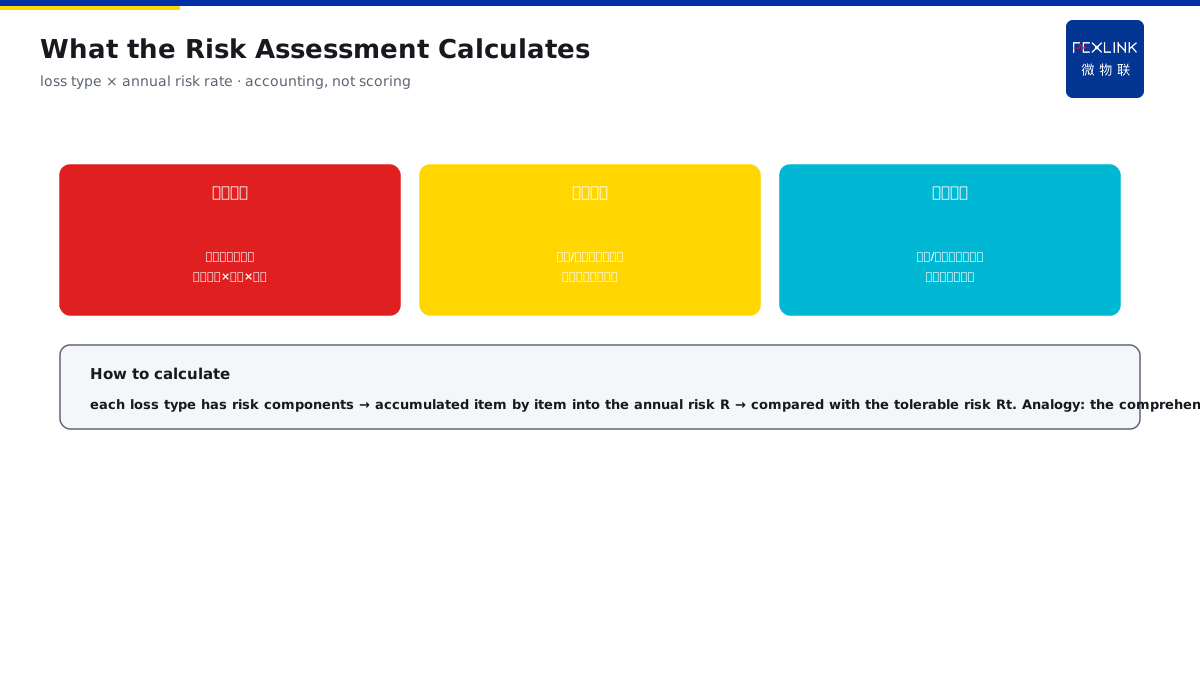
Direct Answer
The client asks for a "lightning risk assessment report" — what accounts does this report actually calculate? The answer: with IEC 62305-2 / GB/T 21714.2 as the framework, the risk assessment quantifies the "loss types (life/service/property) × annual risk rate", and by comparing the tolerable risk with the risk under the existing or proposed measures, it decides whether to add protection and to what level, instead of deciding by experience.
At a park a third party did a lightning risk assessment; the report calculated two accounts: the annual risk R under the existing measures, and the tolerable risk Rt; the calculation showed R above Rt, and the conclusion was that SPDs must be added and the air termination upgraded; after the implementation per the report conclusion, the re-assessment brought the risk below the tolerable line, and the review passed at once. The key distinction: the risk assessment is not a "lightning inspection score" but a quantitative design input — it calculates "loss type × annual risk rate", compares the R–Rt gap, and infers whether to add protection and to what level.
Why:
- The assessment inputs: the strike density, the building size, the soil, the facility sensitivity;
- The loss types: life, service interruption and property loss calculated separately;
- The core account: comparing the annual risk R with the tolerable risk Rt;
- The conclusion inference: the gap decides the protection level LPL and the SPD configuration.
Key insight: "The risk assessment calculates 'loss type × annual risk rate' — the inputs are the strike density/building/soil/sensitivity, the core is comparing the R–Rt gap, and the conclusion infers the LPL and the SPD configuration, not decided by experience."
At a factory SPDs were installed by experience without a risk assessment; a strike damaged the equipment, and at the insurance loss assessment it was found that the protection level was chosen too low. After the risk assessment was done and the protection upgraded per the report conclusion, no damage occurred at the same kind of thunderstorms. Lesson: the risk assessment is a quantitative design input — deciding by experience treats the risk as luck, and the report conclusion infers the correct protection level.
Overview: run "what the assessment calculates → what the inputs are → how R and Rt are compared → how the conclusion infers" as one assessment cognition. The "lightning risk assessment report" is the first-step input of the lightning-protection design, but it is often mistaken for "a lightning inspection score". In fact, the IEC 62305-2 / GB/T 21714.2 framework is quantitative accounting: input the strike density, the building size, the soil and the facility sensitivity, calculate the annual risk by the loss types of life/service/property, compare the tolerable risk Rt with the risk R under the existing or proposed measures, and the gap decides whether to add protection and to what level. The four layers are unfolded below.
A "medical checkup report" analogy: think of the risk assessment as a medical checkup. An inspection score is like a blood-pressure reading — telling you the number; a risk assessment is like the comprehensive conclusion of the report — putting the blood pressure, the blood lipids, the family history and the lifestyle together, calculating "the risk of cardiovascular events in the coming years", and comparing it with the tolerable threshold to decide whether to take medicine and how strong. The lightning risk assessment is the same: the strike density is the "lifestyle", the building and the soil are the "constitution", and the facility sensitivity is the "family history"; together they calculate the annual risk R, which is compared with the tolerable risk Rt to decide the protection "dosage" (the LPL and the SPD configuration). The checkup analogy: an inspection score = the blood-pressure reading, a risk assessment = the comprehensive conclusion — the strike density/building-soil/sensitivity together calculate the annual risk R, compared with Rt to decide the protection dosage.
1. What the Assessment Calculates
Step one: first see the essence of the assessment — not scoring, but calculating the risk.
The essence of the assessment:
- Not "a lightning inspection score";
- A quantitative design input;
- Calculating the annual risk rate;
- Deciding the protection level.
Which accounts:
- The life loss: the annual risk of casualties;
- The service loss: the annual risk of supply/communication interruption;
- The property loss: the annual risk of equipment/building damage;
- The cultural loss: the non-reproducible heritage (special projects).
How to calculate:
- Each loss type has risk components;
- Strike density × exposure × consequences;
- Accumulated item by item into the annual risk R;
- Compared with the tolerable risk Rt.
Key insight: "The essence of the assessment is accounting, not scoring — calculating the annual risk of the life/service/property losses, accumulating the strike density × exposure × consequences item by item, and comparing with the tolerable risk Rt to decide the protection level."
2. The Assessment Inputs: What They Are
Step two: the input decides the output — without complete inputs, the assessment is a shot in the dark.
The strike density:
- The local thunderstorm days/strike density Ng;
- Deciding the strike probability;
- The starting point of the assessment.
The building and the size:
- The building size decides the equivalent area;
- The surrounding buildings;
- The height and the structural material.
The soil and the earthing:
- The soil resistivity;
- The current earthing resistance;
- Affecting the earth potential and the SPD.
The facility sensitivity:
- The internal equipment value;
- The service importance;
- The personnel density;
- Deciding the loss consequences.
Key insight: "The input decides the output — the four inputs of the strike density Ng, the building size/equivalent area, the soil resistivity/earthing status, and the facility sensitivity (equipment value/service importance/personnel density); missing one makes the assessment a shot in the dark."
3. R and Rt: How to Compare
Step three: the core account is comparing the existing risk R with the tolerable risk Rt.
The tolerable risk Rt:
- Looked up by the loss type;
- The strictest for the life loss;
- Service/property per the importance;
- The line of "whether acceptable".
The existing risk R:
- Calculated by the existing measures;
- R high when the measures are insufficient;
- "How risky now".
The comparison and the gap:
- R ≤ Rt: the existing measures are acceptable;
- R > Rt: the protection must be added;
- The gap size decides how much to add;
- Re-assessed after the addition to confirm.
Key insight: "The core is the comparison — the tolerable risk Rt is looked up by the loss type (the strictest for life), and the existing risk R is calculated by the existing measures; R ≤ Rt is acceptable, R > Rt requires protection, the gap size decides how much, and the addition is confirmed by a re-assessment."
An "insurance claim" analogy for the gap: the R–Rt gap is like the difference between the current coverage and the required coverage. The tolerable risk Rt is the "required coverage" per the loss importance; the existing risk R is the "current coverage" under the existing measures. If the current coverage is higher than the required one, the risk is acceptable and no additional "premium" is needed; if the current coverage is lower, the gap is the amount that must be "topped up" — the larger the gap, the larger the top-up (the higher the LPL and the more complete the SPD). The coverage analogy: Rt = the required coverage, R = the current coverage — R ≤ Rt no top-up needed, R > Rt the gap is the top-up amount, the larger the gap the higher the LPL.
4. How the Conclusion Infers
Step four: the assessment conclusion is not "pass/fail" but inferring the protection level and the configuration.
Inferring the LPL:
- A large gap → a high protection level LPL;
- A small gap → the LPL can be relaxed;
- The LPL decides the air-termination/down-conductor/SPD requirements.
Inferring the SPD configuration:
- Select the SPD throughput per the LPL;
- The stage locations per the zones;
- The quantity and the installation locations;
- Combined with the monitoring for continuous verification.
The relation to the monitoring:
- The lightning-current monitoring records the operations;
- The SPD monitoring shows the degradation;
- The data speaks at the re-assessment;
- The protection effect continuously verified.
Key insight: "The conclusion infers the protection — a large gap → a high LPL, a small gap → relaxable; select the SPD throughput and stages per the LPL, and the lightning-current/SPD monitoring continuously verify, with the data speaking at the re-assessment."
A four-step way to "read" the report: for a report, read it in four steps. Step one, look at the inputs — whether the four inputs of the strike density, the building, the soil and the sensitivity are complete and the values reasonable; step two, look at the loss classification — whether the life/service/property are all calculated and the weights set per the project; step three, look at R and Rt — what the existing risk R is, what the tolerable line Rt is, and how large the gap is; step four, look at the conclusion — what the LPL and the SPD configuration inferred by the gap are, and whether the re-assessment after adding the protection meets the standard. After the four steps, it is clear whether the report is a "pass certificate" or a "design input". The four steps: look at the inputs (whether the four are complete) → look at the loss classification (the three weights) → look at R and Rt (the gap) → look at the conclusion (the LPL/SPD and the re-assessment) — after reading, you know whether it is a certificate or a design input.
5. Product Implementation: The Risk-Assessment Loop
WeiWuLian products close the risk assessment into operation:
- The lightning-current monitoring: air-termination operations/strike-count records;
- The SPD monitoring: the operations/degradation of each stage online;
- The data accumulation: measured inputs for the re-assessment;
- The loop verification: the protection effect continuously confirmed.
The design principle in one sentence: "The assessment decides the level and the monitoring verifies the effect — the risk assessment infers the LPL and the SPD configuration, and the lightning-current and SPD monitoring continuously verify; the report is the design input, and the data is the re-assessment basis."
Why the re-assessment matters: the risk assessment is not one-off. Equipment added to the building, new high-rise buildings around, soil renovation and changes in the thunderstorm frequency all change the inputs; when the inputs change, R changes, and the original protection level may no longer match. The standard practice is "re-assessment after major changes" — recalculating the R–Rt gap, confirming whether the original LPL and the SPD configuration are still sufficient, and upgrading if not. In practice, many projects "assess once and finish", which is exactly the reason the risk re-accumulates during the operation. The significance of the re-assessment: building/surrounding/soil/thunderstorm changes all alter the inputs → R changes → the original protection may no longer match — the re-assessment after major changes is mandatory, and assessing once and finishing is the reason the risk re-accumulates.
6. Common Understanding Misjudgments
- "The risk assessment is the lightning inspection": wrong. The inspection checks compliance, while the assessment calculates the risk; they are two things.
- "A passing report means no protection needed": wrong. The assessment conclusion is the input of the protection level, not a "pass certificate".
- "One assessment is enough": wrong. Re-assess after the building/facility/strike-environment changes.
- "Rough inputs are fine": wrong. Missing the strike density/soil/sensitivity makes the conclusion unreliable.
- "The higher the protection level, the better": wrong. Set the level per the R–Rt gap; over-protection is a waste.
Scope and Limitations
This article explains the accounting logic of the lightning risk assessment (the essence, the inputs, the R–Rt comparison and the conclusion inference), applicable to report understanding and design-input judgments. The specific risk-component formulas and tolerable-risk values follow IEC 62305-2 / GB/T 21714.2; this article explains only the framework logic. All cases are anonymized (a park/a factory) and do not refer to any specific customer.