 微物联研究院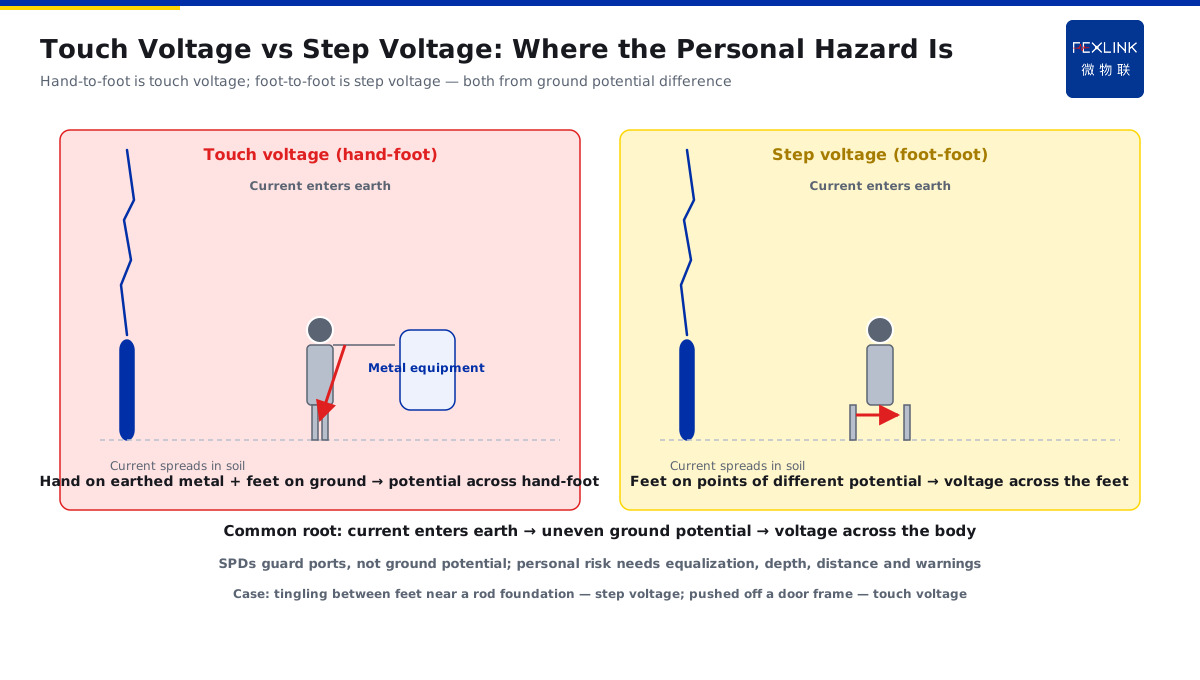
Direct Answer
Lightning-protection design focuses on keeping equipment intact — but what about the person standing near the earthing point the moment lightning strikes? The answer: when the lightning current enters the ground, it creates a potential gradient on the ground surface around the earth electrode. A person standing nearby experiences an instantaneous voltage between hand and foot (touch voltage) or between the two feet (step voltage) — this is a real personal-safety hazard that no amount of SPDs covers. It must be controlled by potential equalization, deeper earth grids, and safe separation distances.
After a thunderstorm at a substation, an inspector walking near the lightning-rod foundation felt a distinct tingling shock between his feet; at another distribution-room entrance, a person holding a door frame while standing on the ground was thrown back the instant of a strike. Neither event damaged equipment, but both happened at the moment the lightning current entered the ground — the first was step voltage, the second touch voltage. The key distinction: step voltage is "between the two feet"; touch voltage is "between hand and foot" — personal risk cannot be covered by saying "the equipment SPDs are installed."
Why:
- Step voltage: the lightning current spreads through the soil and the ground potential decays with distance; when the two feet stand on points of different potential, a voltage exists between them;
- Touch voltage: when a person touches a metal part bonded to the earth grid with one hand while standing on the ground, the potential difference is bridged between hand and foot;
- SPDs only guard equipment ports: they clamp line surges but do not change the ground potential distribution;
- Control relies on potential equalization: equalization tapes/rings, deeper earth grids, and safe distances keep the potential difference across the body within safe limits.
Key insight: "Equipment protection is about cables and lines; personal protection is about ground potential." The ground potential gradient at the moment of a strike is the real danger for people standing nearby.
A factory once had a worker knocked down by step voltage near an outdoor distribution box after a thunderstorm, despite a compliant earth resistance and complete SPDs. Investigation found the earth grid was buried too shallow and no equalization ring surrounded the box, so the ground potential difference near the box was large when the current entered. After laying an equalization tape around the box and deepening the earthing electrode locally, no recurrence was reported. Lesson: a "qualified" earth resistance does not mean the ground potential is "uniform" — personal safety must be assessed separately.
1. How Touch Voltage and Step Voltage Form: The Earth Potential Gradient
Step one: what happens to the ground when the lightning current enters.
Current entering the earth:
- The lightning current is discharged into the soil via the down-conductor and earth electrode;
- The current spreads outwards through the soil;
- The current density and potential are highest near the electrode;
- The further from the electrode, the lower the potential.
Potential gradient:
- The ground potential decays with distance (not uniformly);
- The potential changes sharply near the electrode;
- Far away, the potential approaches zero (reference earth potential);
- The steeper the gradient, the larger the potential difference between two points.
Two personal voltages:
- Touch voltage: a person touches an energized metal part while standing on the ground — the hand-to-foot potential difference;
- Step voltage: the potential difference between two feet standing on points of different potential;
- The larger the stride and the steeper the local gradient, the higher the step voltage;
- The ground potential can rise to kilovolt levels for a very short time at the moment of a strike.
Key insight: "Current enters the earth → ground potential becomes uneven → a person straddling two points sees a voltage." The gradient is the root cause; equalization is the cure.
2. How Lightning Personal Risk Differs from Power-Frequency Electric Shock
Step two: why the "power-frequency shock" experience does not apply.
Time-domain difference:
- Power-frequency shock: 50 Hz continuous action; body resistance governs the current;
- Lightning personal voltage: a microsecond-to-millisecond pulse, extremely short in duration;
- At the same voltage, lightning injury is closer to an impact-type breakdown mechanism.
Hazard boundary:
- The human body tolerates impulse voltages differently from power frequency (shorter duration, relatively higher tolerance);
- But lightning current amplitudes are huge and the voltage rise is high, so injury is still possible;
- Step voltage in particular is dangerous: once breakdown occurs between the feet, the current path through the trunk increases cardiac risk;
- Codes focus on "permissible touch/step voltage limits" assessed for the lightning scenario.
Why it must not be taken lightly:
- The probability of injury is low, but the consequence is severe (ventricular fibrillation / secondary injury from falling);
- Inspection, construction, and operation staff are often outdoors near earthing points;
- Wet ground after rain changes the body-to-ground contact state.
Key insight: "Lightning personal voltage is an impulse-type risk — low probability, severe consequence, not the same as power frequency." Design must also consider where a person stands at the moment of a strike.
3. Why SPDs Cannot Solve Personal Voltage
Step three: equipment protection and personal protection are not the same thing.
The boundary of SPDs:
- An SPD clamps surge voltage on the line (equipment-port protection);
- It protects the potential difference between the equipment port and earth;
- Installing an SPD only means "line surges at the equipment side are constrained."
The source of personal voltage:
- Personal voltage comes from the potential distribution of the ground/metal at the person's location;
- Earth-grid depth, equalization tapes, and safe distances are the parameters that affect personal voltage;
- Earth resistance affects the total potential rise, not directly the uniformity of the ground.
Common misunderstandings:
- "SPDs installed, so people are safe" — wrong; SPDs guard equipment ports;
- "Earth resistance qualified, so the ground is safe" — wrong; low resistance ≠ uniform potential;
- "No equipment damage means safe" — wrong; personal risk must be assessed separately;
- "Lightning probability is low, no need to consider people" — wrong; inspection scenarios are precisely high-exposure.
Key insight: "SPDs protect equipment; equalization protects people — two systems, neither dispensable." Even with full equipment protection, the potential difference across a person still exists.
4. Control Measures: Equalization, Deep Burial, Distance, and Isolation
Step four: compress the personal potential difference into a safe range.
Equalization tapes/rings:
- Lay equalization tapes around equipment foundations, boxes, and structures;
- The ring "flattens" the ground potential and reduces the local gradient;
- Substation structure zones and outdoor distribution boxes are priorities;
- Connect reliably to the main earth grid (equipotential).
Deeper earth grid:
- Increasing the burial depth of electrodes/the grid makes the surface gradient gentler;
- Deep burial lets the current spread faster into deeper soil;
- The effect is more obvious when the surface soil resistivity varies;
- Combine with "shallow burial + multiple rods" for optimization.
Safe distance:
- Keep people away from isolated electrodes and lightning-rod foundations (marked warning zones);
- Set up barriers/fencing near down-conductors (against touch voltage);
- Maintain safe spacing from metal structures during outdoor work;
- Avoid lingering near earthing points during thunderstorms.
Warning and operating rules:
- Mark isolated electrodes and lightning-rod foundations with "keep away during thunderstorms";
- Schedule inspection/maintenance outside thunderstorm periods;
- Strengthen personal protection (e.g., insulated footwear) in wet environments;
- Include "personal potential risk" in on-site safety briefings.
Key insight: "Equalization tapes flatten the potential, deep burial softens the gradient, distance plus warnings back it up — all four together make personal voltage controllable." Both design and operations must be applied on site.
5. Key Locations in Public Facilities and Outdoor Stations
Step five: where personal-voltage risk is most likely.
Outdoor substations/distribution rooms:
- Around lightning-rod foundations and isolated electrodes (step voltage hotspots);
- Door frames, fences, equipment enclosures (touch voltage hotspots);
- Boundaries between structure zones and inspection walkways;
- Post-rain inspection periods (wet ground).
Public facilities:
- Charging piles, street-light poles, billboard foundations (dense pedestrian flow);
- Playground equipment and plaza metal structures (child contact risk);
- Communication towers and base-station foundations (frequent maintenance access);
- Areas where secondary injury is amplified.
Priority order for assessment:
- First, locate the current ingress path (air-termination/down-conductor/earthing);
- Second, identify where people may stand or touch;
- Third, check whether equalization measures cover those positions;
- Fourth, verify on-site warnings and isolation.
Key insight: "Outdoor station + current ingress path + personnel walkway — the intersection of these three circles is the priority area." Add equalization there first.
6. Product Implementation: Intelligent Lightning-Protection Online Monitoring
WeiWuLian products bring personal-voltage risk into online management:
- FR Earth-Resistance Monitor: tracks earth resistance and earth-grid status (the potential-rise risk indicator);
- Monitoring platform: earth-resistance trends + lightning-event correlation analysis;
- Supporting measures: verification of equalization-tape effectiveness, before/after comparison of deep-burial retrofits;
- Field application: earthing status of key locations visible remotely, inspections evidence-based.
The design principle in one sentence: "Equipment protection guards lines, personal protection guards potential, and monitoring makes the risk visible." Equalization + deep burial + distance + monitoring — people are safer when lightning strikes.
7. Common Misjudgments
- "SPDs installed means safe": they only protect equipment ports. Result: personal potential-difference risk is ignored. Correct: assess touch/step voltage separately.
- "Earth resistance qualified means safe": low resistance ≠ uniform potential. Result: local gradients still injure people. Correct: apply equalization and evaluate the potential distribution.
- "Only equipment, not people": design only calculates equipment withstand. Result: inspectors are exposed. Correct: include personal voltage in design review.
- Ignoring step voltage: looking only at touch voltage. Result: breakdown between the feet near electrodes. Correct: assess the two-feet-spacing scenario separately.
- Inspecting right after the storm: approaching the earthing point immediately after a strike. Result: the grid potential has not fully settled. Correct: enter after a safe time interval.
Scope and Limitations
This article explains the formation of touch and step voltage in lightning scenarios, the difference from power-frequency shock, the boundary of SPDs, and equalization control measures, applicable to lightning-protection design review, personal-safety assessment at outdoor stations, and on-site inspection management. Quantitative limits and calculation methods for touch/step voltage must follow GB/T 21714, GB 50057-2010 and similar codes; the specific values depend on the lightning current amplitude, earth-grid parameters, and soil resistivity, so on-site professional testing and calculation are required. All cases are anonymized (a substation, a distribution room, a factory) and do not refer to any specific customer.