 微物联研究院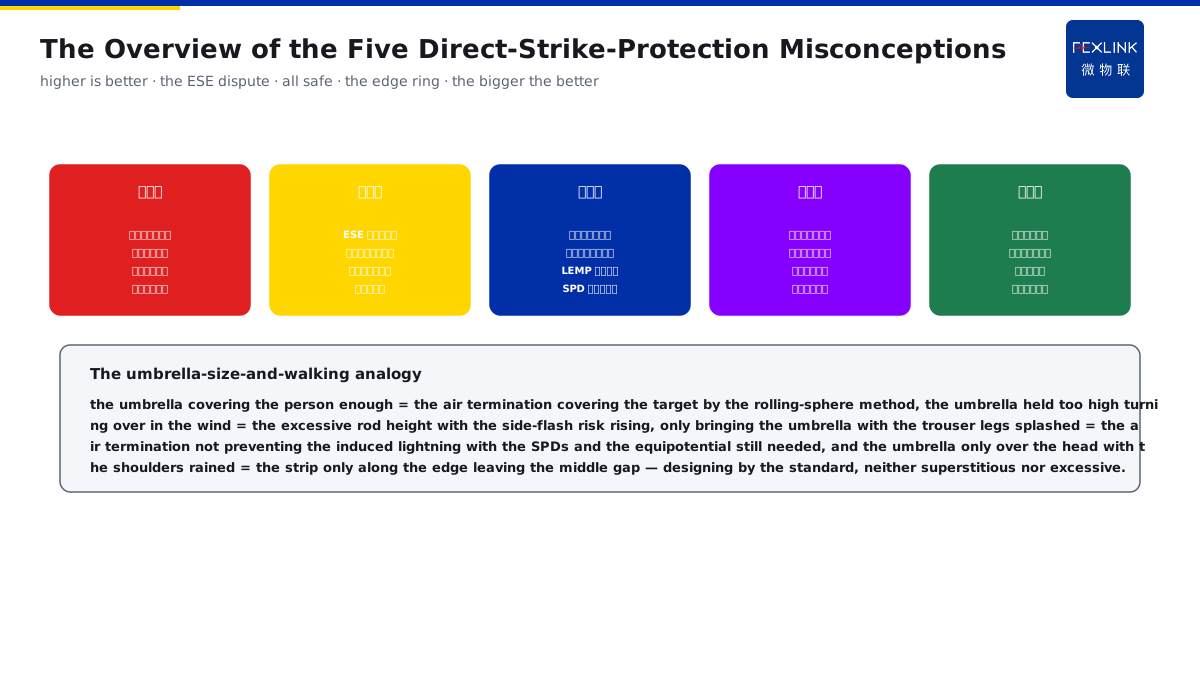
Direct Answer
About the air-termination and the direct-strike protection, which plausible-sounding sayings circulate on site? The answer: five common misconceptions — ① the higher the lightning rod the better (the excessive height actually increases the strike-attraction and the side-flash risks; the rolling-sphere protection zone is enough); ② the ESE early-streamer-emission air terminal protects far beyond an ordinary rod (its claimed enlarged protection zone lacks the general recognition of the current standards); ③ with the air terminal installed everything is safe (the induced lightning and the LEMP still require the SPDs and the equipotential bonding); ④ the air-termination strip only runs along the roof edge (it should cover in a grid); ⑤ the bigger the air-termination device the better (the air termination must match the down-conductor and the earthing cross-sections).
At a plant where the lightning rods were raised higher and higher, the strike-attraction count increased noticeably in one thunderstorm season, and spark discharges occurred on the side metal members of the workshop; the evaluation found that the excessive rod height enlarged the strike-attraction range and raised the side-flash risk; after the rolling-sphere protection-zone review and lowering the rod height, the side-flash risk fell back. The misconception clarification: the rod sufficient is enough, the ESE claims not recognized, the air termination does not prevent the induced lightning, the strip covers in a grid, and the cross-sections matched — selecting the air termination by the standard, neither excessive nor deficient.
Why:
- The misconception one: the higher the better, in fact increasing the strike-attraction and the side-flash risks;
- The misconception two: the enlarged ESE protection zone lacks the general standard recognition;
- The misconception three: the air termination does not prevent the induced lightning; the SPDs and the equipotential are still required;
- The misconceptions four/five: the strip covers in a grid, and the air termination/down-conductor/earthing matched.
Key insight: "The five misconceptions have five things — the rod sufficient is enough (the excessive height increasing the strike-attraction and the side-flash risks), the ESE claims not recognized (lacking the general standard recognition), the air termination does not prevent the induced lightning (the SPDs and the equipotential still required), the strip covering in a grid (not only the roof edge), and the cross-sections matched (the air termination/down-conductor/earthing matched) — selecting the air termination by the standard, neither superstitious nor cut corners."
At a warehouse with the air-termination strip only along the roof edge and a large uncovered middle area, a strike hitting the middle of the roof caused the local damage; after the grid-arranged strip was added, the roof was fully covered. Lesson: the air-termination strip covering in a grid is not a decoration — with only the edge and the middle left open, the strike targets the gap.
Overview: run "the misconception one the higher the better → the misconception two the ESE dispute → the misconception three the air termination not preventing the induced lightning → the misconceptions four/five the grid and the cross-section" as one direct-strike-protection misconception clarification. The five misconceptions are dismantled one by one. The five layers are unfolded below.
An "umbrella size and walking" analogy: think of the air-termination design as holding an umbrella on a rainy day. Misconception one "the higher the rod the better" is like holding the umbrella higher and higher — the canopy is indeed a bit higher, but in a strong wind the umbrella easily turns over (the side-flash risk rising), and the overlong pole is cumbersome instead; the umbrella only needs to cover the person, without poking into the sky (covering the target by the rolling-sphere method is enough). Misconception three "with the air terminal installed everything is safe" is like only bringing the umbrella without any other rain protection — in a heavier rain, the trouser legs still get splashed (the induced lightning invading along the lines), and the rain boots (the SPDs) and the tightened shoelaces (the equipotential bonding) are still needed. Misconception four "the strip only along the roof edge" is like holding the umbrella only over the top of the head, with the shoulders still getting rained on (the uncovered middle of the roof); the canopy (the grid) must cover the whole person. The umbrella analogy: the umbrella covering the person enough = the air termination covering the target by the rolling-sphere method, the umbrella held too high turning over in the wind = the excessive rod height with the side-flash risk rising, only bringing the umbrella with the trouser legs splashed = the air termination not preventing the induced lightning with the SPDs and the equipotential still needed, and the umbrella only over the head with the shoulders rained = the strip only along the edge leaving the middle gap — designing by the standard, neither superstitious nor excessive.
1. Misconception One: The Higher the Lightning Rod the Better
Step one: the higher-the-better and the side-flash risk.
The misconception content:
- The higher the rod the larger the protection;
- The higher the safer;
- The blind on-site heightening;
- The psychological comfort.
The actual risk:
- The excessive height enlarging the strike-attraction range;
- The side-flash risk rising;
- The lightning-current path lengthened;
- The high cost and the high risk.
The right approach:
- Calculating the protection zone by the rolling-sphere method;
- Covering the target is enough;
- No blind heightening;
- Reviewing the side-flash risk.
Key insight: "Misconception one has three things — the misconception content (the higher the rod the larger the protection/the blind heightening), the actual risk (the excessive height enlarging the strike-attraction range/the side-flash risk rising), and the right approach (calculating the zone by the rolling-sphere method/covering the target is enough/reviewing the side flash) — sufficient is enough, not excessive."
2. Misconception Two: The ESE Protects Far Beyond an Ordinary Rod
Step two: the standard dispute of the ESE early-streamer-emission air terminal.
The misconception content:
- The ESE early streamer emission;
- The protection zone far beyond an ordinary rod;
- Reducing the number of air terminals;
- The common on-site marketing.
The standard position:
- Not generally recognized by the current standards;
- The enlarged-zone claim lacking the basis;
- The long-standing dispute;
- Often questioned in the drawing review.
The right approach:
- Evaluating per the current standard;
- Not easily believing the enlarged claim;
- The key places designed by the conventional approach;
- The dispute left with the written basis.
Key insight: "Misconception two has three things — the misconception content (the ESE early streamer emission/the protection zone far beyond an ordinary rod/reducing the number), the standard position (not generally recognized by the current standards/the enlarged claim lacking the basis/often questioned in the review), and the right approach (evaluating per the current standard/not easily believing the claim/the key places conventionally designed) — a claim the standard does not recognize is not a basis."
3. Misconception Three: With the Air Terminal Installed Everything Is Safe
Step three: the air termination does not equal preventing the induced lightning and the LEMP.
The misconception content:
- With the air terminal the safety is done;
- The lightning protection all left to the air termination;
- The induced lightning ignored;
- The install-and-forget.
The actual gap:
- The strike generating the LEMP;
- The induced lightning invading along the lines;
- The main cause of the equipment damage;
- The air termination cannot manage it.
The right approach:
- The SPD graded protection;
- The equipotential bonding;
- The shielding and the routing;
- The comprehensive protection complete.
Key insight: "Misconception three has three things — the misconception content (with the air terminal the safety is done/the induced lightning ignored), the actual gap (the strike generating the LEMP/the induced lightning invading along the lines/the main cause of the equipment damage), and the right approach (the SPD graded/the equipotential/the shielding and routing) — the air termination manages the direct strike, and the induced lightning relies on the comprehensive protection."
4. Misconception Four: The Strip Only Along the Roof Edge
Step four: the air-termination strip should cover in a grid.
The misconception content:
- The strip running along the edge;
- No need for the middle;
- The strip visible;
- The psychological satisfaction.
The actual risk:
- The middle of the roof uncovered;
- The strike hitting the gap;
- The local damage;
- The coverage gap.
The right approach:
- Arranged in a grid;
- The grid size per the class;
- The full-roof coverage;
- No dead angle of the air termination.
Key insight: "Misconception four has three things — the misconception content (the strip along the edge/no need for the middle), the actual risk (the middle of the roof uncovered/the strike hitting the gap), and the right approach (arranged in a grid/the grid size per the class/the full coverage) — the grid coverage, no dead angle."
5. Misconception Five: The Bigger the Air-Termination Device the Better
Step five: the air termination must match the down-conductor and the earthing cross-sections.
The misconception content:
- The bigger the air terminal the safer;
- Only the air termination valued;
- The down-conductor and the earthing ignored;
- Top-heavy.
The actual principle:
- The air termination/down-conductor/earthing as one;
- The cross-sections matched;
- The thin down-conductor and the poor earthing;
- The bottleneck determining the protection.
The right approach:
- The three links matched;
- The cross-sections per the standard;
- Enough down-conductors;
- The earthing reliable.
Key insight: "Misconception five has three things — the misconception content (the bigger the air terminal the safer/the down-conductor and the earthing ignored), the actual principle (the air termination/down-conductor/earthing as one/the cross-sections matched/the bottleneck determining the protection), and the right approach (the three links matched/the cross-sections per the standard/enough down-conductors) — the system matched, not the bigger the better."
6. Product Implementation: The Air-Termination and Monitoring Closed Loop
WeiWuLian makes the direct-strike protection "designed reasonably and the state visible":
- The air termination per the standard: the rolling-sphere protection zone, no blind heightening;
- The comprehensive protection: the SPD graded, the equipotential bonding, the shielding and the routing;
- The lightning-protection monitoring online: the SPD/earthing/lightning events continuously recorded;
- The data closed loop: the protection effect verified by the data.
The design principle in one sentence: "The sufficient is enough without the excess, the ESE claims not easily believed, the air termination plus the SPDs and the equipotential, the grid coverage without the dead angle, and the cross-sections matched into a system — protecting by the standard and verifying with the data."
7. Common Understanding Misjudgments
- "The higher the lightning rod the safer": wrong. The excessive height increases the strike-attraction and the side-flash risks; the rolling-sphere sufficiency is enough.
- "The ESE large protection zone saves money": wrong. The enlarged claim lacks the general standard recognition, and the review often questions it.
- "The lightning rod prevents all lightning": wrong. The induced lightning and the LEMP still require the SPDs and the equipotential bonding.
- "The strip along the edge is enough": wrong. It should cover the whole roof in a grid.
- "The bigger the air terminal the better": wrong. The air termination, the down-conductor and the earthing must be matched.
Scope and Limitations
This article clarifies the common misconceptions of the direct-strike protection (the higher-the-better, the ESE dispute, the induced lightning, the grid coverage and the cross-section matching), applicable to the direct-strike-protection design evaluation. The specific design follows GB 50057-2010; this article explains only the misconception clarification. All cases are anonymized (a plant/a warehouse) and do not refer to any specific customer.