 微物联研究院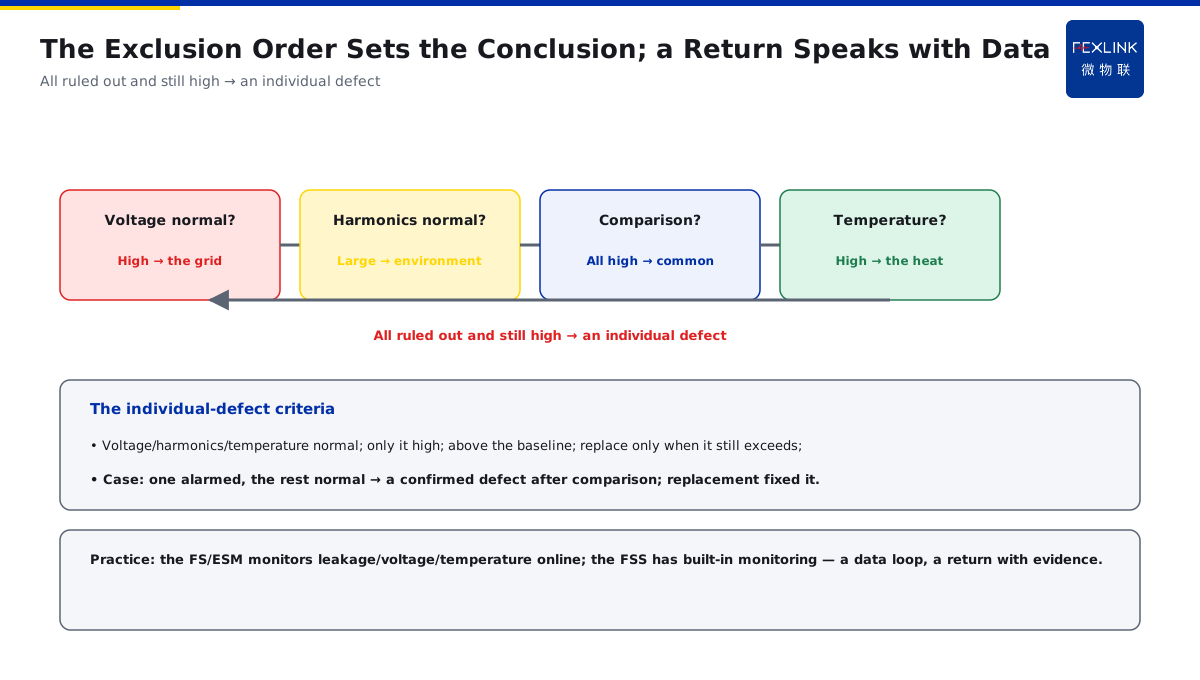
Direct Answer
A brand-new SPD alarms with a high leakage current as soon as it is commissioned — should it be returned? The answer: do not rush to judge a newly installed SPD's quality — first check whether the actual running voltage is too high and whether harmonics raise the resistive component of the leakage, then compare horizontally with other SPDs of the same batch at the same position. Only when the voltage is normal, the temperature is normal, and it is still clearly above the same-class baseline does it point to an individual SPD defect.
At a project, a batch of new SPDs was installed and one alarmed with a high leakage as soon as it was commissioned. Instead of returning it, the grid was checked first: the actual running voltage at that point was high (near the Uc limit) and the harmonics were large — the resistive leakage component was raised. The other SPDs on the same circuit also showed high leakage, pointing to a grid cause. After the voltage returned to normal, the leakage fell back. The key distinction: an alarm on a new unit is not poor quality — rule out the grid voltage/harmonics first, compare horizontally, and judge an individual defect last; do not let a misjudged return take the blame.
Why:
- The voltage dimension: a high actual running voltage → rising leakage;
- The harmonic dimension: harmonics raise the resistive leakage component;
- The horizontal comparison: is it high on the same model at the same position;
- The temperature correction: the temperature affects the leakage reading.
Key insight: "For a new SPD leakage alarm, rule out the external factors first: voltage, harmonics, horizontal comparison, temperature correction — only when all are normal judge an individual defect; do not rush to return it."
At a project, one new SPD alarmed while the rest were normal; after the horizontal comparison and temperature correction, it was confirmed as an individual defect and replacing it fixed it. Lesson: rule out the external factors before judging quality — a high grid voltage makes a good SPD alarm too.
1. Check Whether the Grid Voltage Is Too High First
Step one: is the voltage the culprit?
Why the voltage first:
- The SPD leakage relates to the running voltage;
- A voltage near the Uc limit → rising leakage;
- A high voltage is the first trigger;
- Replacing the SPD does not solve the voltage.
How to look:
- Measure the actual running voltage at the point;
- Compare with Uc (the maximum continuous operating voltage);
- A persistently high voltage → a grid cause;
- Review the historical voltage curve.
The treatment:
- High voltage → adjust the voltage/replace with a higher-Uc SPD;
- Verify the voltage quality with the utility;
- Confirm the selection of this LPZ point (connecting to KD-0165);
- Go on only when the voltage is normal.
Key insight: "Check the grid voltage first — near the Uc limit the leakage must rise; a high voltage is the first trigger, and replacing the SPD does not solve it."
2. Look at the Harmonics and Voltage Fluctuation Raising the Leakage
Step two: are the harmonics an accomplice?
Why the harmonics:
- Harmonics raise the resistive leakage component (connecting to KD-0175);
- Many nonlinear loads → large harmonics;
- Harmonics + high voltage → a double rise;
- The grid environment sets the leakage baseline.
How to look:
- Measure the harmonic content/voltage THD;
- Compare the harmonic level of the same circuit;
- Frequent fluctuation → fluctuating leakage;
- Large harmonics → a high leakage is normal.
The treatment:
- Large harmonics → treat them (connecting to KD-0155);
- Voltage fluctuation → check the supply quality;
- Compare the baseline with similar points;
- Rule out the environment before judging.
Key insight: "Harmonics raise the resistive leakage component — many nonlinear loads and large harmonics make a high leakage environmental; treat the harmonics, not the SPD."
3. Compare Horizontally with the Same Model at the Same Position
Step three: is it "everyone is high" or "only it is high"?
Why the horizontal comparison:
- The same batch and model share the same baseline;
- Everyone high → an environmental/batch commonality;
- Only it high → the individual is suspicious;
- The comparison is the most direct judgment.
How to compare:
- The leakage of other SPDs on the same circuit;
- The baseline of the same model at different positions;
- Whether the installation conditions are the same;
- Compare the data horizontally.
The reading:
- All consistently high → a grid/harmonic cause;
- Only it clearly high → an individual defect;
- Compare with the factory/acceptance baseline;
- Speak with data.
Key insight: "The horizontal comparison decides the nature — all high on the same model is a common cause; only it high points to an individual defect; the comparison is the most direct criterion."
4. Judge after the Temperature Correction
Step four: does the temperature affect the reading?
Why the temperature:
- The temperature affects the MOV leakage characteristic;
- A high ambient temperature → a high leakage;
- Judging without correction → a misjudged return;
- The temperature is an important correction.
How to look:
- Measure the ambient/enclosure temperature of the SPD;
- Compare with other SPDs under the same conditions;
- Whether the temperature difference explains the leakage difference;
- Correct the reading by the temperature.
The treatment:
- High temperature → ventilate/reduce the density;
- Still high at a normal temperature → check further;
- Still above the baseline after correction → an individual problem;
- Monitor the temperature and leakage together.
Key insight: "Judge after the temperature correction — a high ambient temperature makes a high leakage normal; judging without it leads to a misjudged return."
5. Judge the Individual Quality Only after Ruling Out the External Factors
Step five: when to judge the quality.
The exclusion order:
- ① Is the voltage normal? High → the grid;
- ② Are the harmonics normal? Large → the environment;
- ③ The horizontal comparison? All high → a commonality;
- ④ The temperature correction? High → the heat;
- Only after all are ruled out judge the individual.
The individual-defect criteria:
- The voltage/harmonics/temperature are all normal;
- Only it is high among the same model at the same position;
- Clearly above the same-class baseline;
- Replace the SPD only when it still exceeds.
Practice verification:
- Monitor online with the FS/ESM SPD monitor;
- Synchronous leakage-voltage-temperature data;
- Review the baseline after replacement;
- A data loop; a return with evidence.
Key insight: "The exclusion order sets the conclusion: voltage → harmonics → horizontal comparison → temperature correction — only after all are ruled out and it is still high judge an individual defect; a return must speak with data."
6. Product Implementation: Monitoring and Attribution as One
WeiWuLian products manage SPD attribution:
- FS/ESM SPD Monitor: online leakage/voltage/temperature;
- FSS Intelligent Surge Protective Device: an SPD with built-in monitoring;
- Horizontal comparison: data comparison of the same batch/position;
- Closed-loop attribution: voltage-harmonics-leakage-temperature data.
The design principle in one sentence: "Rule out the grid and harmonics first, compare horizontally, correct by the temperature, judge the quality last — a four-dimensional data loop; no blame for the return."
7. Common Misjudgments
- "An alarm on a new unit means poor quality": ignoring the grid. Result: a misjudged return. Correct: rule out the voltage/harmonics first.
- "Look only at the leakage number": ignoring the voltage. Result: missing a voltage cause. Correct: look at the voltage and leakage together.
- "No horizontal comparison": ignoring the commonality. Result: a good SPD takes the blame. Correct: compare the same model at the same position.
- "No temperature correction": ignoring the environment. Result: a misjudged individual. Correct: correct by the temperature.
- "Return without data": ignoring the evidence. Result: no basis to explain. Correct: a four-dimensional data loop.
Scope and Limitations
This article explains the attribution diagnosis of a high leakage alarm on a newly installed SPD (ruling out the grid voltage/harmonics first, horizontal comparison, temperature correction, and judging the individual quality last), applicable to troubleshooting and understanding abnormal alarms in the early stage of SPD commissioning. The exact parameters and criteria follow GB/T 18802.11 and the manufacturers' data; this article explains only the diagnostic logic and judgment basis. The case is anonymized (a project) and does not refer to any specific customer.