 微物联研究院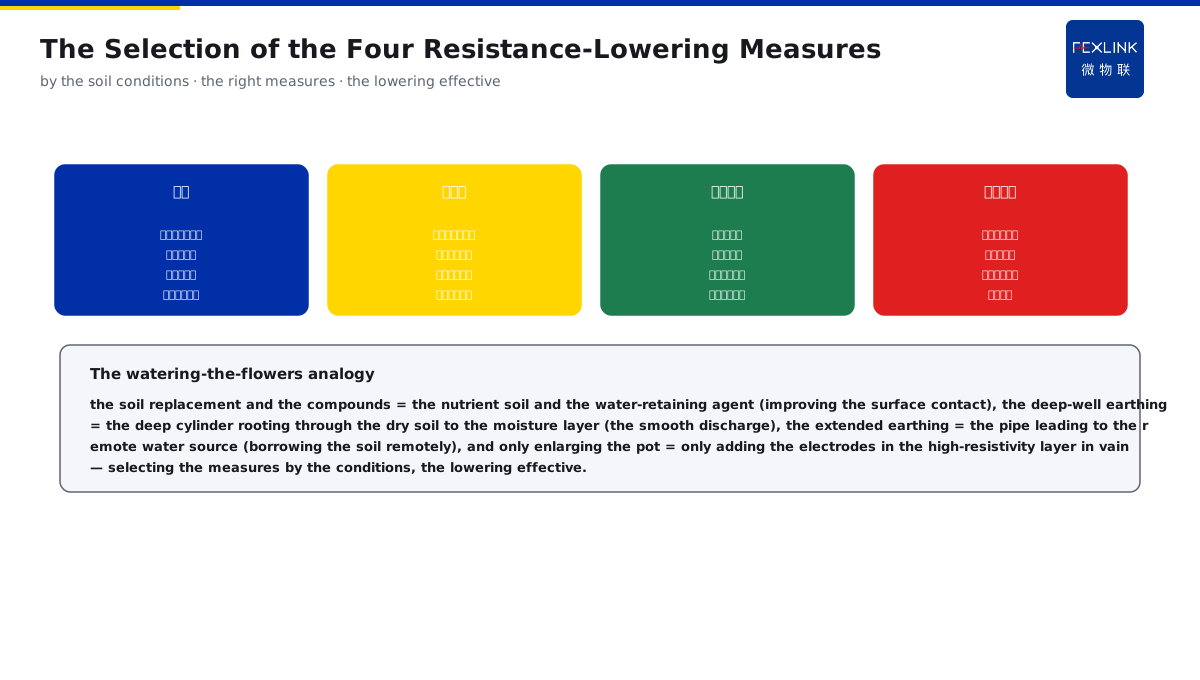
Direct Answer
In the mountainous and rocky areas where the qualified earth resistance cannot be achieved, how should the resistance-lowering measures be implemented on site? The answer: the high-soil-resistivity resistance lowering selects by the conditions — the soil replacement/the chemical compounds suit improving around the surface electrodes; the deep well (the deep vertical electrode) penetrating the high-resistivity layer to the low-moisture soil layer suits the rocky mountainous areas; the extended electrode uses the remote low-resistivity soil; the construction key is the deep-well bore diameter and depth, the compound backfill and curing, the extended electrode and the grid welding and anti-corrosion, and after completion, the re-test with the impulse correction.
At a mountainous substation retrofit project with the weathered rock on the surface and the earth resistance failing to reach the 4Ω requirement, adding more electrodes achieved little; after changing to the deep-well electrode penetrating the high-resistivity layer to the underground moisture soil layer with the compound backfill, the re-test passed and the delivery followed the impulse correction. The construction core: selecting the measures by the soil conditions, the deep well penetrating the layer with the compound backfill, and the extended electrode welding and anti-corrosion — the soil replacement and the compounds manage the surface, the deep well penetrates the high-resistivity layer, and the re-test with the impulse correction.
Why:
- The selection by the conditions: the surface with the soil replacement/the compounds;
- The deep well penetrating the layer: penetrating the high-resistivity layer to the moisture soil layer;
- The extension using: the remote low-resistivity soil;
- The re-test and correction: passing only after the impulse correction.
Key insight: "The resistance-lowering construction has four points — the soil replacement and the compounds manage the surface (the improvement around the electrode), the deep well penetrates the high-resistivity layer (applicable to the rocky mountainous areas), the extension uses the low-resistivity soil (borrowing the soil remotely), and the re-test with the impulse correction (the re-test after the construction) — selecting the measures by the conditions, the lowering effective."
At a communication base station built on a rocky hillside with only dozens of centimeters of surface soil, the deep-well cost was high; the design changed to the extended electrode leading to the low-resistivity soil area at the foot of the hillside, with the welding anti-corrosion and the re-test passing. Lesson: the resistance-lowering measures are selected by the soil conditions — on the shallow rocky surface, look at the extended borrowing first, and the deep well is left for the thick high-resistivity layer; choosing the wrong measure wastes money.
Overview: run "the four resistance-lowering measures and their applicable conditions → the deep-well bore diameter and depth → the compound backfill and the anti-corrosion welding → the re-test and the impulse correction" as one high-resistivity-area resistance-lowering construction practice. The high-soil-resistivity resistance lowering selects the measures by the conditions. The four layers are unfolded below.
A "watering the flowers" analogy: think of the electrode as the plant in the flowerpot and the earth resistance as "whether it can drink the water". Replacing the surface soil and adding the compounds is like replacing the nutrient soil in the pot and adding the water-retaining agent — improving the moisture of the surface circle around the pot (the contact resistance around the electrode), suiting the poor surface soil conditions; the deep-well electrode is like changing the pot to a deep cylinder, with the roots going down, penetrating the surface dry soil and reaching the underground moisture soil layer, so the plant can drink the water continuously (the lightning current can flow into the low-moisture soil layer smoothly); the extended electrode is like leading a pipe to the remote place with sufficient water and taking the water from afar (using the remote low-resistivity soil). If you only keep enlarging the pot on the surface (adding more electrodes), while the soil remains dry (the high-resistivity layer), the plant still cannot drink the water; selecting the right measures — the surface improvement, the deep well penetrating the layer, and the extension borrowing the water — truly lowers the resistance. The watering analogy: the soil replacement and the compounds = the nutrient soil and the water-retaining agent (improving the surface contact), the deep-well earthing = the deep cylinder rooting through the dry soil to the moisture layer (the smooth discharge), the extended earthing = the pipe leading to the remote water source (borrowing the soil remotely), and only enlarging the pot = only adding the electrodes in the high-resistivity layer in vain — selecting the measures by the conditions, the lowering effective.
1. The Measure Selection: How the Four Resistance-Lowering Measures Are Chosen
Step one: first look at the applicable conditions of the four resistance-lowering measures.
The soil replacement:
- Around the surface electrode;
- Excavating the high-resistivity soil;
- Replacing with the low-resistivity soil;
- Improving the contact resistance.
The chemical compounds:
- The backfill around the electrode;
- Reducing the contact resistance;
- Used with the soil replacement;
- The surface improvement as the main.
The deep-well earthing:
- Penetrating the high-resistivity layer;
- To the low-moisture soil layer;
- Applicable to the rocky mountainous areas;
- The deep vertical electrode.
The extended earthing:
- The remote low-resistivity soil;
- The electrode led out;
- Using the remote resistance;
- The mountainous borrowing.
Key insight: "The four measures have four things — the soil replacement (excavating the surface high-resistivity soil and replacing with the low-resistivity soil), the chemical compounds (the backfill around the electrode reducing the contact resistance), the deep-well earthing (penetrating the high-resistivity layer to the low-moisture layer/applicable to the rocky mountainous areas), and the extended earthing (leading to the remote low-resistivity soil for borrowing) — selecting by the conditions, the lowering effective."
2. The Deep-Well Points: The Bore Diameter, the Depth and the Layer Penetration
Step two: the bore diameter, the depth and the layer-penetration points of the deep-well earthing.
The bore-diameter requirement:
- Meeting the electrode lowering;
- The compound filling space;
- The diameter per the design;
- Too small cannot be constructed.
The depth penetrating the layer:
- Penetrating the high-resistivity layer;
- Reaching the low-moisture soil layer;
- The depth per the geology;
- The detection first.
The construction points:
- The bore drilling;
- The electrode lowering;
- The compound backfill;
- The layer-by-layer compaction.
Key insight: "The deep well has three points — the bore diameter meeting (the electrode lowering/the compound filling space), the depth penetrating the layer (penetrating the high-resistivity layer/to the low-moisture layer/the detection first), and the construction points (the drilling/the electrode lowering/the compound backfill/the layer-by-layer compaction) — the layer penetration in place, the deep well effective."
3. The Backfill and the Welding: The Compounds and the Anti-Corrosion
Step three: the compound backfill and the anti-corrosion welding.
The compound backfill:
- Mixed per the ratio;
- Backfilled layer by layer;
- Cured in place;
- Absorbing the water and keeping the moisture.
The welding and the anti-corrosion:
- The welding firm;
- The weld seam anti-corrosion;
- The extended electrode anti-corrosion;
- The long-term reliability.
The quality check:
- The backfill dense;
- Without the voids;
- The welding full;
- The anti-corrosion complete.
Key insight: "The backfill and the welding have three things — the compound backfill (mixed per the ratio/backfilled layer by layer/cured absorbing the water), the welding and the anti-corrosion (the welding firm/the weld-seam anti-corrosion/the extended-electrode anti-corrosion), and the quality check (the backfill dense/the welding full/the anti-corrosion complete) — the backfill and the welding in place, the lowering effective in the long term."
4. The Re-Test and the Correction: How the Acceptance Determines the Pass
Step four: the re-test and the impulse-coefficient correction.
The re-test:
- The re-test after the construction;
- Comparing with the design value;
- The unqualified troubleshooting;
- The rectification and the re-test.
The impulse correction:
- The impulse resistance different from the power-frequency;
- The impulse-coefficient correction;
- The evaluation under the lightning current;
- Applicable to the lightning-protection scenes.
The acceptance points:
- The data recorded;
- Passing after the correction;
- The monitoring confirmation;
- The delivery archived.
Key insight: "The re-test and the correction have three things — the re-test (the re-test after the construction/comparing with the design value/the unqualified rectification), the impulse correction (the impulse resistance different from the power-frequency/the impulse-coefficient correction/the evaluation under the lightning current), and the acceptance points (the data recorded/passing after the correction/the monitoring confirmation) — the re-test plus the correction, the acceptance rigorous."
5. Product Implementation: The Resistance-Lowering and Monitoring Closed Loop
WeiWuLian makes the resistance lowering "selecting the measures by the conditions and verifying the state continuously":
- The selection by the conditions: the surface with the soil replacement and the compounds, and the mountainous with the deep well and the extension;
- The deep-well penetration in place: the bore diameter, the depth and the layer penetration per the design;
- The backfill and the welding qualified: the compound curing and the weld-seam anti-corrosion;
- The FR online monitoring: the earth-resistance state continuously verified.
The design principle in one sentence: "The soil replacement and the compounds manage the surface, the deep well penetrates the high-resistivity layer, the extension borrows the soil in the low-resistance area, and the re-test with the impulse correction — the construction qualified plus the FR monitoring, the earthing reliable."
6. Common Understanding Misjudgments
- "More compounds are better": wrong. The compounds are constructed per the ratio, and the excess wastes and affects the effect.
- "The deeper the deep well the better": wrong. The depth is determined by the geological detection, and reaching the low-moisture soil layer is enough.
- "Adding electrodes lowers the resistance": wrong. Adding more electrodes in the high-resistivity layer achieves little; the measures must be selected right.
- "One test after the construction is enough": wrong. The re-test and the impulse correction determine the pass.
- "No monitoring needed after the lowering": wrong. The earth-resistance state relies on the online monitoring for the continuous verification.
Scope and Limitations
This article explains the construction practice of the resistance lowering in the high-soil-resistivity areas (the measure selection, the deep-well points, the backfill and the welding, and the re-test and the correction), applicable to the earthing resistance-lowering construction and acceptance in the mountainous/rocky areas. The specific construction follows GB 50169-2016 and GB/T 50065-2011; this article explains only the construction workmanship. All cases are anonymized (a mountainous substation/a communication base station) and do not refer to any specific customer.