 微物联研究院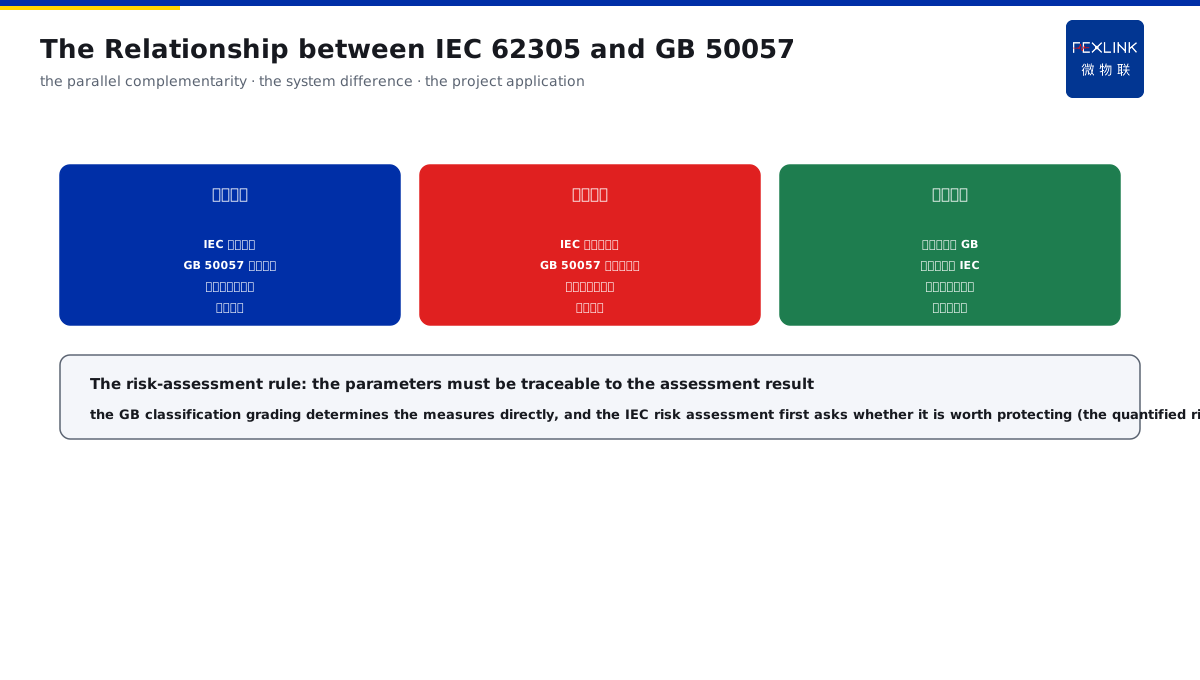
Direct Answer
In the foreign-related or high-end projects, IEC 62305 and GB/T 21714 are often cited — what is the relationship between them, and what does each part cover? The answer: IEC 62305 is the international lightning-protection standard series (corresponding to the national-standard GB/T 21714 series), divided into four parts: the general principles, the risk management, the physical damage to the structures and the life hazard, and the systems inside the structures; it systematizes the "risk assessment (the LPL selection)" and the "protection measures", and is a more complete risk-management framework beyond GB 50057.
At a foreign-related data-center project with the contract requiring the IEC 62305 design: the risk assessment was performed first to determine the LPL level, and then the air-termination, the SPDs and the equipotential were configured by the protection level; the scheme satisfied both GB 50057 and IEC 62305, and the foreign review passed at once. The design core: the series divided into four parts, the level determined by the risk, and the measures by the LPL — IEC 62305 manages the risk-management framework, and GB 50057 manages the building measures, parallel and complementary.
Why:
- The series divided into four parts: the general principles/the risk management/the physical damage/the systems;
- The level determined by the risk: the risk assessment selects the LPL;
- The measures by the LPL: the protection level determines the configuration;
- Parallel with the national standard: the IEC and the GB 50057 complementary.
Key insight: "IEC 62305 has four points — the international series of four parts (corresponding to GB/T 21714), the risk assessment selecting the LPL, the protection measures by the level, and the parallel complementarity with GB 50057 — the foreign-related project citation looks at this standard."
At a high-end project once designed only per GB 50057, the foreign party required the IEC 62305 risk assessment to be added; after the addition, the SPD configuration was adjusted by the LPL level, and the scheme passed. Lesson: satisfying only the national standard in a foreign-related project is not enough — the IEC 62305 risk assessment is a must-review item of the foreign review, and both systems must be covered.
Overview: run "how IEC 62305 is divided → how the risk assessment selects the LPL → what the relationship with GB 50057 is → how the foreign-related project cites it" as one international lightning-protection standard interpretation. The international standard IEC 62305 series is divided into four parts: the general principles, the risk management, the physical damage to the structures and the life hazard, and the systems inside the structures, corresponding to the national-standard GB/T 21714 series. The four layers are unfolded below.
An "international driver's license and domestic driver's license" analogy: think of IEC 62305 and GB 50057 as the international driver's license and the domestic driver's license. Driving domestically uses the domestic license (GB 50057), driving by the domestic traffic rules — how the buildings are classified, how the air-termination is installed and how much the earthing resistance is, and the domestic projects recognize this system; driving abroad requires the international license (IEC 62305), driving by the internationally common rule system — the risk assessment, the protection levels and the parameter requirements, and the foreign review recognizes this system. The two licenses do not conflict: the rule spirit is the same (both require the safe driving and the lightning protection), only the governing system and the expression language differ. The high-end foreign-related project is like the driver often running internationally, with both licenses prepared: the IEC 62305 risk assessment determines the LPL, the GB 50057 lands the domestic measures, the foreign review looks at the risk assessment, and the domestic acceptance looks at the national-standard measures — one scheme satisfying both. The driver's-license analogy: the domestic license = GB 50057 (the domestic projects by the national standard), the international license = IEC 62305 (the foreign-related projects by the international system), the same rule spirit (both require the safe lightning protection), and the international regular both prepared (the foreign-related projects satisfying both) — the two systems parallel and complementary, with the logic connected.
1. The Series Structure: What the Four Parts Cover
Step one: first look at the division of the IEC 62305 series into four parts.
Part 1, the general principles:
- The basic term definitions;
- The lightning parameters;
- The damage causes and types;
- The protection-principle overview.
Part 2, the risk management:
- The risk-assessment method;
- The loss assessment;
- The LPL-level selection;
- The protection-necessity judgment.
Part 3, the physical damage:
- The air-termination/down-conductor/earthing;
- The building physical protection;
- The life-hazard protection;
- The measure configuration.
Part 4, the system protection:
- The systems inside the structures;
- The equipotential and the SPDs;
- The electromagnetic-interference protection;
- The system coordination.
Key insight: "The series has four parts — the general principles (the terms/the lightning parameters/the damage types), the risk management (the risk assessment/the LPL selection), the physical damage (the air-termination/down-conductor/earthing and the life hazard), and the system protection (the system equipotential/SPDs and the electromagnetic interference) — the four parts form a system, closed from the risk to the measures."
2. The Risk Assessment: How the LPL Level Is Selected
Step two: the risk-assessment→LPL-selection→protection-measure logic.
The risk assessment:
- The lightning risk assessed;
- The loss risk calculated;
- Compared with the tolerable value;
- Whether to protect judged.
The LPL selection:
- Selected by the risk level;
- The protection levels graded;
- The LPL determines the parameters;
- The measures follow.
The measure landing:
- Configured by the LPL;
- The air-termination/SPD/equipotential;
- The protection parameters matched;
- The risk reduced to the tolerable.
Key insight: "The risk assessment has three steps — assess the lightning risk (calculate the loss compared with the tolerable value), select the LPL level (the risk graded/the parameters following), and land the measures (the air-termination/SPD/equipotential configured by the LPL) — from the risk to the measures, closed systematically."
3. The Two-System Relationship: How the IEC and the GB 50057 Complement
Step three: the relationship between IEC 62305 and GB 50057.
Parallel and complementary:
- The IEC international framework;
- The GB 50057 national-standard measures;
- The framework and the measures complementary;
- The goal consistent.
The system difference:
- The IEC emphasizes the risk assessment;
- The GB 50057 emphasizes the classification measures;
- The language and the numbering different;
- The logic connected.
The project application:
- The domestic projects by the GB;
- The foreign-related projects by the IEC;
- The high-end projects satisfying both;
- Both reviews passed.
Key insight: "The two-system relationship has three things — the parallel complementarity (the IEC framework + the GB measures with the consistent goal), the system difference (the IEC emphasizes the risk assessment/the GB emphasizes the classification measures), and the project application (the domestic by the GB/the foreign-related by the IEC/the high-end satisfying both) — the logic connected, and the dual-system coverage passes the review without worry."
4. The Foreign-Related Citation: How the Project Uses It
Step four: the citation points of the foreign-related and high-end projects.
The contract citation:
- The standard clarified in the contract;
- The IEC series version;
- The GB/T 21714 correspondence;
- The citation written clearly.
The scheme preparation:
- The risk assessment first;
- The LPL level clear;
- The measure parameters compared;
- Reviewable by the foreign party.
The monitoring support:
- The protection state online;
- The lightning events recorded;
- The risk data corroborated;
- The review has the basis.
Key insight: "The foreign-related citation has three things — the contract citation (the IEC series version and the corresponding national standard written clearly), the scheme preparation (the risk assessment first/the LPL clear/the parameters compared), and the monitoring support (the state online/the events recorded/the data corroborated) — the citation has the basis, and the review does not return for rework."
5. Product Implementation: The IEC 62305 Compliance Closed Loop
WeiWuLian makes the foreign-related lightning-protection project "the risk assessment justified and the protection state visible":
- The risk-assessment support: the thunderstorm data and the site parameters assisting the assessment;
- The LPL-level landing: the SPDs and the monitoring configured by the level;
- The state online: the SPD leakage and the lightning events continuously recorded;
- The data closed loop: the protection effect corroborated by the data, and the review has the basis.
The design principle in one sentence: "IEC 62305 sets the framework, and GB 50057 sets the measures — the risk assessment selects the LPL, the measures are configured by the level, and the monitoring continuously corroborates; the foreign-related project complies with the dual systems."
6. Common Understanding Misjudgments
- "IEC 62305 and GB 50057 are either-or": wrong. The two systems are parallel and complementary, and the high-end projects satisfy both.
- "The risk assessment can be skipped": wrong. The risk assessment is the core of IEC 62305 and a must-review item of the foreign review.
- "GB/T 21714 is another standard": wrong. GB/T 21714 is exactly the national-standard correspondence of IEC 62305.
- "The LPL level is arbitrary": wrong. The LPL is determined by the risk assessment and decides the protection parameters.
- "The foreign-related project needs no monitoring": wrong. The monitoring data corroborates the protection effect, and the review has the basis.
Scope and Limitations
This article interprets the IEC 62305 international lightning-protection standard series (the series structure, the risk assessment, the relationship with GB 50057, and the foreign-related citation), applicable to the lightning-protection compliance of the foreign-related and high-end projects. The specific design follows IEC 62305 and GB/T 21714; this article explains only the standard logic. All cases are anonymized (a foreign-related data center/a high-end project) and do not refer to any specific customer.