 微物联研究院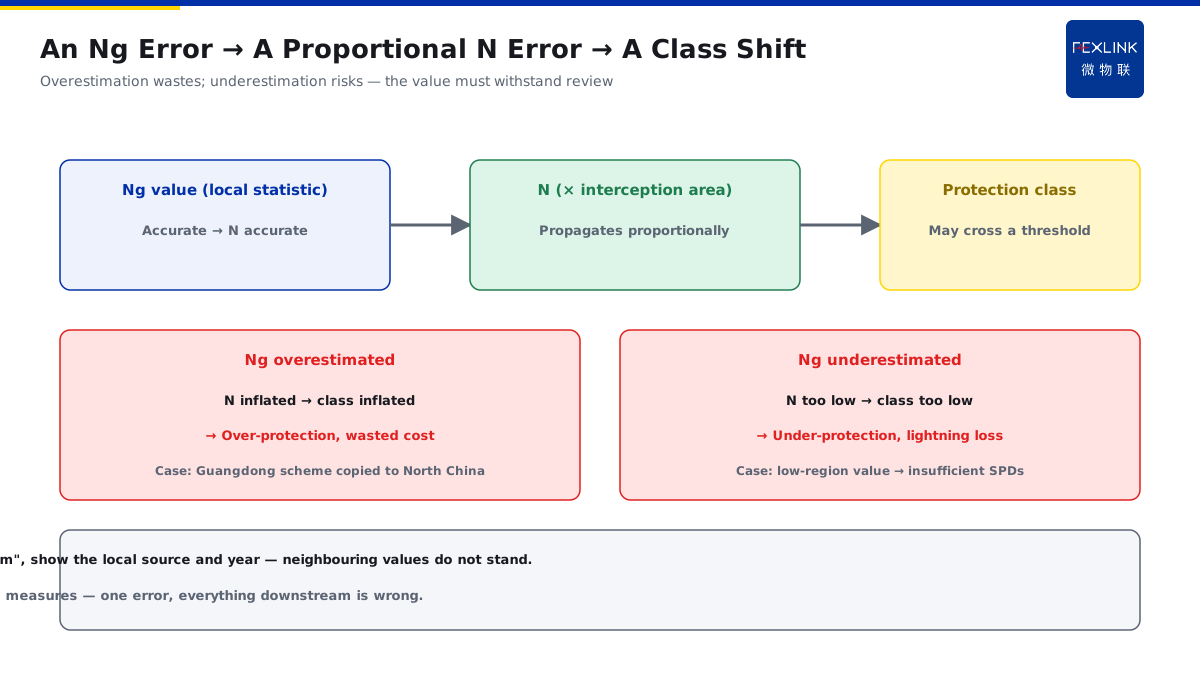
Direct Answer
How many times does the lightning environment differ between a southern high-lightning region and a northern low-lightning region, and where does the data come from? The answer: the ground-flash density (flashes/km²·a) varies significantly across the country; high-incidence regions can reach several times the value of low-incidence regions. Design should use the local public statistics from meteorological services and lightning-location systems, not neighbouring experience — Ng feeds directly into the calculation of N, and a value error is amplified proportionally into a misjudged lightning-protection class.
A group copied a lightning-protection scheme "verified in a Guangdong lightning region" unchanged to a project in North China without updating Ng. Review found the local Ng was only about one-third of the original; N was overestimated and the class inflated. Recalculated with the actual Ng, the class fell and the scheme cost dropped significantly. The key distinction: Ng is a quantitative reading of the local lightning environment — high in the south, low in the north; copying a scheme across regions requires rechecking Ng, not carrying it over.
Why:
- Definition and unit: ground-flash density = ground flashes per square kilometre per year;
- Regional variation: high-incidence regions can reach several times low-incidence regions (a real magnitude difference);
- Data sources: meteorological data + lightning-location system public statistics;
- Risk of propagation: an Ng error → an N error → a misjudged class (connecting to KD-0179).
Key insight: "Ng is a quantitative reading of the local lightning environment — a value error is amplified proportionally into N and the class; cross-region copying requires rechecking it."
A scenic area's distribution retrofit reused "low-incidence experience" for Ng, but the site was actually in a medium-to-high lightning region: N was underestimated and SPDs were insufficient; after two devices were damaged by induced lightning in one storm season, the design was recalculated with the actual Ng and reinforced. Lesson: do not take Ng from "impression" — check the local statistic, and N will stand.
1. The Definition and Unit of Ng
Step one: what this number says.
The definition:
- Ground-flash density Ng: ground flashes per square kilometre per year;
- A ground flash is the cloud-to-ground strike (the type that directly threatens buildings);
- It reflects the intensity of lightning activity in a region;
- It is the "environmental input" of lightning-protection design.
The unit:
- flashes/(km²·a);
- "how many flashes per square kilometre per year";
- The larger the value, the stronger the activity;
- It multiplies directly into N (connecting to KD-0179).
Why it matters:
- Ng is one of the two inputs of N;
- It quantifies "how much lightning is here";
- The protection-measure level changes with Ng;
- It is the parameter that must be rechecked across regions.
Key insight: "Ng has a clear definition and unit — it quantifies 'how much lightning is here' and is the quantitative environmental input of lightning-protection design."
2. The Typical Magnitude Difference between High- and Low-Incidence Regions
Step two: is "several times" real.
Typical distribution (illustrative):
- South-China coastal / Yunnan-Guizhou high-incidence regions have higher Ng;
- North China and the northeast are relatively lower;
- Parts of the Qinghai-Tibet plateau also have high values (orographic lifting);
- High-incidence regions can be several times low-incidence ones.
The magnitude difference:
- High-incidence regions can reach 10+ flashes/(km²·a);
- Low-incidence regions may be only 1–3 flashes/(km²·a);
- The several-times difference is real;
- N and the class change proportionally.
The impact on design:
- The same building may fall into different classes in different regions;
- The same scheme may be insufficient or excessive elsewhere;
- A one-class difference means clear cost and measure differences;
- "Localized values" are common sense in design.
Key insight: "The several-times Ng difference between high- and low-incidence regions is real — copying a scheme across regions can shift the class by one level; recalculate with the local value."
3. Data Sources: Meteorological Data and Lightning-Location Systems
Step three: where to look up Ng.
Authoritative sources:
- China Meteorological Administration lightning bulletins/atlases;
- Provincial/city lightning-disaster-prevention centre statistics;
- Lightning-location system (LLS) multi-year accumulated data;
- The Ng distribution reference in GB 50057 appendices.
Data forms:
- National distribution maps (contours/zones);
- Province/city statistics;
- Multi-year averages (typically 5–10 years);
- Data updates over the years (annual fluctuation).
Search notes:
- Use the latest statistics for the project site;
- Do not substitute neighbouring data;
- Note the source and year;
- In disputes, follow the local authority's definition.
Key insight: "The authoritative sources of Ng are meteorological data and lightning-location statistics — take the latest local value, note the source and year, and never substitute neighbouring data."
4. How an Ng Error Propagates into N and the Class
Step four: how much does a small error cost.
The propagation chain:
- An Ng error → a proportional N error;
- An N error → the class may cross a threshold;
- A wrong class → a wrong measure level;
- Wrong measures → wasted cost or insufficient protection.
An example (illustrative):
- Ng overestimated 50% → N overestimated 50%;
- N crosses the class threshold → an inflated class;
- An inflated class → more money spent (waste);
- An underestimated Ng → a lower class → insufficient protection (risk).
The two consequences:
- Overestimation: over-protection, wasted cost;
- Underestimation: under-protection, lightning loss;
- The larger the error, the clearer the consequence;
- This is exactly why the local value is mandatory.
Key insight: "An Ng error propagates proportionally into N and the class — overestimation wastes money, underestimation risks loss; the value must withstand review challenge."
5. Parameters That Must Be Rechecked When Copying a Design Across Regions
Step five: what to change when copying.
The recheck list:
- Ng: the local statistic (first priority);
- Building size/height: recalculate for the new project;
- Importance: per the new building's use;
- Protection class: per the new N;
- Measure configuration: adjust per the new class.
Why it is easy to fall into the trap:
- Copying is convenient and "already verified";
- But Ng is an environmental parameter that changes with location;
- The class and measures are built on Ng;
- If the environment changes, the conclusion must be re-derived.
Correct practice:
- Treat Ng as a "must-recheck" parameter;
- Recalculate N for every new location;
- Let the class and measures follow N;
- Provide the data source proactively in review.
Key insight: "When copying a design across regions, Ng must be rechecked — the environmental parameter changes with location, and the class and measures are built on it."
6. Product Implementation: Measuring and Verifying the Local Lightning Environment
WeiWuLian products turn the "statistic" of Ng into "on-site measured data":
- FL Lightning-Current Monitor: measures local strike amplitude/energy/count;
- Local lightning archive: accumulates year by year → verifies the design Ng;
- Class recheck: measured intensity vs design assumptions;
- Data loop: design → operation → correction.
The design principle in one sentence: "Ng decides the design; measurement corrects it — multi-year local data makes the lightning configuration increasingly accurate."
7. Common Misjudgments
- "Take a rough Ng by feel": a value without a source. Result: a misjudged class. Correct: check the local statistic.
- "Reuse neighbouring experience": copying across regions. Result: under/over-protection. Correct: recheck by the project location.
- "Only high-incidence regions need protection": ignoring medium/low regions. Result: underestimated risk. Correct: grade by the actual Ng.
- "Ng never changes": ignoring annual updates. Result: outdated data. Correct: use the latest multi-year statistics.
- "One scheme works nationwide": not recalculating N. Result: environmental mismatch. Correct: recalculate N and the class for every location.
Scope and Limitations
This article explains the definition of the ground-flash density Ng, the magnitude of regional differences, authoritative data sources, and how an Ng error propagates into N and the protection class, applicable to localized values in lightning-protection design. The exact Ng values follow the latest local meteorological/lightning-location statistics and the GB 50057-2010 appendices; the values here are illustrative only. Class determination also requires the building-importance correction (connecting to KD-0179). All cases are anonymized (a group, a scenic area) and do not refer to any specific customer.