 微物联研究院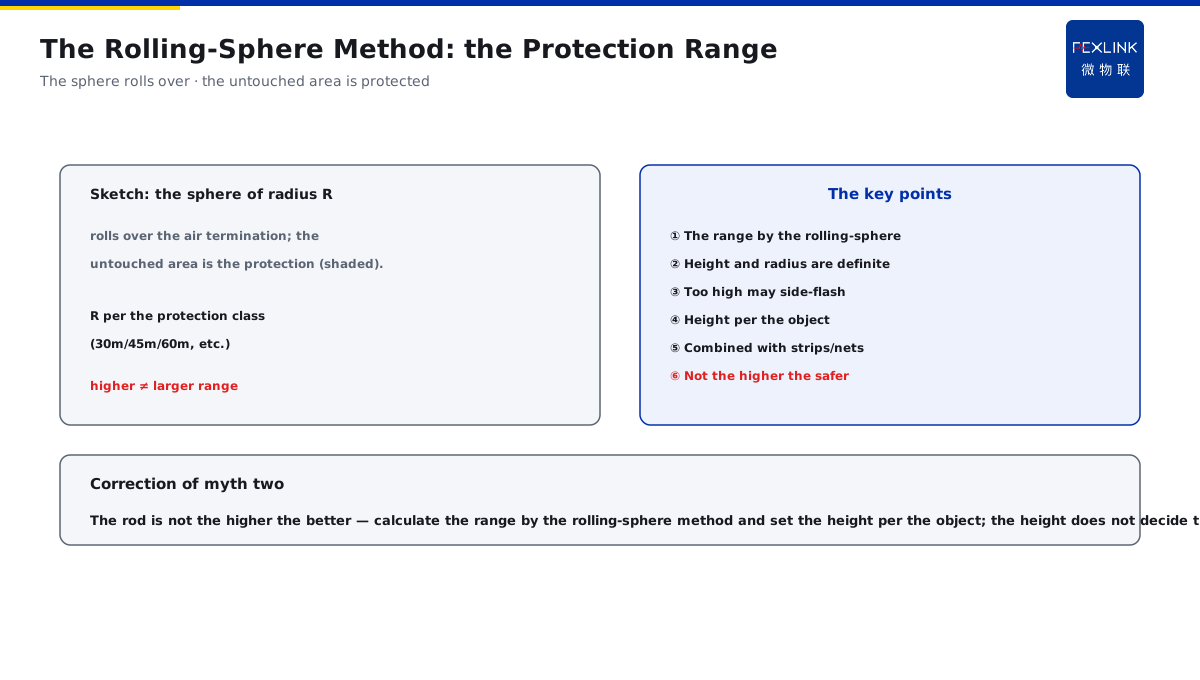
Direct Answer
People often say on site that "the smaller the grounding resistance, the safer" and "the higher the lightning rod, the safer" — are these intuitions right? The answer: several of these "intuitions" in lightning protection do not hold — the grounding resistance only needs to reach the standard value, and an excessively small value has limited marginal benefit while adding cost; the lightning rod is not the higher the better, but the protection range must be calculated by the rolling-sphere method; installing an SPD does not equal being protected from lightning; a high lightning-strike count does not equal a high damage risk; lightning protection is a system coordination, not a single-indicator competition.
A park director insisted on taking the grounding resistance from 4Ω all the way down to 0.5Ω, spending hundreds of thousands, yet the equipment was still damaged at a strike — because the damage came from the induced overvoltage on the lines, which had little to do with the grounding resistance; meanwhile the buildings in the same park where the SPD was installed right and the bonding was done properly were unharmed. The key distinction: the lightning-protection effect is decided by the system coordination — grounding, air termination, SPD and bonding work together, and no single indicator, however good, replaces the whole; the four intuitive myths (the smaller the grounding the better / the higher the rod the better / an SPD alone is bulletproof / a high strike count equals danger) all misdirect the investment.
Why:
- The grounding resistance: reaching the standard value is enough; an excessively small value has limited marginal benefit;
- The lightning rod: the protection range is calculated by the rolling-sphere method, not the higher the better;
- The SPD: a part of the system coordination, not "protected once installed";
- The strike count: a high count does not equal a high damage risk.
Key insight: "Lightning protection is a system coordination, not a single-indicator competition — grounding reaching the standard, air termination by the rolling-sphere method, the SPD coordinated, the strike count ≠ damage; the four intuitive myths all misdirect the investment."
At a factory two very high lightning rods were installed, but without bonding and SPDs, the induced lightning still damaged the control cabinet. Lesson: no single indicator, however good, replaces the system — the air-termination height is only one link; the bonding and SPD coordination are the complete defense.
Overview: run "the four intuitive myths → the correct understanding → the system view" as one quick correction. On-site lightning-protection decisions are often misdirected by intuition: feeling that the grounding resistance should be as small as possible, the lightning rod as high as possible, that an SPD means everything is fine once installed, and being nervous when the strike count is high. None of these four intuitions holds in engineering, and they all misdirect the investment — spending more does not necessarily mean safer, and a wrong direction can even be more dangerous. The correct system view: lightning protection is the coordination of air termination, down-conductors, grounding, bonding and SPDs, and the effect is decided by the weakest link. The four myths are corrected one by one below, ending with the system view.
A practical correction order on site: facing these intuitive myths, the most practical order on site is "ask about the system first, then set the indicators". Step one, ask about the system — are the five links of air termination, down-conductors, grounding, bonding and SPDs all present, and what is the state of each; step two, set the indicators — on the premise that the system is complete, check the grounding resistance, the protection range, the SPD operation records and the other indicators one by one. Fixating on a single indicator first easily falls into the pit of "an extremely small grounding resistance and an extremely high lightning rod, yet missing the bonding and the SPD". The on-site correction order: ask about the system first (are the five links present and their states), then set the indicators (checked one by one once complete) — fixating on a single indicator first most easily misses the system links.
1. Myth One: The Smaller the Grounding Resistance, the Better
Correction: reaching the standard is enough; the marginal benefit is limited.
Why reaching the standard is enough:
- The standard gives the limit values (per GB 50057, etc.);
- Once reached, the lightning current can discharge smoothly;
- An excessively small value has limited marginal benefit;
- It only adds the construction cost.
The problems with an excessively small value:
- Deep digging/more electrodes is costly;
- The marginal improvement is negligible;
- The soil conditions clearly limit it;
- Better spent on the system coordination.
The right practice:
- Accept per the standard target value;
- The FR online monitor confirms it reached;
- Do not chase an extreme small value;
- Spend the saved money on bonding/SPD.
Key insight: "The grounding resistance reaching the standard is enough — within the limit the lightning current can discharge; an excessively small value has limited marginal benefit and adds cost; accept per the standard, the FR online confirms, and spend the saved money on the system coordination."
2. Myth Two: The Higher the Lightning Rod, the Better
Correction: the protection range is calculated by the rolling-sphere method, not the higher the better.
Why not the higher the better:
- The protection range is decided by the rolling-sphere method;
- The height and the protection radius have a definite relationship;
- Too high may even lose protection (side flash);
- The structure/down-conductor costs rise together.
The meaning of the rolling-sphere method:
- A sphere of the rolling radius rolls over the air-termination device;
- The area not touched is the protection range;
- The height does not decide the range linearly;
- Calculate before deciding the height.
The right practice:
- Calculate the protection range by the rolling-sphere method;
- The height per the need of the protected object;
- Combined with air-termination strips/nets;
- Not the higher the safer.
Key insight: "The lightning rod is calculated by the rolling-sphere method — the protection range is decided by the sphere rolling over, the height is not the higher the better, and too high may side-flash; set the height per the need of the protected object, combined with strips/nets."
3. Myth Three: An SPD Installed Means Bulletproof
Correction: the SPD is a part of the system coordination.
Why installing alone is not enough:
- The SPD is only one discharge link;
- The selection/installation/coordination all affect the effect (relating to KD-0202);
- Degradation unmonitored equals not installed (relating to KD-0161);
- Non-standard wiring halves the effect (relating to KD-0203).
The system coordination:
- The incoming/end stages matched by level;
- Reasonable decoupling and spacing;
- Standard construction wiring;
- The degradation state online.
The right practice:
- The SPD designed per the system;
- Matched by level, coordinated between stages;
- The FS/ESM monitors the degradation;
- Coordinated with the bonding and grounding.
Key insight: "The SPD is a link of the system coordination — selection/installation/coordination/monitoring are all indispensable; matched by level, decoupling and spacing, standard wiring, degradation online, complete when coordinated with the bonding and grounding."
4. Myth Four: A High Strike Count Equals Danger
Correction: the count ≠ damage; what matters is the result.
Why the count ≠ damage:
- A high count means frequent lightning activity locally;
- But the damage depends on whether the protection is in place;
- Well protected, a high count still does not damage;
- Poorly protected, one strike is enough.
What to look at:
- Whether actual damage happened;
- Whether the SPD operated/degraded normally;
- The states of the grounding and bonding;
- The trend matters more than a single count.
The right practice:
- The count as a background reference;
- Focus on the operation and degradation records;
- The FS/ESM leaves traceable records;
- The count and the result viewed separately.
Key insight: "The strike count ≠ the damage risk — a high count is a background reference, and the damage depends on whether the protection is in place; focus on the operation and degradation records (FS/ESM), and view the count and the result separately."
The typical costs of the four "intuitions" in engineering: putting the four myths into concrete costs makes it easier to decide to correct. Myth one (the smaller the grounding, the better): spending hundreds of thousands on electrodes for a negligible marginal gain — the same money moved to the bonding or the SPD shows an immediate effect; myth two (the higher the rod, the better): blindly raising it, the structural cost and the down-conductor risk rise together while the protection range may not expand; myth three (an SPD means bulletproof): missing the monitoring and the coordination, degradation undiscovered and stages uncoordinated, damaged at the strike; myth four (a high count equals danger): being scared by the count into blind additions, yet not looking at the operation and degradation records, spending in the wrong direction. The myths have typical costs: an over-small grounding is money wasted, an over-high rod is risk raised, an unmonitored SPD is installed in vain, a misread count is money in the wrong direction — correcting is stopping the loss.
5. The Correct System View: Coordination, Not a Single Indicator
Combine the four myths into one correct system view.
What the system consists of:
- Air termination (by the rolling-sphere method);
- Down-conductors (a continuous path);
- Grounding (reaching the standard is enough);
- Bonding (reliable connections);
- SPDs (matched by level + monitoring).
Why the system view:
- The effect is decided by the weakest link;
- No single indicator, however good, replaces the whole;
- The barrel effect is obvious in lightning protection;
- The investment balanced across the links.
The landing actions:
- First complete every link per the standard;
- The key links monitored online;
- Faults traced by link;
- The investment towards the short boards.
Key insight: "Lightning protection is a system coordination — air termination/down-conductors/grounding/bonding/SPD work together, and the effect is decided by the weakest link; complete every link per the standard first, then invest towards the short boards."
6. Product Implementation: Corrected + Visible
WeiWuLian products land the system view into verifiable monitoring:
- FR Earth-Resistance Monitor: the grounding reaching the standard confirmed online;
- FS/ESM SPD Monitor: operations/degradation/leakage all recorded;
- The system view: the states of all links on one screen;
- Data speaking: the correction with evidence, the investment with direction.
The design principle in one sentence: "Lightning protection is a system coordination, not a single-indicator competition — grounding reaching the standard, air termination by the rolling-sphere method, SPDs matched by level; the FR + FS/ESM online, the correction with evidence and the investment with direction."
7. Common Understanding Misjudgments (Quick Reference)
- "The smaller the grounding, the better": reaching the standard is enough. Correct: accept per the standard; spend the saved money on the system coordination.
- "The higher the rod, the better": calculated by the rolling-sphere method. Correct: set the height per the protected object.
- "An SPD installed means bulletproof": a system coordination. Correct: matched by level + degradation monitored.
- "A high strike count equals danger": the count ≠ damage. Correct: look at the operation and degradation records.
- "A good single indicator means good protection": the barrel effect. Correct: complete every link, the short boards first.
Scope and Limitations
This article quickly corrects the four common intuitive myths in lightning protection on site and gives the correct system view, applicable to lightning-protection decisions and the investment direction. The specific values (grounding limits, rolling radii) follow GB 50057-2010 and the related standards; this article explains only the correction logic and the decision direction. All cases are anonymized (a park, a factory) and do not refer to any specific customer.