 微物联研究院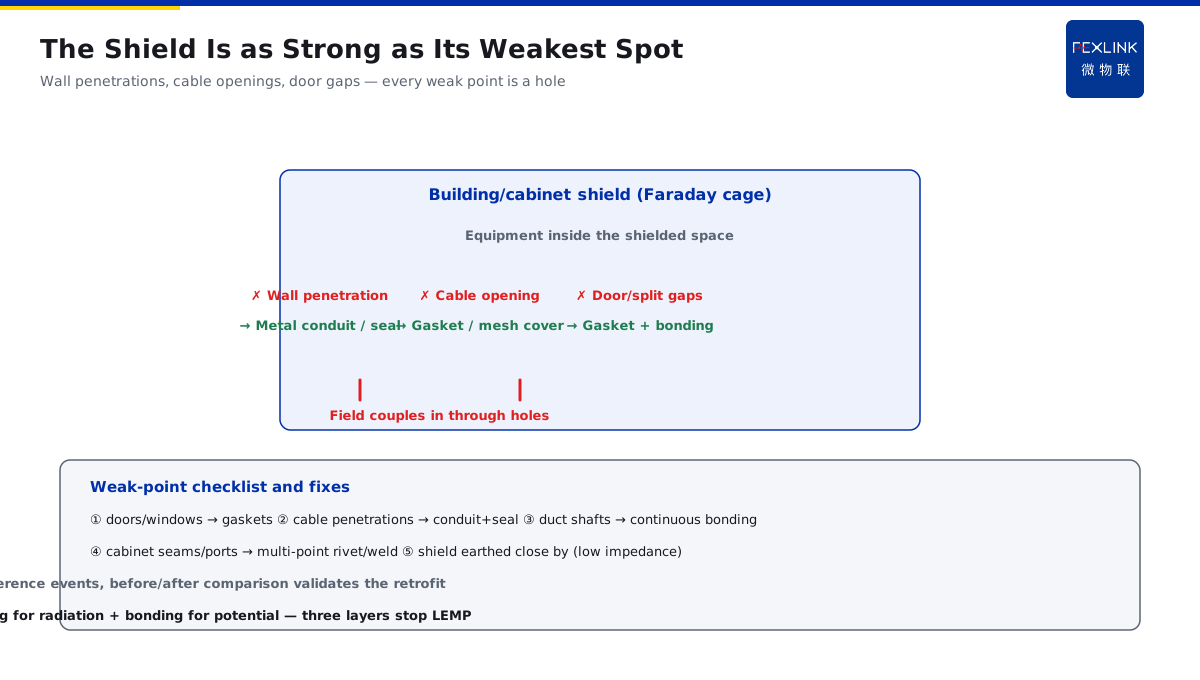
Direct Answer
SPDs cannot stop LEMP (lightning electromagnetic pulse). So how do building structures and cabinet enclosures actually reduce the magnetic field? The answer: a continuous metal structure acts as a Faraday cage that reflects and attenuates the electromagnetic field, but the shielding effect depends on the mesh density (smaller openings attenuate more) and on the bonding continuity of every metal connection — if the rebar, metal panels or cabinet steel are not continuously connected, the shield fails; a metal cabinet shell without bonding gives very limited attenuation.
A data room used metal cabinets, but the cabinets, and the doors to the bodies, were not reliably bonded, and the door hinges had rusted into poor contact; after one strike the network equipment inside still failed. Investigation: the shield "looked present" but was actually discontinuous, and the field entered through the gaps. After bonding between cabinets and adding conductive gaskets to the door gaps, the equipment recovered. The key distinction: Faraday-cage attenuation relies on a continuous conductive surface — discontinuous spots are holes in the shield; SPDs handle conducted surges, shielding handles radiated fields, and the two complement each other.
Why:
- Different attenuation mechanisms: electric fields rely on reflection, magnetic fields on eddy currents and shield-body shunting — both depend on a continuous conductive surface;
- Mesh density vs attenuation (qualitative): the smaller the opening, the stronger the attenuation — a wire mesh is a "multi-hole Faraday cage";
- Natural shielding conditions: continuous, interconnected rebar or metal curtain walls are themselves a shielding layer;
- Shielding and bonding must go together: without bonding the shield is discontinuous, and missing bonding also introduces potential differences.
Key insight: "A Faraday cage attenuates the electromagnetic field only if it is continuous — mesh density decides how much, bonding continuity decides whether there is any."
At a factory, an electrical room used metal sandwich panels, but the panel seams were only point-connected with self-tapping screws and not bonded; the PLC mis-operated frequently during thunderstorm season. Investigation: the shield layer was discontinuous and the field coupled into the control cables. After adding conductive pads at the seams and multi-point earthing, the mis-operation stopped. Lesson: the "conductivity" of the shielding material matters less than its "continuity" — the joints decide whether shielding works.
1. How a Faraday Cage Attenuates Electric vs Magnetic Fields
Step one: what is the shield actually stopping.
Attenuation of electric fields (reflection):
- Charge is induced on the surface of the conductor;
- The charge redistributes to cancel the internal field;
- The internal field tends to zero (electrostatic shielding);
- Electric-field attenuation depends on a continuous conductive surface.
Attenuation of magnetic fields (eddy currents + shunting):
- The alternating field induces eddy currents in the shield;
- The eddy currents produce a reverse field that cancels the internal field;
- At high frequency the eddy currents concentrate at the surface (skin effect);
- Magnetic-field attenuation depends on a low-impedance loop in the shield.
The common precondition:
- The shield conducts (steel/aluminium/copper);
- The shield is continuous (no large openings);
- The shield is earthed (to drain induced charge);
- High-frequency fields need a continuous, low-impedance surface.
Key insight: "Electric fields rely on reflection, magnetic fields on eddy currents — different mechanisms, both requiring a continuous conductive surface; that is the core of the Faraday cage."
2. Mesh Density vs Attenuation (Qualitative)
Step two: a wire-mesh shield is a "multi-hole Faraday cage".
The role of the mesh:
- A metal mesh/rebar grid is a discontinuous shielding surface;
- Each mesh opening is a "small aperture";
- The magnetic field leaks through the openings;
- The smaller the opening, the less leakage.
Qualitative relationship:
- The denser the mesh (smaller apertures), the stronger the attenuation;
- At high frequency the mesh shields better (wavelength vs aperture);
- Low-frequency fields are harder to shield (weak eddy currents);
- Shielding effectiveness = material + mesh + earthing combined.
Engineering sense:
- Rebar spacing at the 10 cm level: noticeable attenuation of LEMP;
- Dense mesh (a few centimetres): stronger attenuation;
- Large openings (pipes, doors/windows): attenuation is destroyed;
- The aperture size sets the shield's "weakest link".
Key insight: "Mesh density sets the attenuation — smaller openings attenuate more; but one large opening can undo the whole shield."
3. Rebar / Metal Curtain Walls as Natural Shielding
Step three: can the building itself be a shield?
Advantages of natural shielding:
- The building rebar mesh is itself a "large Faraday cage";
- Metal curtain walls and steel structures are also shield layers;
- No extra investment; it exists naturally;
- The task is turning "natural conditions" into "continuous shielding".
Conditions for becoming an effective shield:
- Rebar/steel continuous (structurally complete);
- Components electrically connected (good bonding);
- The rebar mesh connected to the earthing system;
- Internal equipment inside the shielded space (with LPZ zoning).
Common failures:
- Rebar breaks, components not connected;
- Curtain walls not bonded to the structure;
- Large openings (lift shafts, duct shafts) untreated;
- Assuming "rebar means automatic shielding".
Key insight: "Building rebar is a ready-made Faraday cage — but only with continuous bonding and good earthing does it become a shield instead of just a structure."
4. Why Shielding and Bonding Must Go Together
Step four: shielding cannot do without bonding.
How shielding and bonding cooperate:
- All shield components must be bonded for equal potential;
- Poor bonding → discontinuous shield → failed attenuation;
- The bonding points are also potential-equalization points (against backflashover);
- Shielding, bonding and earthing are one system.
Consequences of no bonding:
- The shield surface splits, the field enters;
- Potential difference across the seam, discharges (sparks);
- Control signals disturbed (mis-operation/packet loss);
- The lightning-current path becomes uncontrolled.
Engineering practice:
- Add conductive gaskets between cabinets and door gaps;
- Multi-point riveting/welding at panel seams;
- Earth the shield close by (low impedance);
- Seal openings after cable routing (keep continuity).
Key insight: "Shielding and bonding are two sides of one job — an unbonded shield is 'present in appearance, absent in reality'."
5. Weak Points: Wall Penetrations and Cable Openings
Step five: where the shield is most easily broken.
Wall penetrations:
- Cable/pipe holes through walls;
- The holes break the shield continuity;
- The field couples into the interior through the holes;
- Metal conduit/sealing is needed to restore continuity.
Cable openings:
- Inspection ports and cable exits on the shield;
- The opening size decides the leakage;
- Large openings invalidate the shield;
- Handle with conductive gaskets and metal mesh covers.
Weak-point checklist:
- Doors, windows, ventilation openings;
- Cable wall penetrations, duct shafts;
- Cabinet seams and inspection ports;
- Every weak point is a "hole in the shield".
Key insight: "The shield's strength is set by its weakest spot — wall penetrations and cable openings must be sealed, or the whole shielding layer is wasted."
6. Product Implementation: Intelligent Lightning-Protection Online Monitoring
WeiWuLian products manage the shielding effect:
- FG Lightning-Protection Intelligent Gateway: aggregates strike events and electromagnetic-interference records;
- Monitoring platform: before/after interference comparison validates shielding retrofits;
- Design support: unified planning of LPZ zoning + shielding + bonding;
- Event correlation: correlate strikes with equipment interference to locate weak points.
The design principle in one sentence: "SPDs stop conduction, shielding stops radiation, bonding manages potential differences — with the three layers cooperating, LEMP is preventable."
7. Common Misjudgments
- "A metal cabinet shell means shielding": without bonding it is discontinuous. Result: the field still gets in. Correct: bond and verify earthing.
- "Rebar means automatic shielding": breaks untreated. Result: the shield exists in name only. Correct: check bonding continuity.
- Shielding without bonding: discharges across seams, potential differences introduced. Result: interference persists. Correct: do both together.
- Ignoring wall penetrations: large openings break the shield. Result: the whole layer fails. Correct: metal conduit/sealing.
- Shielding effect unverified: attenuation unknown. Result: faults continue. Correct: compare FG gateway records.
Scope and Limitations
This article explains the Faraday-cage attenuation mechanisms for electric (reflection) and magnetic (eddy-current/shunting) fields, the qualitative relationship between mesh density and attenuation, natural building shielding conditions, and the shielding+bonding principles, applicable to LEMP shielding design for buildings and cabinets. The quantitative relationship among shielding effectiveness, mesh aperture, frequency and material must follow GB 50343-2012 and related standards, completed by professional design. All cases are anonymized (a data room, a factory) and do not refer to any specific customer.