 微物联研究院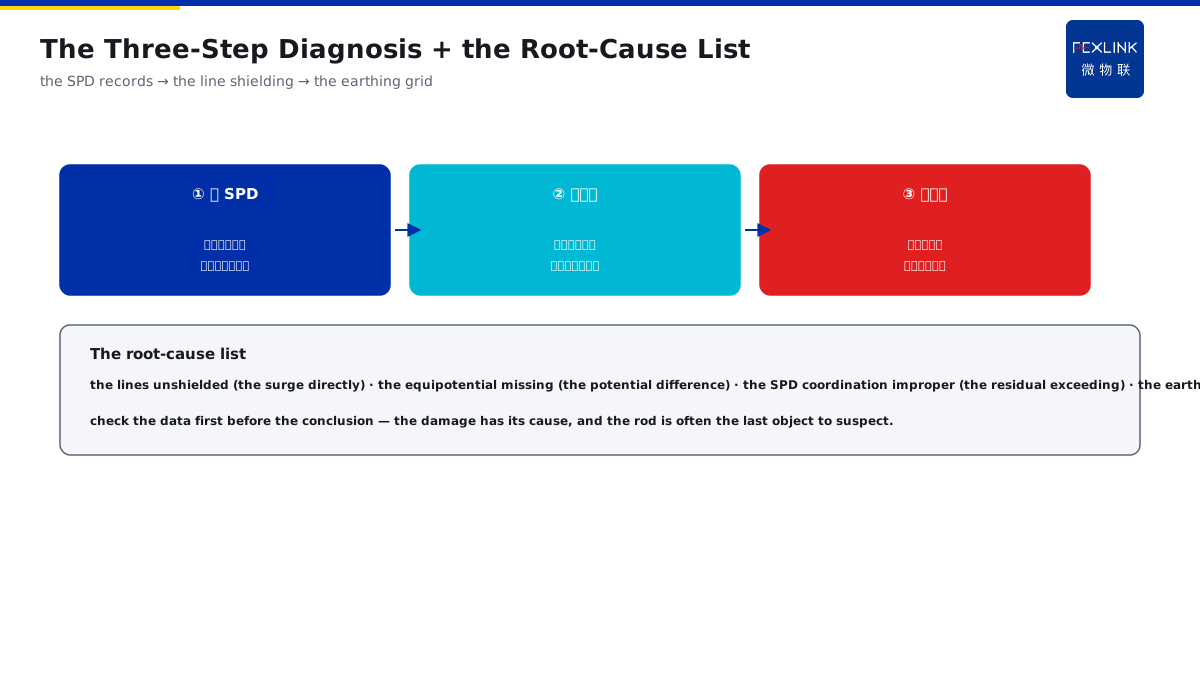
Direct Answer
The air-termination protection zone on the drawing covers the equipment, but after the thunderstorm the equipment is still damaged — what went wrong? The answer: the air-termination rod protects only against the direct strike; "inside the protection zone" only means not being hit directly; the equipment damage mostly comes from the LEMP induced overvoltage, the surge brought in by the signal and the power lines, and the earth-potential rise back-strike — and none of these is what the rod manages; the diagnostic order should be: check the SPD operation records → check the line shielding and the equipotential bonding → check the earthing grid.
At a plant, the equipment was inside the air-termination protection zone, but after the thunderstorm the frequency converter was still burnt. The protection-zone recheck found no problem; the investigation found three loopholes: the power and the signal lines were not shielded and the surge invaded along the lines, the SPD operation records showed many discharges but the residual voltage still exceeded the equipment withstand, and the earthing-grid potential rise back-struck — none of the three is managed by the rod. After the rectification, the damage disappeared. The key distinction: the protection zone ≠ the safety — the rod protects only against the direct strike; the equipment damage mostly comes from the induced overvoltage, the line-introduced surge and the earth-potential back-strike; diagnose by the three steps of "the SPD operation records → the line shielding and the equipotential → the earthing grid".
Why:
- The rod only against the direct strike: the protection zone cannot manage the induction;
- The line-introduced surge: the signal/power lines are the invasion channels;
- The earth-potential back-strike: the earthing-grid potential rise back-flows;
- The SPD residual voltage: after the discharge, the residual may still exceed the equipment withstand.
Key insight: "The protection zone only against the direct strike — the equipment damage mostly comes from the LEMP induced overvoltage, the line-introduced surge and the earth-potential back-strike; diagnose by the three steps: check the SPD operation records → check the line shielding and the equipotential → check the earthing grid."
At a data center, the rod protection covered well, but after one strike the switch was damaged; the SPD records showed many operations but the residual-voltage coordination was insufficient, the signal line was unshielded with the surge directly invading, and the earthing-grid potential rose. After the three-step rectification, the same strike did not damage the equipment again. Lesson: the drawing coverage ≠ the equipment safety — the protection zone only counts the direct strike; the induction, the line and the earth-potential three defenses must be checked separately.
Overview: run "how the direct-strike and the induction differ in the damage path → why the damage still occurs inside the protection zone → how the three-step diagnosis goes → what the typical root causes are" as one protection-zone cognition. The rod protects only against the direct strike; "inside the protection zone" only means not being hit directly; the equipment damage mostly comes from the LEMP induced overvoltage, the surge introduced by the signal and the power lines, and the earth-potential back-strike. The four layers are unfolded below.
An "umbrella and rain boots" analogy: think of the lightning protection as going out on a rainy day. The rod is an umbrella (the protection zone); the umbrella blocks the rain pouring straight down (the direct strike), but the puddle on the ground (the induction and the line surge) still wets the shoes — the umbrella does not manage the feet; if the sole is broken (the equipotential missing), the puddle directly soaks the feet (the potential back-strike); even wearing the rain boots (the SPD), the boots are not high enough (the residual-voltage coordination insufficient), and the puddle still gets in. The umbrella only manages the head; the feet need the rain boots, the intact sole and walking around the puddle — the direct strike relies on the rod, and the induction and the line surge rely on the shielding, the equipotential and the SPD coordination. The umbrella-boots analogy: the rod = the umbrella blocking only the direct rain (the direct strike), the puddle = the induction and the line surge that the umbrella does not manage, the boots = the SPD with the residual coordination insufficient and the water still getting in, the sole = the equipotential missing and the potential back-strike — the protection needs "the umbrella overhead, the boots on the feet, and the intact sole".
1. The Direct Strike vs. the Induction: How the Damage Paths Differ
Step one: first look at the comparison between the direct-strike protection zone and the induction damage path.
The direct-strike path:
- The lightning current to the ground along the rod;
- Not hit inside the protection zone;
- The range managed by the rod;
- Only against the direct hit.
The induction path:
- The overvoltage induced by the LEMP magnetic field;
- The surge coupled by the lines;
- Not relying on the rod;
- Not managed by the protection zone.
The damage comparison:
- The direct strike: the equipment hit directly;
- The induction: invading by the lines and the magnetic field;
- The direct strike relies on the rod;
- The induction relies on the shielding and the SPD.
Key insight: "The path difference is clear — the direct strike relies on the rod against the direct hit, and the induction invades by the LEMP magnetic field and the line coupling that the rod cannot manage; the direct strike relies on the rod, and the induction relies on the shielding and the SPD."
2. Why the Damage Still Occurs Inside the Protection Zone
Step two: why the equipment inside the protection zone is still damaged.
The line-introduced surge:
- The power/signal lines long;
- The induced surge along the lines;
- Directly to the equipment port;
- Not managed by the rod.
The earth-potential back-strike:
- The lightning current raising the potential;
- The earthing-grid potential back-flow;
- The potential difference across the equipment;
- The insulation breakdown.
The SPD residual voltage:
- The residual after the SPD discharge;
- Still possibly exceeding the equipment withstand;
- The coordination improper;
- The equipment damaged.
Key insight: "The damage has the three root causes — the line-introduced surge directly to the port, the earth-potential back-strike back-flowing to the equipment, and the SPD residual exceeding the equipment withstand — none of which the rod can manage, requiring the shielding, the equipotential and the SPD coordination."
3. The Three-Step Diagnosis: How to Check
Step three: the three-step diagnosis of the SPD operation records, the line shielding and the earth potential.
Step one: the SPD:
- The operation records reviewed;
- The count and the residual checked;
- Whether the coordination is proper;
- The record is the breakthrough.
Step two: the lines:
- Whether the shielding is in place;
- Whether the equipotential is complete;
- The surge invasion channels;
- Checked path by path.
Step three: the earthing:
- The earthing-grid state;
- The back-strike risk;
- The earthing resistance checked;
- The discharge path healthy.
Key insight: "The three-step diagnosis is ordered — first check the SPD operation records for the breakthrough (the count and the residual coordination), then check the line shielding and the equipotential (the invasion channels), and finally check the earthing grid (the potential back-strike and the discharge path)."
4. The Typical Root-Cause List
Step four: the typical root-cause list of the damage inside the protection zone.
Root cause one: the lines unshielded;
- The signal/power lines exposed;
- The surge directly to the equipment;
- The shielding rectified.
Root cause two: the equipotential missing;
- The bonding incomplete;
- The potential difference across the equipment;
- The equipotential completed.
Root cause three: the SPD coordination improper;
- The residual exceeding the equipment withstand;
- The graded coordination missing;
- The selection and the coordination corrected.
Root cause four: the earthing degraded;
- The earthing resistance rising;
- The back-strike aggravated;
- The earthing rectified.
Key insight: "The root-cause list has four items — the lines unshielded (the surge directly), the equipotential missing (the potential difference), the SPD coordination improper (the residual exceeding), and the earthing degraded (the back-strike aggravated) — check item by item, the damage has its cause, and check the data first before the conclusion."
5. Product Implementation: Finding the Root Cause with the Data
WeiWuLian products expose the loopholes outside the protection zone:
- FL lightning-current monitor: the records of the strike energy and the path;
- FS surge-protective-device monitor: the SPD operation and the leakage records;
- The linkage review: the damage event compared with the data;
- The root-cause location: the shielding/equipotential/earthing checked item by item.
The design principle in one sentence: "The protection zone only against the direct strike, and the data finds the root cause — FL records the strike energy, FS records the SPD operation, the three-step diagnosis is well-founded, and the loopholes appear one by one."
6. Common Understanding Misjudgments
- "Inside the protection zone = safe": wrong. Only against the direct strike; the induction and the lines are not managed.
- "The equipment damaged is the rod failure": wrong. Mostly the induction/line/earth-potential problems.
- "Installing the SPD is enough": wrong. The SPD coordination and the line shielding are done together.
- "The shielding only affects the signal": wrong. The power line introduces the surge as well.
- "The earthing qualified is safe": wrong. The earthing is only one of the three defenses.
Scope and Limitations
This article explains the diagnosis of the equipment damage inside the air-termination protection zone (the path difference, the damage causes, the three-step diagnosis and the root-cause list), applicable to the strike-damage investigation. The specific protection follows GB 50057-2010 and GB 50343-2012; this article explains only the diagnostic logic. All cases are anonymized (a plant / a data center) and do not refer to any specific customer. Remember one sentence: the umbrella blocks what is overhead, and the road under the feet is checked by yourself — beyond the protection zone, there are the three doors of the induction, the lines and the earth potential.