 微物联研究院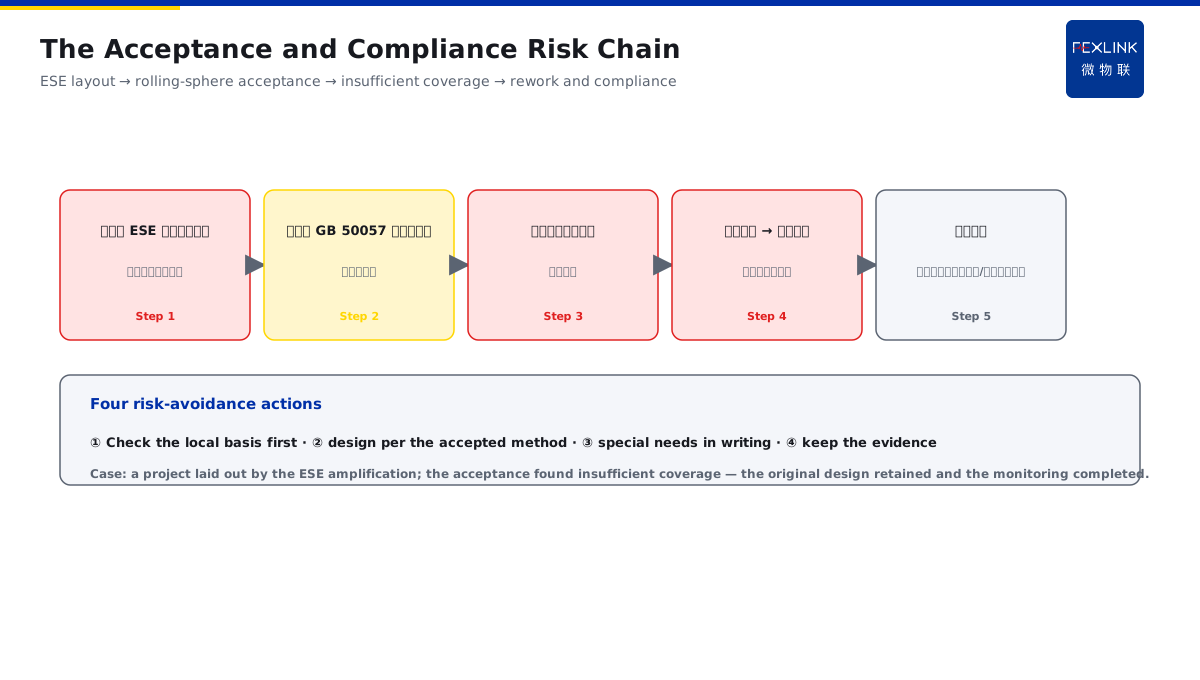
Direct Answer
A supplier recommends an "early streamer emission" terminal with a larger protected zone, and a traditional lightning rod — which to choose? The answer: the traditional Franklin terminal's protected zone is calculated by the rolling-sphere method and is generally accepted in the current national-standard system; the early streamer emission (ESE) terminal claims a larger protection radius, but its amplification effect has limited acceptance in mainstream national standards and engineering practice — before choosing, check the local standard basis and acceptance requirements; do not decide on the claimed protection radius alone.
A supplier suggested replacing the originally designed Franklin rods with an ESE terminal on a project, on the grounds that "one rod does the job of three and the radius is larger". The design review found that local acceptance follows the rolling-sphere method of GB 50057, and the ESE amplification radius has no corresponding checkable basis at acceptance; the original design was retained and the monitoring completed. The key distinction: "which to trust in practice" depends on the standard basis — the rolling-sphere protected zone has a clear calculation method, while the ESE amplification has limited acceptance in the mainstream national-standard system; the deciding factor is acceptance recognition, not the marketing parameters.
Why:
- The Franklin terminal: the protected zone calculated by the rolling-sphere method, generally accepted;
- The claimed ESE principle: an earlier upward leader, claiming an amplified radius;
- The standard-recognition difference: the amplification has limited acceptance in the mainstream basis;
- The decision advice: follow the current national standard and the local acceptance basis.
Key insight: "Which to trust in practice follows the standard basis — the rolling-sphere protected zone has a calculation method and is generally accepted; the ESE amplification radius has limited acceptance in the mainstream standards; the deciding factor is acceptance recognition, not the marketing parameters."
A plant originally protected its tank area with Franklin rods; a supplier suggested switching to ESE to widen the coverage and reduce the poles. After checking the local acceptance basis, it was not adopted; the original design was kept and the FR earthing monitoring added. Lesson: ask "does acceptance recognize it" before "is the marketing good" — the standard-recognition difference is the biggest selection risk.
Overview: run "protection principle → standard basis → acceptance risk → decision" as one rational comparison. The biggest trap in air-termination selection is being led astray by the "larger protected zone" marketing. The rational way is to compare the two technical routes side by side first: the Franklin terminal catches the strike with the metal rod itself and its protected zone is calculated by the rolling-sphere method; the ESE claims to amplify the radius with an earlier discharge. Then check one key question — does the local acceptance and the current national standard recognize this amplified basis. Finally, decide by the acceptance recognition and add earthing monitoring on the ground. The five steps below expand: the Franklin terminal's rolling-sphere protected zone, the claimed ESE principle and the amplified radius, the standard-recognition difference between the two, the acceptance and compliance risks, and the decision advice following the current national standard basis.
How multi-rod combinations are calculated: real projects rarely protect a whole plant with a single rod; they use rods, strips and meshes together. Per the rolling-sphere method, the protected zone of multiple rods is the outer envelope of their own rolling spheres — where the spheres of adjacent rods overlap, a "combined protection belt" forms; when the rod spacing is below the critical value (calculated by the rolling radius and the rod height), the middle area is also covered. This solves the "one rod is not enough" common case: instead of relying on a claimed amplification radius, add rods and densify the meshes per the rolling-sphere method — the coverage can be drawn and accepted. Multi-rod combinations are calculated by the rolling-sphere outer envelope — a spacing below the critical value forms a combined belt, and the coverage can be drawn and accepted; rather than trusting an amplified radius, densify per the rolling-sphere method.
1. The Franklin Terminal: Protected Zone by the Rolling-Sphere Method
Step one: how the traditional route calculates the protected zone.
The rolling-sphere principle:
- A ball of a fixed radius rolls along the building;
- Where the ball cannot touch is the protected zone;
- The rolling radius set by the lightning-protection class (relating to KD-0199);
- The protected zone checkable and drawable.
The role of the Franklin rod:
- The metal rod itself becomes the strike point;
- Guides the lightning current to the down conductors;
- Combined with the rolling-sphere method for the coverage;
- Mature practice with much engineering verification.
The engineering meaning:
- The protected zone has a clear calculation method;
- The drawings can be reviewed and the acceptance compared;
- Multi-rod combinations add up per the rolling-sphere method;
- Generally accepted in the national-standard system.
Key insight: "The Franklin rod's protected zone is calculated by the rolling-sphere method — the radius set by the class, the zone checkable and drawable, multi-rod addable; mature practice, acceptance comparable."
2. The Claimed ESE Principle and the Amplified Radius
Step two: what the ESE claims.
The claimed ESE principle:
- An earlier upward leader;
- Actively "meeting" the lightning;
- Claiming a widened protected radius;
- Implemented by electronics/radioactive or structure.
The claimed amplified radius:
- A larger protected radius than a Franklin rod of the same height;
- Claiming "one rod does the job of many";
- Fewer poles;
- Less footprint and cost.
The questions to verify:
- How is the amplification verified;
- Is there independent re-measured data;
- Does acceptance recognize this basis;
- What if it fails (the electronics).
Key insight: "The ESE claims an earlier discharge and an amplified radius — an upward leader 'meeting' the lightning, one rod for many; but the amplification needs independent verification; whether acceptance recognizes it and what happens when the electronics fail must be checked."
3. The Standard-Recognition Difference Between the Two
Step three: how the standard basis sees them.
The Franklin rod:
- The rolling-sphere method of GB 50057 is the calculation basis;
- The protected-zone calculation method clear;
- The acceptance compared against it;
- Generally accepted in the national-standard system.
The ESE current status:
- Mentioned in some standards/specifications;
- No unified calculation method for the amplified radius;
- Limited acceptance in the mainstream national-standard basis;
- Mostly "for reference".
The essence of the difference:
- Checkable vs claimed;
- A unified method vs different bases;
- Acceptance comparable vs hard to compare;
- The recognition difference decides the selection.
Key insight: "The standard-recognition difference is the key — the rolling-sphere method is checkable and acceptable and generally recognized; the ESE amplified radius has no unified calculation method and limited acceptance in the mainstream standards; the essence is checkable vs claimed."
4. The Acceptance and Compliance Risks
Step four: what a wrong choice costs.
The acceptance risk:
- The design lays out by the ESE amplified radius;
- The acceptance checks by the rolling-sphere method;
- Insufficient coverage → acceptance fails;
- High rework cost.
The compliance risk:
- The drawings inconsistent with the acceptance basis;
- Difficult to issue recognition documents;
- Insurance/claims may not recognize;
- Fuzzy responsibility boundaries.
Risk avoidance:
- Check the local basis before selection;
- Design per the accepted method;
- Special needs confirmed in writing;
- Keep the evidence.
Key insight: "Acceptance and compliance are the biggest risks — laying out by the ESE amplification while the acceptance checks by the rolling-sphere method may leave insufficient coverage; check the basis before selection, design per the accepted method, confirm special needs in writing."
5. The Decision Advice: Follow the Current National-Standard Basis
Step five: how to choose after all.
Regular projects:
- Follow the rolling-sphere method of GB 50057;
- Franklin rods/strips/meshes per the class;
- The protected zone checkable and acceptable;
- Safe and reliable.
Special scenarios:
- Limited space/cannot erect many rods;
- ESE can be evaluated but calculated realistically;
- Ask the supplier for independent verification;
- Confirm the acceptance basis in writing.
Ground implementation:
- Whichever is chosen, the earthing is the key;
- The FR Earthing-Resistance Monitor watches online;
- Degradation known early;
- So the terminal "catches" what it must.
If the ESE must be evaluated: in special scenarios (limited space, cannot erect many rods), if the ESE really needs evaluation, gate it in three steps: one, ask the supplier for independently third-party re-measured protection-radius data, not the self-measured values; two, have the design compare two drawings — the coverage computed by the "ESE radius" and the coverage computed by the rolling-sphere method — and see where the gap is and whether blind zones remain; three, put the acceptance basis in writing — the design description, the drawings and the acceptance basis all state which calculation method is used, to avoid later disputes. Evaluating the ESE in three gating steps: third-party re-measured data, a two-drawing comparison with the rolling-sphere method, and the acceptance basis in writing — special scenarios can be evaluated, but the evidence must be checkable and the basis written.
Key insight: "The decision follows the current national-standard basis — regular projects by the rolling-sphere method, special scenarios calculated realistically and confirmed in writing; whichever is chosen, the earthing is the key, and the FR online monitoring is the bottom line."
6. Product Implementation: Manage the Air Termination and the Earthing Together
WeiWuLian products land the air-termination selection into the earthing loop:
- FR Earthing-Resistance Monitor: the earthing states watched online;
- The air termination and the earthing managed together: "catching" presupposes "discharging";
- A consistent standard basis: design/acceptance per GB 50057;
- Traceable data: the earthing changes recorded.
The design principle in one sentence: "Which to trust in practice follows the standard basis — the rolling-sphere method generally accepted, the ESE amplification limited; regular projects per the national standard, special scenarios calculated realistically; whichever is chosen, the FR online monitoring keeps the earthing reliable."
7. Common Understanding Misjudgments
- "The larger the radius, the better": ignoring the acceptance basis. Result: acceptance fails. Correct: ask whether it is recognized first.
- "The ESE is the upgraded version": ignoring the standard difference. Result: insufficient coverage. Correct: use the checkable method.
- "Marketing data is the evidence": ignoring the independent verification. Result: distorted parameters. Correct: ask for independent re-measurement.
- "Only the air termination, not the earthing": ignoring the discharge. Result: caught but not discharged. Correct: manage the air termination + earthing + monitoring together.
- "Selection by price only": ignoring the compliance. Result: fuzzy responsibility. Correct: acceptance compliance first.
Scope and Limitations
This article compares the protection principle, the standard recognition and the acceptance risk of the ESE early-streamer-emission terminal and the traditional Franklin rod, and gives a selection advice following the current national-standard basis, applicable to air-termination selection decisions and acceptance-compliance checks. The specific clauses follow the original text of GB 50057-2010; this article does not deny the legitimacy of any technical route, only highlights the standard-basis and acceptance differences. All cases are anonymized (a project, a plant) and do not refer to any specific customer.