 微物联研究院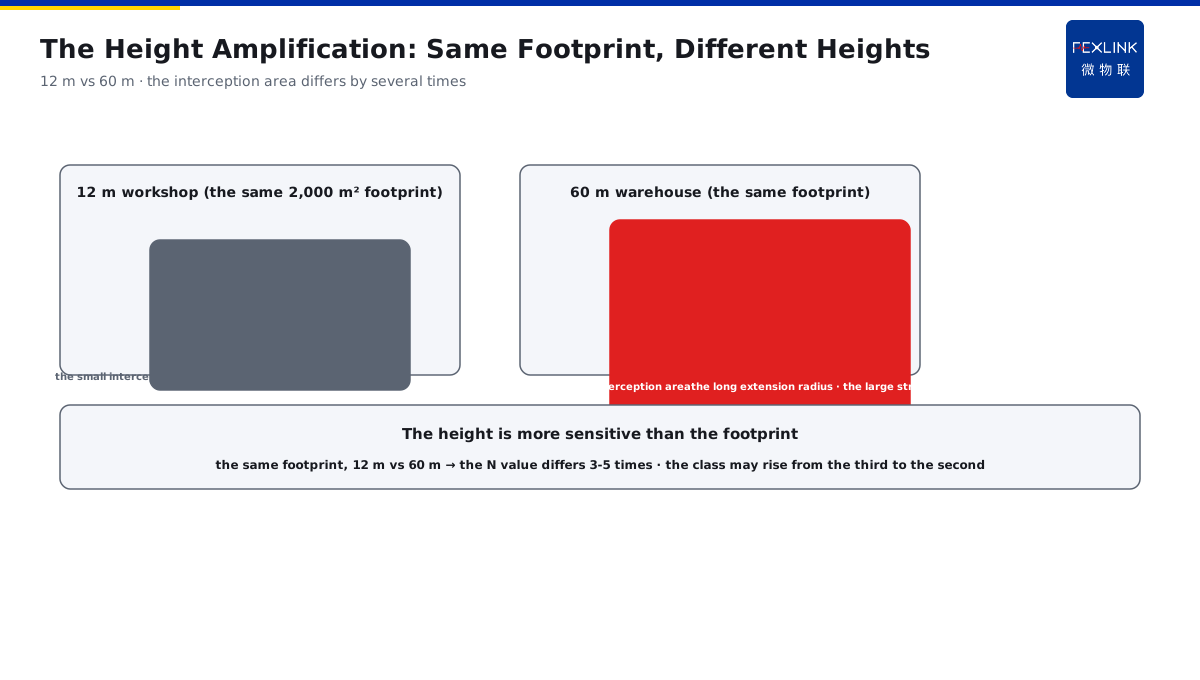
Direct Answer
When the lightning-protection classification mentions the "expected annual number of lightning strikes", where does this N value come from and what are the thresholds? The answer: the expected annual number of lightning strikes N is obtained by multiplying the ground flash density (converted from the local average annual thunderstorm days Td) by the equivalent interception area of the building (related to the length, width and height); GB 50057 gives the discrimination thresholds for the second and third classes respectively, and the larger N and the more important the building, the higher the class.
For a workshop 80 m long, 40 m wide and 12 m high, with the local average annual thunderstorm days of 40, the calculation gives N ≈ 0.16 strikes/year, falling within the second-class threshold (N > 0.05 and not meeting the third-class conditions), and the design is set as a second-class lightning-protection building; for a warehouse of the same footprint but 60 m high, the equivalent interception area is significantly amplified by the height, and the N value increases obviously. The key distinction: N is not an empirical number — it is obtained by multiplying the flash density (converted from Td) by the equivalent interception area (related to the length, width and height); the height amplifies the interception area, and the larger N and the more important the building, the higher the class.
Why:
- The flash density: converted from the average annual thunderstorm days;
- The interception area: related to the length, width and height;
- The height amplification: the higher, the larger the interception area;
- The threshold discrimination: the second/third-class N thresholds compared.
Key insight: "The N value multiplies two factors — the flash density (converted from Td) by the equivalent interception area (related to the length, width and height); the height amplifies the interception area, and the larger N and the more important the building, the higher the class, with the second/third-class thresholds compared."
A design institute classified an office tower 55 m high; it estimated the N value only by the footprint, missing the height amplification of the interception area, so the N value was underestimated by half an order of magnitude and the building was misjudged as the third class; after the strikes, the roof air-termination devices operated frequently, and the review corrected it to the second class. Lesson: the N value without the height is distorted — the equivalent interception area is sensitive to the height, and the estimated N must be calculated by the formula, not only by the footprint.
Overview: run "how the flash density comes → how the equivalent interception area is calculated → how the height amplifies it → where the second/third-class thresholds are" as one N-value cognition. The expected annual number of lightning strikes N is obtained by multiplying the ground flash density (converted from the local average annual thunderstorm days Td) by the equivalent interception area of the building (related to the length, width and height); GB 50057 gives the discrimination thresholds for the second and third classes respectively, and the larger N and the more important the building, the higher the class. The four layers are unfolded below.
A "fishing-net coverage" analogy: think of the equivalent interception area as a "lightning-catching net" centered on the building. The footprint is the "central chassis" of the net, and the height is the "extension radius" of the net — the higher the building, the larger this net spreads and the higher the probability of catching the strike. The flash density is the "fish density of this water area": in a lake with many fish (large Td), the same net catches more "fish" (the strikes). The N value is the "expected catch" calculated as "the net area × the fish density" — with a large net and many fish, the expected strikes are more, and the protection grade must be higher. The fishing-net analogy: the interception area = the lightning-catching net (the footprint = the chassis, the height = the extension radius), and the flash density = the fish density (large Td, many fish) — N = the net area × the fish density, and more expected strikes require higher protection.
1. The Flash Density: Converted from the Thunderstorm Days
Step one: first look at how the ground flash density is converted from the average annual thunderstorm days.
The average annual thunderstorm days Td:
- The local meteorological statistics;
- Reflecting the thunderstorm frequency;
- The regional difference large;
- Obtained from the meteorological data.
The flash-density conversion:
- The ground flash density related to Td;
- The large Td, the large flash density;
- The conversion formula per the standard;
- The unit: strikes/km²/year.
The influence on N:
- Td is the first factor of N;
- The N larger in the thunderstorm-prone areas;
- The same building with a higher class;
- The regional difference reflected.
Key insight: "The flash density is converted from Td — the local meteorological average annual thunderstorm days reflect the thunderstorm frequency, the large Td, the large flash density and the large N; in the thunderstorm-prone areas, the same building has a higher class, and the regional difference is reflected in N."
2. The Equivalent Interception Area: How to Calculate It
Step two: the equivalent interception area of the building is related to the length, width and height.
The basic composition:
- The actual footprint of the building;
- The interception zone extended outward;
- Related to the height;
- Reflecting the "strike-catching" range.
The height influence:
- The higher, the larger the interception area;
- The high-rise building with a large "strike-catching" surface;
- The height is the amplification factor;
- Not only by the footprint.
The calculation principle:
- The length, width and height substituted into the formula;
- The extension radius with the height;
- The special shapes corrected;
- Executed per the standard formula.
Key insight: "The interception area depends on the length, width and height — the footprint plus the interception zone extended outward, with the extension larger at a higher height; the high-rise building has a large 'strike-catching' surface, and the length, width and height must be substituted into the formula, not only by the footprint."
3. The Height Amplification: Why It Cannot Be Ignored
Step three: the amplification effect of the building height on the interception area.
The amplification principle:
- The height increasing the extension radius;
- The interception area growing quadratically;
- The same footprint with different heights differing greatly;
- The height is the sensitive variable of N.
The actual difference:
- 12 m vs 60 m with the same footprint;
- The interception area differing by several times;
- The N value differing by several times;
- The class possibly different.
The consequence of the omission:
- The N underestimated and the class lower;
- The lightning-protection measures insufficient;
- The strike-loss risk increased;
- Must be calculated by the formula.
Key insight: "The height amplification cannot be ignored — the height increases the extension radius and the interception area grows quadratically, and 12 m vs 60 m with the same footprint differ by several times; without the height, N is underestimated, the class is lower and the protection is insufficient."
4. Where the Thresholds Are: How to Judge the Second/Third Class
Step four: the discrimination of the second/third-class N thresholds in GB 50057.
The second-class threshold:
- N greater than the specified value;
- And not meeting the third-class conditions;
- Or the important building directly set as the second class;
- The class higher.
The third-class threshold:
- N in the specified range;
- The general building;
- The class lower;
- The basic lightning-protection measures.
The discrimination flow:
- Calculate the N value;
- Compare the thresholds;
- Combine the importance;
- Determine the final class.
Key insight: "The threshold discrimination depends on N — the second class with N greater than the specified value (or the important building directly set), and the third class with N in the range (the general building); calculate N → compare the threshold → combine the importance → determine the class, and N is the key input of the classification."
5. Product Implementation: From the Classification to the Monitoring Loop
WeiWuLian products bring the lightning-protection classification to the verifiable level:
- Intelligent lightning-protection online monitoring: the full-chain monitoring of the air termination/SPD/earthing;
- The data support: the actual strike data feeding back to verify the N value;
- The trend warning: identifying the strike-prone areas;
- The loop improvement: the classification compared with the protection effect.
The design principle in one sentence: "The class calculated accurately and the monitoring follows up — the N value is calculated per the standard to determine the class, the intelligent lightning-protection online monitoring verifies the protection effect on the full chain, and the strike data feeds back to verify the classification."
6. Common Understanding Misjudgments
- "The N value is an empirical number": wrong. N is calculated by the formula of the flash density × the interception area.
- "Only the footprint matters": wrong. The height amplifies the interception area, and without it N is underestimated.
- "Td does not matter": wrong. The N is larger in the thunderstorm-prone areas, and the class is higher.
- "There is only one threshold": wrong. The second/third classes each have their thresholds, combined with the importance.
- "Done after the classification": wrong. The strike data can feed back to verify the N value, and the protection effect must be monitored and verified.
Scope and Limitations
This article explains the calculation of the expected annual number of lightning strikes N (the flash density, the interception area, the height amplification, and the threshold discrimination), applicable to the lightning-protection classification calculation and discrimination. The specific formula and threshold values follow GB 50057-2010; this article explains only the calculation logic. All cases are anonymized (a workshop/an office tower) and do not refer to any specific customer.