 微物联研究院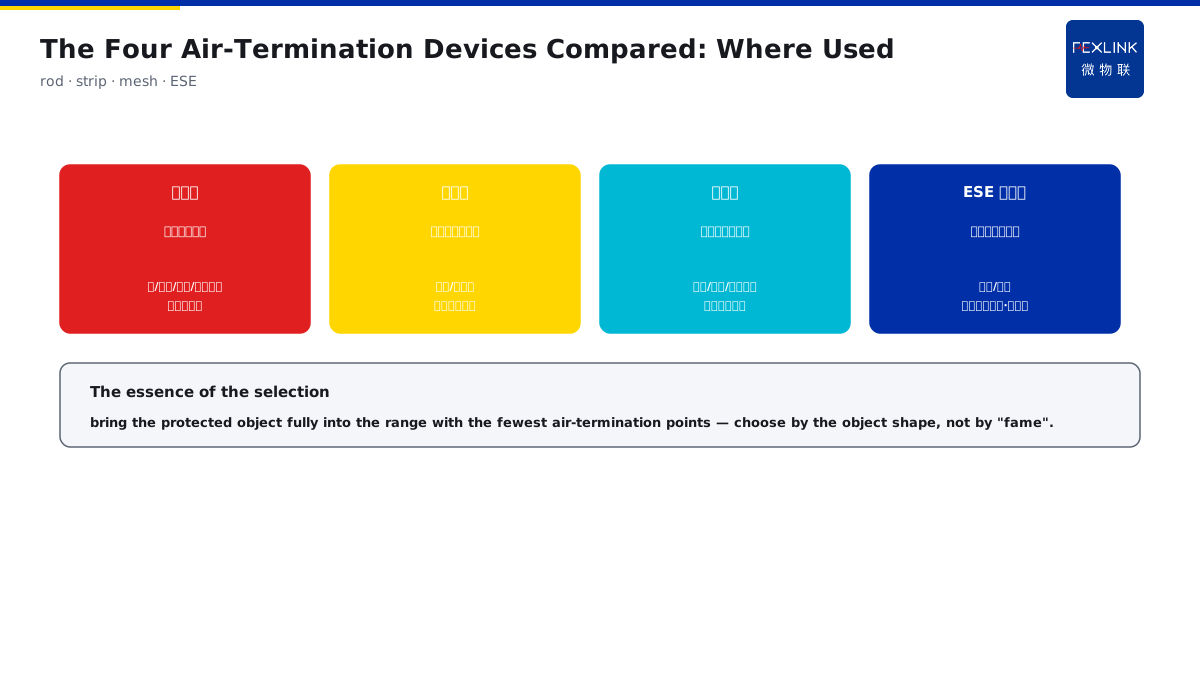
Direct Answer
There are several kinds of air-termination devices for direct-strike protection — in which scenario should you choose which one? The answer: the air rod is used for isolated tall objects (towers, chimneys, oil depots), the strip/mesh for roof-surface protection, and the ESE (early streamer emission) terminal for open large-span places where a dense mesh is hard to lay (note its effectiveness controversy and the standard attitude); the essence of the selection is to bring the protected object fully into the protection range with the fewest air-termination points.
At a park a 40m chimney: the designer, by experience, erected a very tall air rod on top, but the calculated protection range did not cover the open equipment area beside it; later a "rod + strip" combination was used — the rod protects the chimney itself and the strip protects the surrounding equipment, at a lower cost and with fuller coverage. The key distinction: the essence of the selection is to bring the protected object fully into the protection range with the fewest air-termination points — the rod for isolated tall objects, the strip/mesh for flat roofs, the ESE considered for open large-span places (note the controversy); choose by the shape of the protected object, not by "fame".
Why:
- The air rod: protects isolated tall objects, one point covers an area;
- The strip/mesh: roof-surface protection, the mesh covering evenly;
- The ESE: claims an enlarged protection radius for open large-span places, but the standard attitude is cautious;
- The common essence: the rolling-sphere calculation brings the protected object fully into the range.
Key insight: "Choose the four devices by the object shape — the rod for isolated tall objects, the strip/mesh for roofs, the ESE for open large-span places (controversial); the essence is bringing the protected object fully into the range with the fewest air-termination points."
At a factory the mesh was installed per the drawing, but an equipment on a roof corner happened to exceed the mesh coverage and was damaged at a strike; after a short rod was added the coverage was complete. Lesson: the device must target the coverage blind spot — points not covered by the mesh need a rod; a coverage blind spot is the strike entrance.
Overview: run "the four devices → the protection range → the ESE controversy → the connection requirements" as one selection cognition. The "air-termination family" for direct-strike protection has four members: the air rod, the air strip, the air mesh and the ESE early-streamer-emission terminal. They all "catch" the lightning current and conduct it to the down-conductor, but their shapes, coverage features and applicable scenarios differ. The essence of the selection is not picking the "most powerful" but bringing the protected object fully into the range with the fewest air-termination points. The four layers are unfolded below.
An on-site "who protects whom" judging method: at the site, look at the shape of the protected object first, then decide the device — the order cannot be reversed. Step one, look at the object — is it an isolated tall object (a chimney, a tower, an oil depot), a flat roof (a factory, a computer room) or an open large span (a square, a freight yard); step two, match the device — the rod for isolated tall objects, the strip/mesh for flat roofs, the ESE evaluated for open large spans; step three, calculate the coverage — check with the rolling-sphere method for blind spots, and fill the blind spots with a rod/strip. With the three steps, the device selection basically does not run astray; conversely, looking first at "which device is famous" and then applying it to the site most easily produces coverage blind spots. The "who protects whom" method: look at the object shape (isolated tall/flat roof/open large span) → match the device (rod/strip-mesh/ESE) → calculate the coverage (rolling-sphere for blind spots, filled with a rod/strip) — look at the object first, then select the device, and the coverage blind spots will not appear.
1. The Four Devices: Shape and Applicable Object
Step one: first recognize what each of the four looks like and what it protects.
The air rod (lightning rod):
- An upright metal rod, one-point air termination;
- Applicable: isolated tall objects;
- Typical: towers, chimneys, oil depots, open equipment;
- Feature: one point protects an area.
The air strip:
- A metal strip laid along the roof perimeter;
- Applicable: the edges of flat/pitched roofs;
- Typical: roof eaves, parapets;
- Feature: linear coverage of the perimeter.
The air mesh:
- A grid of metal conductors on the roof surface;
- Applicable: large flat roofs;
- Typical: factory, computer-room and warehouse roofs;
- Feature: surface grid coverage.
The ESE terminal:
- An air-termination device with an active discharge mechanism;
- Claims an enlarged protection radius;
- Typical: open large-span places;
- Note: the effectiveness is controversial.
Key insight: "The four devices in one sentence — the rod protects isolated tall objects (one point covers an area), the strip protects the roof perimeter (linear), the mesh protects large roofs (surface), the ESE protects open large spans (controversial); recognize the shapes first, then talk about the selection."
2. The Protection Range: Calculated by the Rolling-Sphere Method
Step two: whichever device you choose, the protection range is calculated by the rolling-sphere method.
The idea of the rolling-sphere method:
- A sphere of the rolling radius rolls over the air-termination device;
- The area not touched is the protection range;
- The radius taken per the protection class;
- The height and the protection radius have a definite relationship.
The coverage features of the devices:
- The rod: protects a cone/spherical-segment area;
- The strip: a coverage band along the laid line;
- The mesh: the whole area inside the grid covered;
- The combination: rod + strip/mesh complement the blind spots.
The meaning of the calculation:
- Covering all the protected objects counts as qualified;
- Blind spots need a device added or the layout adjusted;
- Not the higher/more the better;
- The solution set by the calculation result.
Key insight: "The protection range is calculated by the rolling-sphere method — the rod protects a cone/segment, the strip a band, the mesh a surface, and the combination fills the blind spots; covering all the protected objects counts as qualified, and blind spots need a device added or the layout adjusted."
3. The ESE Controversy: Understand the Standard Attitude
Step three: the ESE claims an enlarged protection radius, but the standard attitude is cautious.
The ESE claim:
- Early streamer emission, an enlarged protection radius;
- One point covering a larger area;
- Fewer air-termination points;
- Applicable to open large-span places.
The standard attitude:
- GB 50057 gives no clear endorsement of the enlarged radius;
- In engineering, conservatively calculate by the conventional rolling-sphere method;
- Acceptance and insurance recognize the conservative range;
- The effectiveness controversy must be evaluated when adopting it.
How to decide:
- Conventional places prefer the traditional devices;
- Evaluate again only when a large span is truly hard to mesh densely;
- Hedge with the conservative range;
- Key projects do not gamble on the controversial device.
Key insight: "The ESE claims an enlarged radius but the standard is cautious — GB 50057 gives no clear endorsement and acceptance follows the conservative range; conventional places prefer the traditional devices, evaluate again for a hard-to-mesh large span, and key projects do not gamble."
4. Connection and Down-Conductor: Air Termination Is Not an Isolated Link
Step four: the air-termination device must be joined with the down-conductor and the earthing.
The connection requirements:
- Air termination → down-conductor → earthing electrode;
- A continuous path and reliable welding;
- The number and spacing of the down-conductors per the standard;
- The corrosion and mechanical strength meet the requirements.
The relation to the monitoring:
- Whether the air termination operated can be recorded by the lightning-current monitoring;
- The down-conductor path state can be inspected;
- The earthing state confirmed online (relating to the FR class);
- The intelligent lightning protection brings the air termination into the system view.
The engineering points:
- The material specifications per the standard;
- Welding/anti-corrosion up to standard (relating to KD-0204);
- Test points reserved for re-measurement;
- The whole connected into a lightning-protection system.
Key insight: "Air termination is not an isolated link — air termination → down-conductor → earthing are joined into one; reliable welding, compliant down-conductors and re-measurable test points, and the intelligent lightning protection brings the air termination into the system view."
5. Product Implementation: The Air-Termination Family + Visible
WeiWuLian products bring the air-termination devices into a verifiable system:
- The lightning-current monitoring: air-termination operations/strike records;
- The online earthing: the down-conductor and earthing state confirmed;
- The system view: air termination-down-earthing on one screen;
- The data loop: after a strike, verify whether the air termination worked.
The design principle in one sentence: "Choose the four devices by the object — the rod for tall objects, the strip/mesh for roofs, the ESE evaluated before use; air termination-down-earthing joined into one, and the lightning-current monitoring makes the air-termination operation visible."
6. Common Understanding Misjudgments
- "The higher the rod, the better": wrong. The protection range is calculated by the rolling-sphere method, not decided linearly by the height.
- "With a rod, no mesh is needed": wrong. The shapes cover different areas; the rod and strip/mesh are often complementary.
- "The ESE is always stronger than the traditional": unproven. The effectiveness is controversial and the standard is cautious; key projects do not gamble.
- "The air-termination device is an independent item": wrong. It must be joined with the down-conductor and the earthing, or it is useless.
- "Air termination means fully protected": wrong. The direct strike is only one link; the induced lightning/LEMP still needs the SPD and the rest.
Scope and Limitations
This article explains the four air-termination devices (the rod/strip/mesh/ESE) — their shapes, applicable objects, protection-range calculation and connection requirements — applicable to direct-strike protection selection. The specific rolling radii, down-conductor numbers and other values follow GB 50057-2010; this article explains only the selection cognition and the logic. All cases are anonymized (a park/a factory) and do not refer to any specific customer.