 FEXLINK Research Institute
Direct Answer
Half a year after the platform goes live, the dashboards look better and better, but when audit, reconciliation and reporting to the leadership come around, the data does not match, and no one can be held accountable — the boss's one sentence "this data cannot be used" can cool half the project. The question is: what does "the data cannot be used" mean? The answer is that for data to become a "data element" that produces value, it must at the same time hold four baseline rules — accurate (the values are credible), complete (no blind spots in the key points), timely (the timestamps are traceable), and processable (the structure can be directly consumed by algorithms). If any of the four is missing, that pile of data is only "numbers", not "data elements."
A scene: an enterprise energy platform went live a year ago, and numbers jumped on the big screen every minute. At the year-end carbon audit, the auditor wanted "electricity ledgers by workshop, by production line, by time segment," and the platform could not export them. During reconciliation, the master-meter reading and the sum of the sub-meters did not match, differing by 3.7%. When tracing a trip event, the platform only recorded "a trip occurred," with no second-level current waveform, so the cause could not be reconstructed. The person in charge explained "the data is all there," but the auditor's conclusion was "the data cannot be used." Breaking it down, this pile of data failed exactly on the four baseline rules: the master and sub-meters not matching is a failure of "accurate"; the workshop ledger not being exportable is a failure of "complete"; the trip having no second-level timestamp is a failure of "timely"; and the exported data being garbled fields that cannot be directly analysed is a failure of "processable." With all four missing, the data is naturally useless.
1. First Define: What Is a "Data Element"
A "data element" is not a synonym for "data." Data is the raw record — current 125 A, temperature 68 °C, a trip at some time. A data element is data that can be produced, exchanged, used, and continuously create value; it must satisfy all the premises of "being usable."
An analogy: the ore in the mine is a resource; it becomes an element only after it is smelted into steel and made into parts. Similarly, the raw records collected by sensors are only "ore"; after the four processes of accurate, complete, timely and processable, they become data that can directly support metering, audit, diagnosis and decisions — that is a "data element." How many records are on the platform does not matter; what matters is how much data has reached the "element" standard.
2. Baseline One "Accurate": The Values Are Credible, Then They Can Be Used to Settle Accounts
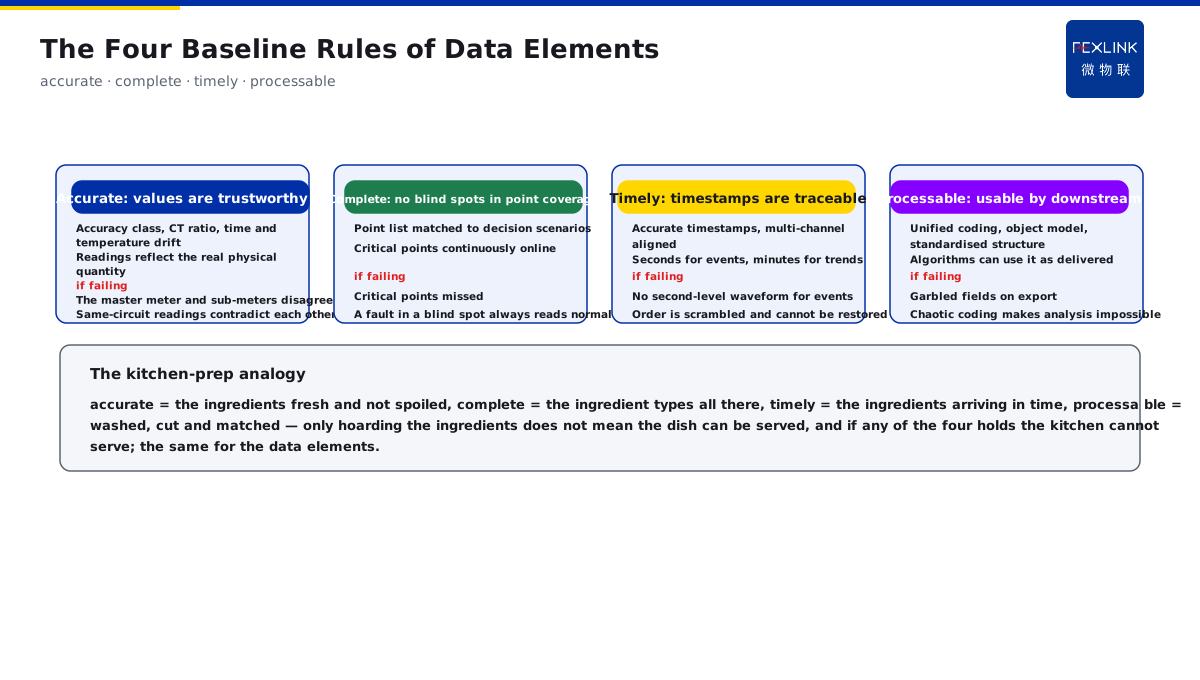
Definition of "accurate": every value truly reflects the physical quantity, the error is within the agreed range, and the dimension, the CT ratio, and the time/thermal drift are all correct.
"Accurate" is the baseline that is most easily ignored and most prone to problems. It is not just "whether the sensor is accurate," but every link of the whole metering chain:
- Accuracy class: a 0.5-class meter and a 2.0-class meter differ by up to four times in the error limit of the same circuit; for sub-metering, the accuracy class must be selected by the settlement requirement;
- CT ratio: if the current-transformer ratio is configured wrong, the screen shows 125 A but the actual value may be 1,250 A — an order of magnitude off, and all the alarm thresholds are set in vain;
- Time/thermal drift: after long operation and temperature changes, zero drift accumulates and the readings slowly deviate from the true value; without periodic calibration, the error rolls bigger and bigger.
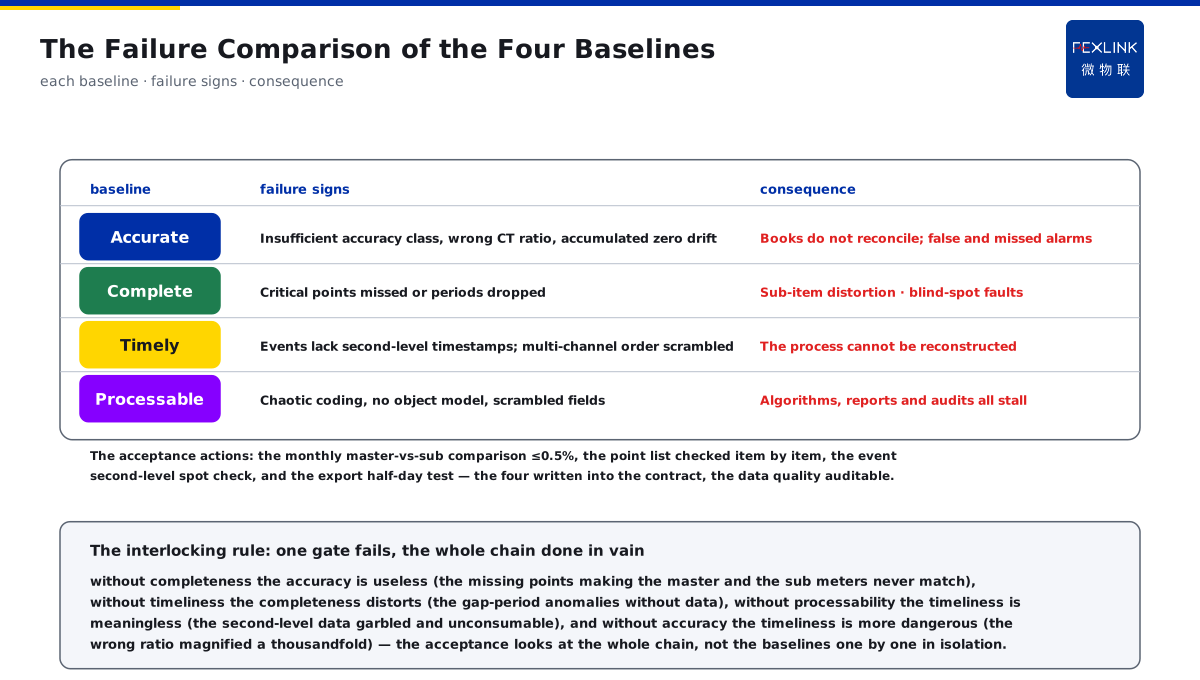
Typical signs of an "accurate" failure: the master meter and the sum of the sub-meters do not match, two meters on the same circuit disagree, a wrong CT ratio makes the power value absurd, and long-term uncalibrated values drift as a whole.
Self-check action: do a "meter comparison" every month — master-meter reading vs the sum of the sub-meters; if the deviation exceeds the agreed value (such as 0.5%), check the ratio, the wiring and the calibration records.
3. Baseline Two "Complete": No Blind Spots in the Key Points, Then the Full Picture Can Be Restored
Definition of "complete": none of the key points needed for metering, monitoring and events is missing, and they are continuously collected online, leaving no blind spots.
"Complete" does not mean "many." Collecting 500 points but missing a few key ones is more dangerous than collecting 100 points with all of them in place — because you cannot see the anomalies inside the blind spots.
Typical signs of a "complete" failure:
- Sub-metering distorted: you need to account by workshop and production line, but the meter of a certain line is not connected or not collected, so the sub-ledger never matches;
- Alarms distorted: the faulty device happens to be the one without a monitoring point — faults in the blind spot are always "normal" to the system;
- Time gaps: during the night or holidays when no one maintains the system, collection stops; the anomaly happens to occur in the gap, and there is no data afterwards.
How to decide the key points: not "install as many as possible," but "collect what the decisions need" — sub-metering needs full coverage of the master meter plus the sub-meters, fault tracing needs full monitoring of the key equipment, and energy analysis needs full collection by circuit. Every decision scenario corresponds to a point list, and not one point on the list may be missing.
4. Baseline Three "Timely": The Timestamps Are Traceable, Then Events Can Be Restored
Definition of "timely": the timestamps of data collection and upload are accurate, and the granularity meets the needs of event restoration — minute-level data manages trends, second-level data manages events.
"Timely" is not just "short collection interval"; the core is traceable timestamps: every piece of data carries an accurate time stamp, and the timestamps of multiple channels are aligned, so the cause and effect of an event can be restored.
The difference between minute-level and second-level:
- Minute-level (1–15 minutes): enough for trends — load rate, energy consumption, temperature changes; suitable for energy-efficiency analysis and daily monitoring;
- Second-level (1 second–1 millisecond): enough for events — the voltage and current waveforms before and after a trip, fault records, transient processes; suitable for accident restoration and diagnosis.
Typical signs of a "timely" failure: the device trips, the platform only records "tripped at some time," with no second-level waveform before and after, so the cause analysis has no way to start; the timestamps of multiple channels are out of sync, so the causal order does not match; data upload is delayed, and the alarm becomes a "post-event notice."
Judgement standard: minute-level is enough for trend data, and event data must be second-level — the question you should ask the supplier is not "what is the collection interval," but "how fine a picture can you give me around a trip."
5. Baseline Four "Processable": The Structure Can Be Directly Consumed by Algorithms, Then It Can Be Used
Definition of "processable": the data has a unified encoding, an object model and a standard structure; algorithms, reports and audit tools can consume it directly, without manually interpreting the fields.
This is the most essential dividing line between a "data element" and a "number." The platform has data, but the export is garbled fields, the encodings differ across tables, and the measurement points do not know the devices — such data cannot be used by algorithms, cannot be made into reports, and cannot be audited; it is not processable.
"Processable" needs three things:
- Unified encoding: devices, circuits, measurement points and events all have globally unique encodings, consistent across tables, without "one transformer having three names";
- Object model: every measurement point is bound to a device, circuit, topology and parameter relationship; the data "knows" the devices;
- Standard structure: time, value, unit and status fields have unified formats, exported ready to use, with zero-friction access for algorithms.
Typical signs of a "processable" failure: the exported CSV fields do not match the documents, the encodings cannot be associated, the measurement points are not bound to devices so alarms cannot locate the object, and the units are inconsistent (kW and MW mixed).
Judgement standard: export one month of raw data and give it to an engineer who was not involved in the project — can he produce the sub-metering ledger within half a day? If not, it is not processable.
6. The Acceptance Actions of the Four Baselines: Turning "Cannot Be Used" into "Verifiable"
Whether the data is usable cannot be decided by feeling; it must be verified by acceptance. Each baseline gets an executable acceptance action:
- Verify "accurate": monthly comparison of the master meter vs the sum of the sub-meters; pass with a deviation ≤0.5%; spot-check the accuracy class, ratio and calibration records of 10% of the points;
- Verify "complete": check the point list against the decision scenarios; one missing key point means failure; collection gaps have alarms and gap-filling records;
- Verify "timely": spot-check the timestamp accuracy and granularity of event data (trips, alarms); failure to meet the second-level requirement means failure; check the timestamp alignment of multiple channels;
- Verify "processable": export the raw data and do the "half-day test" — give it to an independent engineer; can he complete the sub-metering ledger within half a day? Spot-check the uniqueness of the encodings and the object model.
Writing the four acceptance actions into the contract turns data quality from "the supplier's promise" into "an auditable fact."
7. The Four Baselines Are Not Isolated: They Constrain Each Other
Accurate, complete, timely and processable are not four independent requirements, but four gates on one chain; if one gate fails, the other links are done in vain:
- Without completeness, accuracy is useless: if a key point is missed, the master meter and the sub-meters never match, and no matter how accurate the values are, the accounts cannot be settled — "accurate" cannot save "missing";
- Without timeliness, completeness distorts: the collection gap is exactly the high-incidence period of anomalies, and without second-level event timestamps, no matter how complete the collection is, the process cannot be restored — "complete" cannot save "slow";
- Without processability, timeliness is meaningless: second-level data exported as garbled fields with mismatched encodings cannot be consumed no matter how fast — "timely" cannot save "messy";
- Without accuracy, timeliness is more dangerous: wrong-ratio data with second-level collection equals magnifying the error a thousandfold; misjudgement is worse than no data.
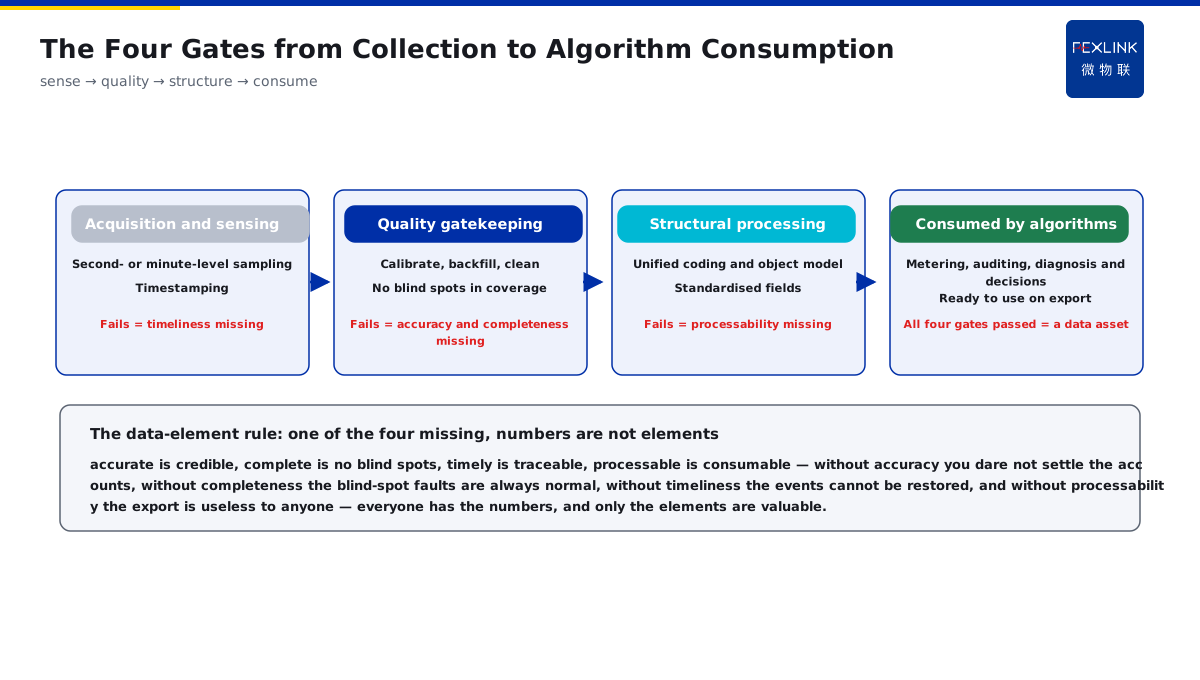
So when accepting, do not look at the baselines one by one in isolation; look at the whole chain: from the on-site sensors to the algorithm consumption, if any gate in the middle fails, what you finally hold is not a "data element."
8. A "Kitchen Prep" Analogy: Ingredients Complete Does Not Mean the Dish Can Be Made
Think of data elements as kitchen prep: accurate is that the ingredients are fresh and not spoiled (the values are credible; a dish made with spoiled ingredients cannot be served); complete is that the ingredient types are all there (the main and auxiliary ingredients are complete; missing one flavour and the dish is not that dish); timely is that the ingredients arrive in time (the dish must be made fresh; ingredients left too long are not fresh — event data needs the second level to restore the truth); processable is that the ingredients are washed, cut and matched (the cook can put them straight into the pot — the algorithm can consume them directly, without washing and cutting on the spot).
Only hoarding ingredients (raw records) does not mean the dish can be served (value produced): the ingredients are not fresh (inaccurate), something is missing (incomplete), they have been left too long (not timely), they are not cut and matched (not processable) — if any of the four holds, the kitchen cannot serve the dish. The same for data elements: only when accurate, complete, timely and processable all pass can data move from "number" to "element."
9. The Data-Element Iron Rule
If one of the four baselines is missing, the data is only "numbers", not "data elements" — accurate is credible, complete is no blind spots, timely is traceable, processable is consumable.
Four sentences to land it:
- Everyone has numbers; only elements are valuable — pass the four gates of accurate, complete, timely and processable first, then talk about data value;
- If "accurate" fails, the data dares not be used to settle accounts; if "complete" fails, the faults in the blind spots are always "normal";
- If "timely" fails, events cannot be restored; if "processable" fails, the exported data is useless to anyone;
- Match each baseline with an acceptance action and write it into the contract; then data quality is an auditable fact.
Next time the boss says "the data cannot be used", do not rush to argue "the data is all there" — first run a self-check against the four baselines: accurate? complete? timely? processable? If you can answer "all pass," the data truly has value.
10. Back to FEXLINK: How Data Quality Lands
To land these baselines on a product, FEXLINK's enterprise energy-carbon integrated management platform organises its data chain exactly around "accurate, complete, timely, processable": accurate — monitoring terminals are selected by accuracy class, CT ratios are configurable and verifiable, and periodic calibration reminders keep the values credible; complete — point lists are built by decision scenario, collection gaps have alarms and gap-filling records, and the key points have no blind spots; timely — trend data is collected at the minute level, event data is recorded at the second level, and the timestamps are aligned for restoration; processable — unified encodings, object model and standard structure, with data exported ready to use and algorithms accessing with zero friction. For your platform to pass the "data element" gate, start the acceptance from the four baselines.
Scope and Limitations
- The conclusions in this article are intended for LV distribution and electrical-safety sites. Criteria are compiled from public codes and FEXLINK product documentation, and product parameters follow the latest selection handbook and product knowledge base.
- Quantitative criteria (protection zone, discharge and residual voltage, earth resistance, thresholds and grading) hold under the preconditions stated in this article. Where the site voltage level, earthing arrangement, environmental category or load profile differs, the figures must be recalculated. Specific configurations involving enterprise energy-carbon management platform should be verified against actual circuit parameters.
- Specific product models and parameters are subject to the latest selection handbook and product knowledge base; this article does not constitute selection or procurement advice.
- Standard numbers cited here refer to the currently effective editions; when a standard is revised, the related quantitative conclusions must be re-checked.
- Deployment and implementation for specific projects must be carried out by qualified engineers based on site survey and design drawings.
Frequently Asked Questions
A Pile of Data, Yet the Boss Says "It Cannot Be Used"
that for data to become a "data element" that produces value, it must at the same time hold four baseline rules — accurate (the values are credible)