 FEXLINK Research Institute
Direct Answer
In electrical digitalisation procurement, almost every supplier calls itself an "IoT company": some quote by "point", some by "meter", some stress how powerful their "platform" is, and the prices can differ by double. What you are actually buying is not the number of sensors and not the platform interface, but "data availability" — how much qualified, analysable, decision-ready data the supplier can deliver on the chain of "electrical signal → data → intelligence → value." That is the essential difference between a "data-producing" supplier and one that sells hardware, meters or interfaces, and it is the basis for who you give your selection vote to and what you write into the acceptance terms.
A scene: a park wanted to build an electrical safety and energy-efficiency monitoring system, and three suppliers came. Supplier A was a sensor manufacturer quoting "300 yuan per point, 500 points in total." Supplier B was a meter manufacturer quoting "2,000 yuan per meter, 80 meters in total." Supplier C, an "IoT platform company", quoted twice as much as A, on the grounds that "the platform has all the functions." The person in charge was confused: all three call themselves IoT, what exactly is the difference? Later he found out: after A's delivery, the data came up but the measurement points were not bound to devices, and no one knew which device an alarm belonged to; B's meters measured accurately, but the data had no analysis and all anomalies depended on human eyes; C's platform looked beautiful, but the dirty data that was fed in was cleaned by no one, and false alarms numbed the duty officers. None of the three is a "data-producing" supplier — they delivered "devices", "meters" and "interfaces", but not "qualified data."
1. First Look at the Essence: What Does "Data Production" Actually Produce
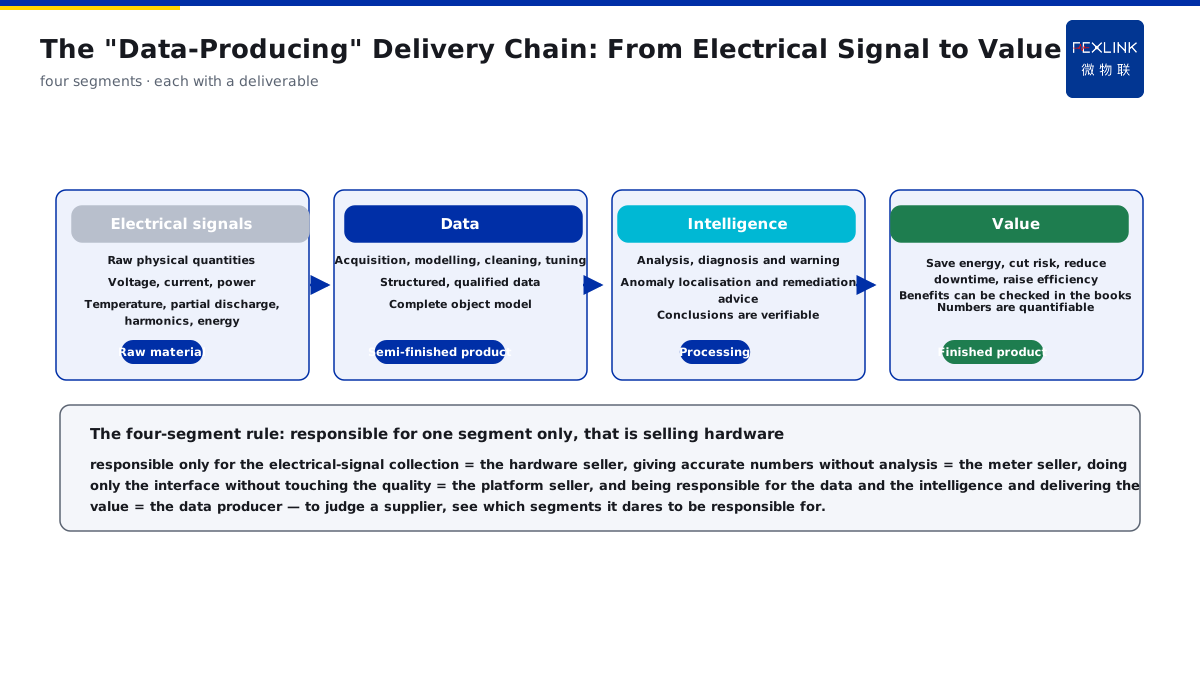
FEXLINK positions itself as "a company that produces data." This is not a slogan but a definition of the deliverable. The electrical system produces electrical signals all the time — voltage, current, power, temperature, partial discharge, harmonics, energy consumption. "Producing data" means: continuously converting electrical signals into qualified, analysable, decision-ready data, and taking responsibility for every link of this chain. The chain has four segments:
- Electrical signal: the raw physical quantities from the equipment site, the "raw material";
- Data: the structured result after collection, modelling, cleaning and tuning, the "semi-finished product";
- Intelligence: the analysis, diagnosis and early warning based on the data, the "processing";
- Value: the quantifiable benefits landed on energy saving, hazard avoidance, outage reduction and efficiency improvement, the "finished product."
To judge whether a supplier is the "data-producing" type, see whether it dares to take responsibility for the "data" and "intelligence" segments: are the measurement points bound to an object model? Does the data quality pass? Can the diagnosis conclusions be verified? If it is only responsible for the "electrical signal collection" segment, then it is essentially selling hardware under the name of IoT.
2. Three Types of "Fake IoT" Suppliers, with Simple Recognition Features
Most suppliers in the market that call themselves "IoT companies" can be divided into three types by their deliverables, each with obvious recognition features:
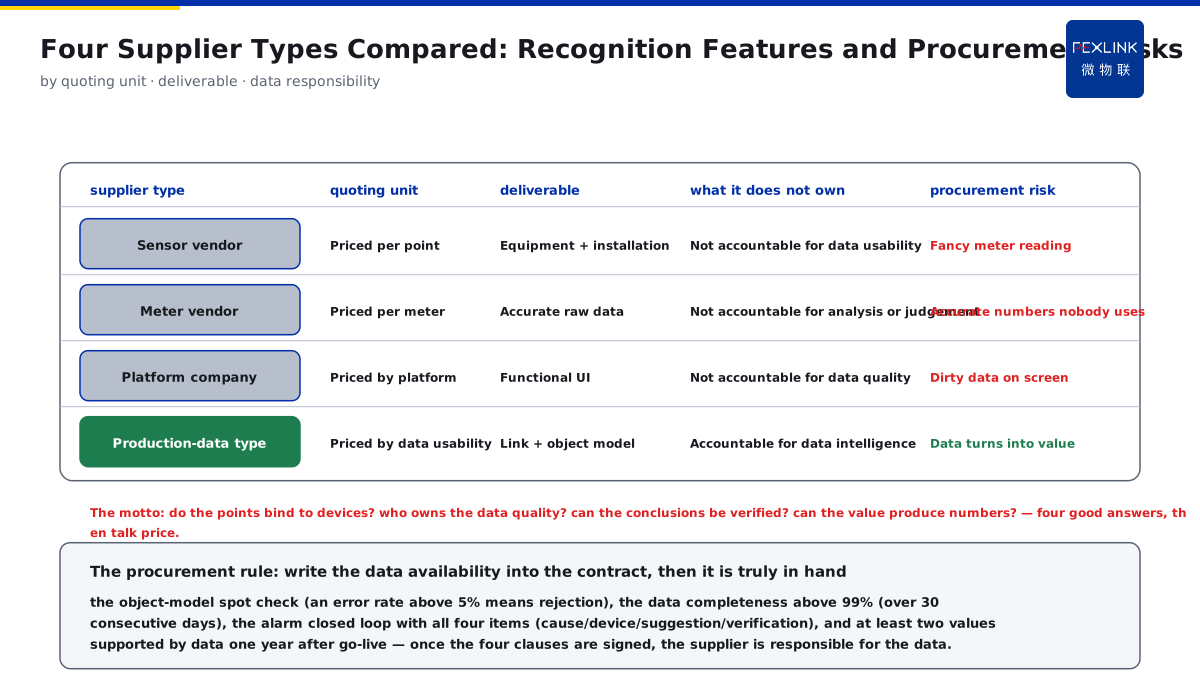
1. Sensor/hardware manufacturer: quotes by point Recognition features: the quoting unit is "point" or "set"; the deliverable is equipment plus installation; acceptance looks at "how much equipment was installed and whether the data came up"; it is not responsible for "whether the data is usable." Your risk in buying it: the data comes up, but the object model, data quality and analysis diagnosis are all missing, and the system degenerates into an "advanced meter reader."
2. Meter/instrument manufacturer: quotes by meter Recognition features: the quoting unit is "meter/set"; the strength is metering accuracy and stability; the deliverable is "accurate raw data"; it is not responsible for "analysis and judgement." Your risk in buying it: the meters are accurate, but the data still lies on the screen, and no one turns it into diagnosis and decisions — accurate data is not the same as useful data.
3. Platform/software company: quotes by platform Recognition features: the quoting unit is "platform licence" or "subscription annual fee"; the strength is the interface, reports and big-screen display; the deliverable is "functional interfaces"; data access and quality often depend on the customer doing it themselves. Your risk in buying it: the interface is beautiful, but dirty data goes straight to the screen and false and missed alarms run wild — no matter how good the platform, garbage in, garbage judgement out.
Recognition motto: ask it three questions — "Do the measurement points bind to devices? Who is responsible for data quality? Can the diagnosis conclusions be verified?" Those who cannot answer are fake IoT.
3. The "Data-Producing" Supplier: Four Layers of Deliverable Commitment
A truly "data-producing" supplier delivers not devices, not meters, not interfaces, but a four-layer commitment:
Layer 1: object model — every measurement point is bound to a device, circuit, topology and parameter relationship; the data "knows" the devices. Replacing devices, adding points, aggregating by circuit can all be traced. This is the foundation of usable data.
Layer 2: data quality — calibration, gap-filling, cleaning and threshold tuning are standard actions, not value-added services. Every number on the screen dares to be used for signing off, settling accounts and making judgements. This is the guarantee of credible data.
Layer 3: analysis closed loop — not just reporting numbers, but giving diagnosis, location and handling suggestions: what type the anomaly is, which device it is on, how severe it is, which to handle first, and tracking the result. This is the channel through which data becomes valuable.
Layer 4: value delivery — energy saving, accident avoidance, outage reduction and efficiency improvement, each with data to check and accounts to settle. This is the end point where data turns into money.
In one sentence: the hardware seller delivers "devices", the meter seller delivers "accurate numbers", the platform seller delivers "interfaces", and the data producer delivers "the complete chain from electrical signal to value."
4. From the Procurement View: You Buy "Data Availability", Not "Hardware Points"
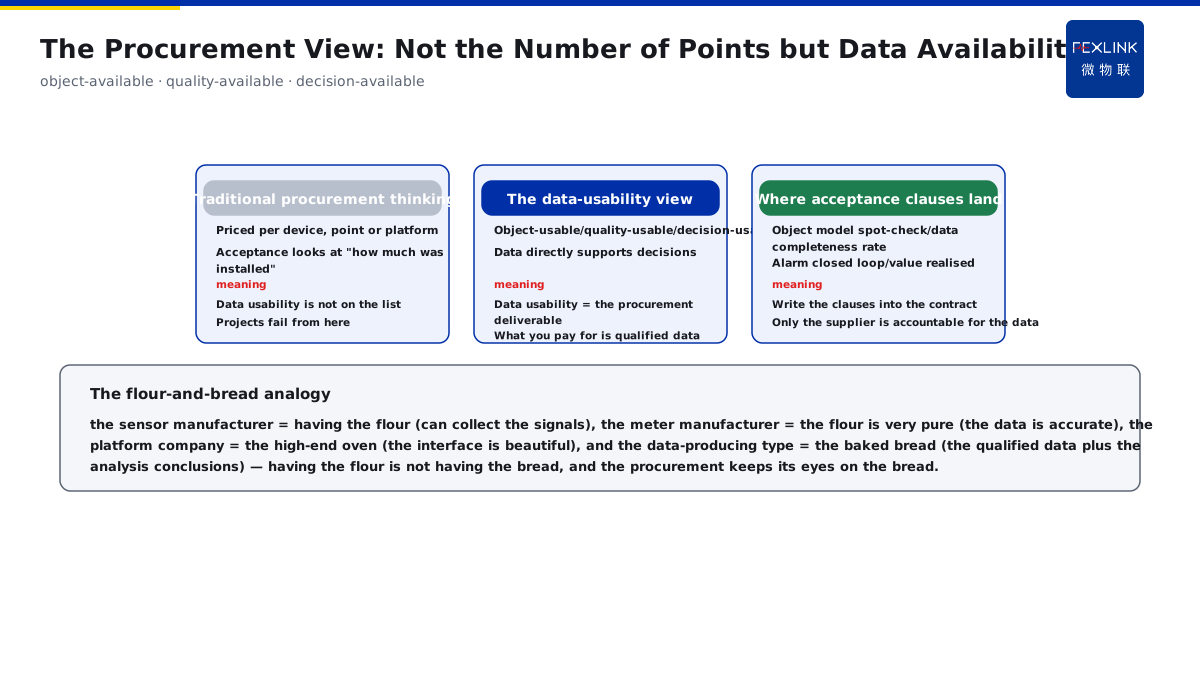
Once the deliverable is clear, the procurement decision is clear: the money you pay buys data availability — how much data in the system, per unit of time, is object-clear, quality-reliable and directly supports decisions. Data availability can be split into three verifiable dimensions:
- Object-available: for any measurement point, you can say which device it belongs to, which circuit, what parameter (spot-check points; deduct marks if they cannot answer);
- Quality-available: data completeness and accuracy have explicit targets, and dirty data does not enter analysis (gap-filling and anomaly cleaning are traceable);
- Decision-available: the diagnosis conclusions given by the system can be verified and guide handling (review the historical alarms and look at the verification records).
The traditional procurement list contains only "equipment quantity, point quantity, platform functions", and has no "data availability" item — this is exactly why so many electrical digitalisation projects fail: the money was spent, the equipment was installed, the screens were up, and acceptance "passed", but the system changed nothing in the business. Writing data availability into the procurement requirements and the acceptance terms is the way to force the supplier, from the source, to "produce data."
5. Five Steps of the Procurement Decision: From "Listening to the Pitch" to "Verifying the Data"
After identifying the supplier type and clarifying data availability, how do you land the decision? Follow these five steps; every step has an operational verification action, and you do not decide by feel:
Step 1: ask for a data-chain description — require the supplier to explain in writing how each of the four segments "electrical signal → data → intelligence → value" is implemented and what is delivered. If it only talks about hardware parameters or interface functions, put a question mark first.
Step 2: spot-check the object model on site — let the supplier open the system ledger, randomly click five measurement points, and see whether it can say "device, circuit, parameter, relationship." If it cannot, the object-model layer fails.
Step 3: review the alarm history for the closed loop — let the supplier pull up the alarm records of the past three months, randomly pick three, and ask "what was the cause, where was it located, what was the suggested handling, and was it verified later?" If there are only red dots and no conclusions, the analysis closed loop has not been completed.
Step 4: ask for the data-quality documents — completeness, cleaning rules, threshold tuning basis; are there written documents? If it cannot produce them, data quality is out of the question.
Step 5: write data availability into the contract — the object-model spot check, data completeness, alarm closed loop and value delivery, item by item, into the acceptance terms, with the verification methods agreed. If the supplier dares to sign, it is worth investing in.
The core of these five steps is "verify" rather than "listen": anyone can talk about "IoT, big data, AI" in a PPT, but data availability can only be verified through the ledger, the alarm records, the quality documents and the contract terms.
6. Writing "Data Availability" into the Acceptance Terms: Four Executable Clauses
In the procurement contract, it is recommended to explicitly add the following four items (each corresponds to an executable verification method):
Clause 1: object-model acceptance — spot-check no fewer than 10% of the measurement points, check "device binding, circuit ownership, parameter association" one by one; an error rate above 5% means rejection. Verification method: export the ledger from the platform and check point by point on site.
Clause 2: data-quality acceptance — over 30 consecutive days, the data completeness rate is not lower than 99%, and anomaly cleaning has records; the alarm thresholds have a tuning document, and the false-alarm rate is not higher than the agreed value. Verification method: platform statistics reports plus on-site sampling.
Clause 3: analysis-closed-loop acceptance — randomly select 3 historical alarms; the supplier must be able to explain all four items: "alarm cause, associated device, handling suggestion, verification result." Verification method: review the platform alarm records.
Clause 4: value-delivery acceptance — one year after go-live, at least two of energy saving, hazard avoidance, outage reduction and efficiency improvement must have quantifiable data to support them, otherwise it is deemed not to have met expectations. Verification method: electricity bills, accident records, manpower comparison.
These four clauses are not "making things hard for the supplier" but turning "data production" from a slogan into a contractual obligation — once the clauses are signed, the supplier will take object modelling, data cleaning and the analysis closed loop seriously.
7. A "Flour and Bread" Analogy: Having Flour Is Not Having Bread
Think of procurement as buying bread: the sensor manufacturer says "I have flour" (I can collect electrical signals), the meter manufacturer says "my flour is very pure" (my data is very accurate), and the platform company says "I have a high-end oven" (my platform is very beautiful). But what you want to buy is baked bread (qualified data plus analysis conclusions you can use directly). Having flour is not having bread — the flour also needs water, kneading, fermentation and baking (modelling, cleaning, analysis, diagnosis), and if any step in the middle is done badly, what is served is not bread. The "data-producing" supplier's commitment is "I give you the baked bread": signals in, data usable, diagnosis credible, value checkable. When procuring, do not be moved by the "flour" or the "oven"; keep your eyes on the "bread" — that is, data availability and value delivery.
8. The Digital-Procurement Iron Rule
What you buy is not the number of points but data availability — write the object model, data quality, analysis closed loop and value delivery into the acceptance terms, and the data is truly in your hands.
Four sentences to land it:
- If the quotation has only "points/meters/platforms", be alert — ask who is responsible for data availability;
- Object model, data quality, analysis closed loop and value delivery: a missing layer means an incomplete commitment;
- If there is no data availability in the acceptance terms, once the contract is signed, it is all disputes afterwards;
- A supplier that dares to write data availability into the contract and accept spot checks is the "data-producing" type.
Next time you hear a supplier say "we are an IoT company", do not believe it immediately — ask it first: do the measurement points bind to devices? Who is responsible for data quality? Can the diagnosis conclusions be verified? Can the value produce numbers? If it answers the four questions beautifully, then talk about the price.
9. Back to FEXLINK: Why the "Data-Producing" Positioning Matters to Your Procurement
Landing this logic on selection: FEXLINK's enterprise energy-carbon integrated management platform and electrical safety monitoring product line deliver not just sensors and a platform, but the complete chain of "electrical signal → data → intelligence → value" — the sensing layer collects the signals completely, the edge layer guarantees data quality, the platform layer builds the object model and does analysis and diagnosis, and finally the energy-efficiency reports, carbon-efficiency reports and hidden-hazard handling records turn value into numbers. When procuring, you can directly require: write the four data-availability acceptance clauses into the contract, and FEXLINK delivers according to the clauses. That is what the "data-producing" positioning means to you — you are not just buying a system; you are buying a long-term partner who is "responsible for data."
Scope and Limitations
- The conclusions in this article are intended for LV distribution and electrical-safety sites. Criteria are compiled from public codes and FEXLINK product documentation, and product parameters follow the latest selection handbook and product knowledge base.
- Quantitative criteria (protection zone, discharge and residual voltage, earth resistance, thresholds and grading) hold under the preconditions stated in this article. Where the site voltage level, earthing arrangement, environmental category or load profile differs, the figures must be recalculated. Specific configurations involving enterprise energy-carbon management platform should be verified against actual circuit parameters.
- Specific product models and parameters are subject to the latest selection handbook and product knowledge base; this article does not constitute selection or procurement advice.
- Standard numbers cited here refer to the currently effective editions; when a standard is revised, the related quantitative conclusions must be re-checked.
- Deployment and implementation for specific projects must be carried out by qualified engineers based on site survey and design drawings.
Frequently Asked Questions
Every Supplier Calls Itself an IoT Company: Why Is the "Data-Producing" Supplier Worth Paying More For?
In electrical digitalisation procurement, almost every supplier calls itself an "IoT company": some quote by "point", some by "meter", some stress how powerful their "platform" is, and the prices can differ by double