 微物联研究院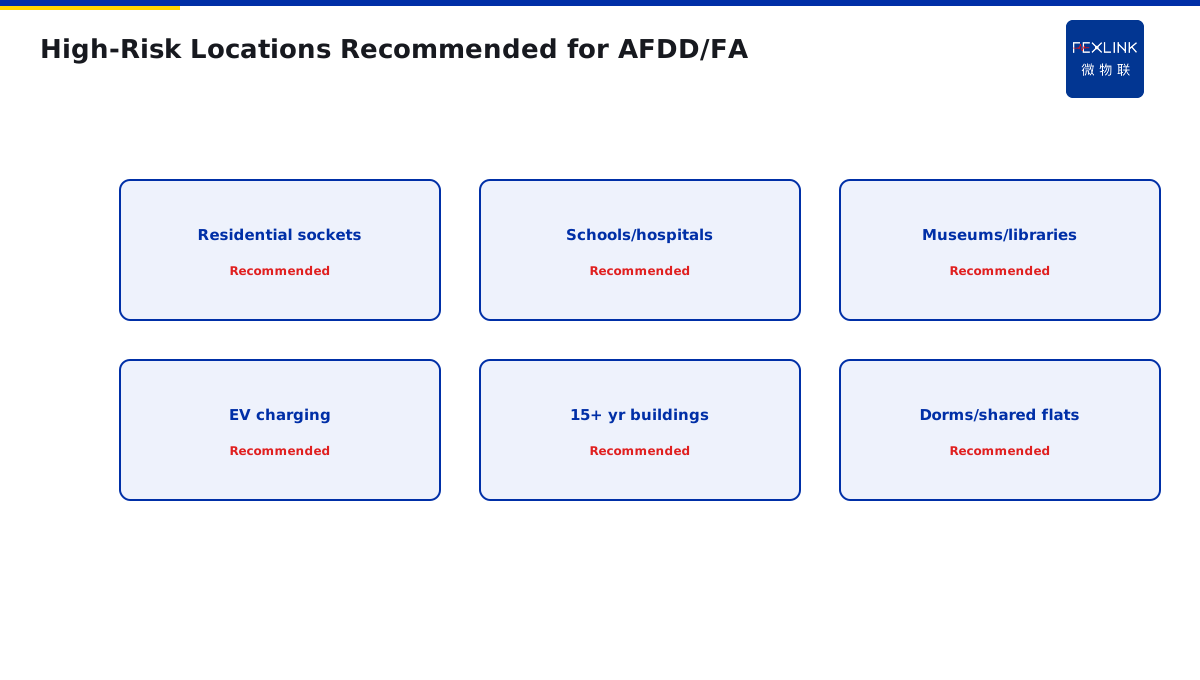
Direct Answer
GB/T 31143 (identical adoption of IEC 62606), "General Requirements for Arc Fault Detection Devices (AFDD)," does not mandate *where* to install AFDDs—it specifies what a compliant AFDD must detect, under which test conditions it must operate, and when it must not nuisance-trip.
In the distribution hierarchy, the AFDD sits in series at the end circuit, alongside the MCB and RCD. It replaces none of them: the MCB handles overload/short circuit, the RCD handles earth leakage, and the AFDD closes the blind spot where current is normal, leakage is normal, but a terminal is heating and arcing.
It is not universal protection. DC-side arcs, HV arcs, and slow insulation-ageing leakage are outside its scope. It does not replace sound wiring and installation practice.
1. What GB/T 31143 Actually Specifies
Open the standard and you will find test methods, not installation rules. Installation rules live in GB 50054 and GB 50096.
The standard defines the test circuits an AFDD must pass:
- Test A1: series arc simulation (loose terminal, broken wire);
- Test A2: short-gap series arc;
- Test B1: parallel arc (L-to-N);
- Test B2: earth arc.
Each test circuit specifies current, voltage, arc gap and electrode material. The AFDD must operate correctly within prescribed times under these standard tests.
Equally important are the no-operation tests: under normal loads (motors, PCs, LEDs, air conditioners), the AFDD must not nuisance-trip. This prevents the familiar end state where O&R bypasses a device that trips every week.
2. Where the AFDD Sits in the System
A complete end circuit, from upstream panel to socket, should be wired in this series chain:
Upstream MCB/MCCB (selective coordination)
|
v Circuit MCB (overcurrent/short protection)
|
v RCD (earth leakage, 30 mA)
|
v AFDD (arc-fault protection)
|
v
Cable -> socket -> load
Three points to note:
The AFDD cannot stand alone. It has no overcurrent or short-circuit rating; it must be wired in series with an MCB. Combined MCB+AFDD units exist, but internally they are still two units.
The AFDD cannot replace the RCD. The RCD measures earth leakage; the AFDD measures arc waveform. Physically different quantities. Wet locations, outdoor sockets and hand-tool circuits must retain RCD protection regardless of the AFDD.
The AFDD belongs at the end circuit, not the feeder. On a feeder with many mixed loads, normal high-frequency content from VFDs and SMPS stacks up and causes false trips. It is designed for lighting, sockets, air conditioning, kitchen and EV charging circuits.
3. Where AFDD Is Recommended
The standard itself does not mandate installation, but its annex lists recommended locations. Combined with GB 50096 (residential design code) and fire-service guidance:
- Socket circuits in new homes—especially bedrooms, living rooms and kitchens; bedroom fires have the highest fatality rate;
- Schools, hospitals, elderly homes, kindergartens—weak evacuation capability;
- Museums, libraries, archives—irreplaceable collections;
- EV charging circuits—high incident rate;
- Buildings over 15 years old—insulation ageing and terminal loosening;
- Temporary structures, site dorms, shared-rental flats—unsafe ad-hoc wiring.
One airport terminal commercial-fitout project retrofitted FA monitors on all socket circuits downstream of RCDs. In one year, 23 loose-arcing events were warned—none developed into fire.
4. Protective AFDD vs Monitoring FA
On site people ask: what is the difference between an AFDD and the FEXLINK FA-01121-R?
| Protective AFDD | Monitoring FA | |
|---|---|---|
| Standard | GB/T 31143 type-tested | Enterprise standard |
| Action | Trips on arc detection | Alarms and uploads; does not cut power |
| Mounting | In panel, in series | In panel, samples current waveform |
| Nuisance-trip risk | Exists (esp. VFD circuits) | None (alarms only) |
| Data retention | Trip events only | Continuous waveform, trend, events |
| O&R integration | Manual investigation after trip | Auto work-order, circuit locating |
| Typical use | Homes, schools, hospitals (mandated) | Commercial buildings, industry, data centres |
In short: AFDD cuts power at threshold; FA tells you there is a problem but does not disconnect on its own.
Commercial buildings and industrial sites favour FA monitoring—an unplanned outage is expensive, and O&R needs a maintenance window. Homes and schools favour AFDD protection—occupancy is dense, better to nuisance-trip than to burn.
In high-risk sites, combine both: FA for online trend warning, AFDD as the end-circuit final protector.
5. Common Misconceptions
Misconception 1: "AFDD replaces the RCD."
No. AFDD reads arc waveform; RCD reads earth leakage. If a person touches a live conductor, the RCD trips at 30 mA within 0.1 s and saves a life; the AFDD may not act (human shock is resistive current with no arc signature). In wet locations, the RCD trips on earth leakage; the AFDD sees nothing. The two must coexist.
Misconception 2: "AFDD prevents all electrical fires."
No. It only recognises series and parallel arcs. Overload heating—long-term conductor over-current, slow insulation carbonisation—is not an arc, and the AFDD does not act. That requires IR thermography and temperature sensors (e.g. EST-22920-R multi-channel temperature monitor).
Misconception 3: "With an AFDD, old wiring need not be replaced."
No. The AFDD closes a blind spot; it does not rehabilitate ageing wiring. If insulation resistance is already below 0.5 MΩ, the correct action is rewiring, not adding an AFDD to run the circuit while sick.
Misconception 4: "AFDD trips all the time."
A compliant AFDD has passed GB/T 31143 no-operation tests and will not nuisance-trip on normal loads. But circuits with many VFDs, SMPSs and LED drivers can stack high-frequency content and cause false positives. In such cases, the monitoring FA (with tunable algorithm thresholds) is the better fit.
6. ROI of Adding FA/AFDD
Consider a 100,000 m² commercial complex retrofitting FA monitors on all end socket circuits. Hardware cost is a few hundred thousand RMB. That sounds like a lot—until you compare it to one electrical fire:
- A mid-size commercial building fire means direct property loss in the tens to hundreds of millions;
- 3–6 months of shutdown means rent and goodwill losses on top;
- Liability for casualties is beyond price.
More importantly, the FA system monitors voltage, current, leakage, temperature and harmonics as a by-product. Those same data feed energy management, demand control and predictive maintenance. Fire prevention is the *first* benefit—not the only one.
Scope and Limitations
Applies to GB/T 31143 interpretation and AFDD/FA selection in 0.4 kV LV end circuits. HV systems, DC PV and hazardous areas require dedicated standards. Location recommendations are generic; specific projects follow local fire and utility review. FA-01121-R is a FEXLINK capability reference; selection follows the latest catalogue.